
Introduction: why set up your medaka tank properly?
The medaka (Oryzias latipes) is often presented as an easy fish to keep, and that is true. But that ease does not excuse you from following a few basic rules when setting up your tank. An environment that is well designed from the start will let your medaka live in good health, breed regularly and express all their natural behaviours. This complete guide takes you step by step through setting up an ideal medaka tank, even if you are a complete beginner.
Choosing the right volume: 30 litres minimum
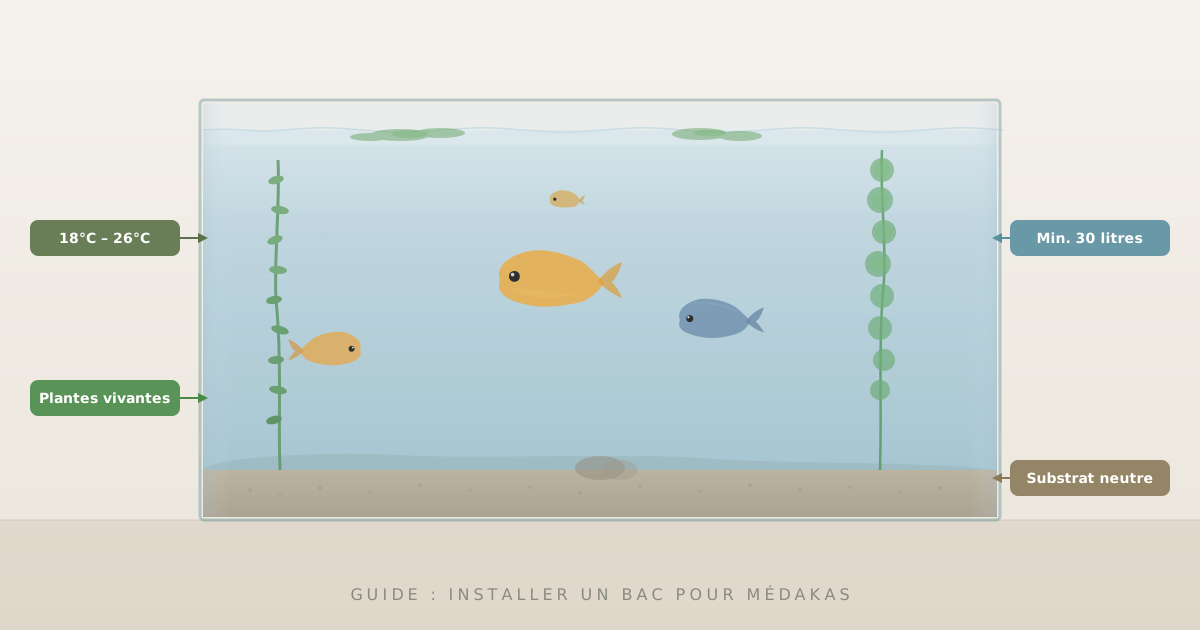
The first question beginners ask is about volume. For adult medaka, the recommended minimum volume is 30 litres for a small group of 6 to 8 individuals. Below that threshold, the water degrades too quickly and variations in parameters are hard to control.
For more comfortable keeping, or if you want to build a larger group, a tank of 60 to 80 litres offers better conditions. Medaka are active fish that appreciate horizontal space: so favour long, shallow tanks over cubes or tall tanks. A large water surface also encourages gas exchange, which is essential for natural oxygenation.
Substrate: essential for wellbeing and appearance
The choice of substrate affects both the look of the tank and the health of your fish. Several options are possible:
- Fine gravel (2-4 mm): the classic choice, easy to maintain, available in many colours
- Sand: very attractive, appreciated by medaka, which sometimes like to poke about on the bottom
- Nutrient-rich soil: ideal if you want to plant the tank, it supplies the nutrients the plants need to grow
- Bare bottom: makes maintenance and egg monitoring easier, often used in breeding tanks
Avoid substrates that are too coarse or have sharp edges that could injure your fish. A layer of 3 to 5 cm is generally sufficient.
Gentle filtration: essential, but without excessive current
Medaka are surface fish that naturally live in calm waters such as rice fields and ditches. They cannot tolerate strong currents. Filtration must therefore be gentle and well directed so as not to create significant turbulence.
The best-suited solutions are:
- Air-driven sponge filter: ideal for medaka, inexpensive, easy to maintain and completely silent
- Low-flow internal filter: effective if the flow is adjustable and directed along the glass
- Hamburg Mattenfilter: excellent biological filtration, minimal current
Avoid powerful filters designed for large tanks: they would create currents that stress your medaka and could suck in the fry. A filtration flow equivalent to 3 to 5 times the tank volume per hour is more than enough.
Lighting: natural or artificial?
Medaka are sensitive to photoperiod, that is, to the length of daily sunlight. To stimulate breeding, they need 12 to 14 hours of light a day. Indoors, a low to medium power LED strip is more than enough.
If your tank is placed near a window, natural light may be enough in summer, but beware of summer overheating and excessive algae growth in direct sunlight. Programmable artificial lighting offers more regularity and control. Allow about 8 hours of light in winter and 14 hours in summer to respect natural cycles.
Temperature: between 18 °C and 26 °C
One of the medaka’s great qualities is its tolerance of temperature variations. It can survive from 5 °C to 35 °C, but its ideal comfort zone lies between 18 °C and 26 °C. Within this range, it feeds well, is active and breeds easily.
Indoors, if the temperature of your home does not drop below 18 °C, no heating is needed. If your home is cooler in winter, an aquarium heater set to 20-22 °C will be beneficial. In an outdoor tank, medaka can overwinter naturally in temperate zones if the tank does not freeze solid.
Plants: a major asset for the tank’s balance
Plants play a fundamental role in a medaka tank. They contribute to biological filtration, oxygenate the water, provide refuge areas and are ideal spawning supports. Here are some particularly suitable plants:
- Brazilian waterweed (Egeria densa): an easy plant, an excellent oxygenator, perfect for spawning
- Hornwort (Ceratophyllum demersum): floating or planted, much appreciated by medaka
- Java moss (Vesicularia dubyana): ideal for spawning, easy to maintain
- Milfoil (Myriophyllum): a fine-leaved plant that naturally filters the water
Having one third to one half of the tank surface occupied by vegetation is a good target to ensure a stable biological balance.
Filling the tank and the nitrogen cycle
Before introducing your medaka, it is essential to let your tank cycle, that is, to allow the development of the nitrifying bacteria that convert toxic ammonia into less harmful nitrates. This process takes 3 to 6 weeks.
To speed up the start, you can add a handful of substrate from an existing, already mature tank, or use commercial bacterial starter products. Test your water parameters (ammonia, nitrite, nitrate, pH) regularly before introducing your fish.
Conclusion
Setting up a medaka tank takes a few hours of preparation, but the effort is amply rewarded by the pleasure of watching these fish thrive in a healthy, balanced environment. Find all the aquariums for medaka as well as the filters suited to medaka to equip your tank in the best conditions.