

A regular partial water change is the best maintenance for a medaka tank. A large occasional change is the worst. In a filtered aquarium, allow 10 to 20% a week. Without a filter, a third to a half twice a month. Outdoors, in a planted tub, mostly top-ups to make up for evaporation, plus one partial change a month in season. The new water is left to stand, at the same temperature, and poured in gently. Never change water in winter, and never with fry in their first weeks.
Changing or topping up
These are two different actions. A water change removes part of the water from the tank and replaces it: it clears out nitrates, phosphates and everything that builds up. Topping up, which the Japanese call 足し水 (tashimizu), replaces only what has evaporated: it removes nothing. It dilutes, it does not clean (t-aquagarden). A planted outdoor tub lives mostly on top-ups. An indoor aquarium lives on changes.
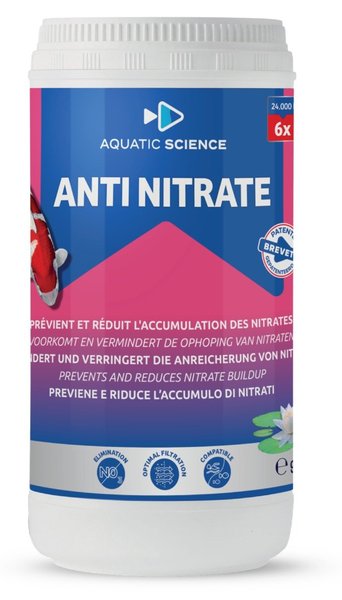
A water change only clears nitrates if the new water contains fewer of them. If the water used for changes is already loaded, as with a well or borehole in farming country, or a supply close to the 50 mg/l drinking-water limit, you are replacing loaded water with loaded water. The nitrate level of your tap water appears in the analysis results published by your water supplier. In that case the water change keeps its role for everything else, and a nitrate reducer takes over: Aquatic Science’s Anti Nitrate, a bacterial formula, is dosed at 30 g per m³, that is 3 g for a 100-litre tank. See our presentation of the range.
Frequency by type of tank
Filtered indoor tank. The filter houses the bacteria and the tank is stable. At À Flore d’Eau, we advise 10 to 20% a week. WEB図鑑 gives a quarter to a third a week in the active season. The right value depends on stocking density: at one litre per fish, the limit, you are at the top of the range. See keeping medaka indoors.
Indoor tank without a filter. Nothing removes waste between two interventions. Kamihata gives a third to a half twice a month; t-aquagarden, a third to a half every week, with at most fifteen medaka in a 60 cm tank. Between the two, density and the amount of plants decide. A lightly stocked, heavily planted tank manages with two changes a month. A full tank needs a change every week.
Planted outdoor tub. Plants, sunlight and green water do much of the work. TAG gives about one change a month plus top-ups. t-aquagarden gives a third a month, and a third every two weeks for a small tub or in summer. Many breeders change the water in their tub only two or three times a year and simply top up. See keeping medaka outdoors.
In every case, summer increases the pace: warm water degrades quickly and turns acidic (t-aquagarden). Autumn and winter reduce it to zero.
How much to change
A third of the volume is the benchmark. Never more than half at once, except in an emergency. A complete change removes the bacteria and changes the pH, hardness and temperature all at once, and it is the first accident described by Japanese breeders: fish dying within hours or days of a “big clean” (t-aquagarden). Two changes of a third a few days apart are better than one of two thirds.
The procedure
Prepare the water the day before: tap water left to stand for 24 hours outdoors or 2 to 3 days indoors, or treated with a conditioner (WEB図鑑). Chlorine evaporates; chloramine, which does not, is rare in supply networks. Medaka Care neutralises chlorine and protects the mucous membranes when you have not been able to prepare the water in advance.
Check the temperature: the new water should not differ by more than 2 °C from the tank water, and above all not towards the cold (t-aquagarden). One thermometer in the bucket and one in the tank are enough.
Siphon from the bottom rather than scooping from the surface: that is where the waste is. Fix a piece of net or fine mesh to the end of the hose, otherwise the fry leave with the water. Pour the new water in slowly, onto a saucer or a plant leaf, so as not to stir up the substrate or jostle the fish. Do it in the morning or in the middle of the day, when the fish are active, and wait an hour or two before feeding.
Never rinse the filter on the same day. See bacteria and cycling.
The five water-change accidents
t-aquagarden lists five, and they are the ones that keep coming back with beginners.
- Deaths after the change. Cause: a change that is too large or too sudden. Remedy: a third, regularly, with prepared water.
- Cloudy water just afterwards. Cause: water poured in too hard has stirred up the fine particles of the substrate. Remedy: pour slowly, siphon the bottom with a suitable hose. The cloudiness settles in a few hours.
- Vanished fry. Cause: sucked up by the siphon. Remedy: a net on the hose, or no water change at all with fry.
- Not knowing when to change. Guides: colour, smell, turbidity. A test strip for nitrites and nitrates removes the doubt.
- Apathetic fish after a total change. Cause: a shock of temperature and parameters at the same time. Remedy: never change everything; in an emergency, move the fish to a bucket of water from the tank during the operation and put them back gradually, without feeding in the hours that follow.
When to change straight away
Three situations do not wait for the scheduled date (t-aquagarden): overfeeding, because food rots within hours; a dead fish found in the tank; water that turns cloudy, yellow or slimy. In these cases, change a third of the volume immediately, then another third the next day if the appearance does not improve. See also the signs of a sick medaka.
Topping up outdoors
An open-air tub loses several centimetres a week in summer, through evaporation and through plants. Topping up is the main action for an outdoor tank (t-aquagarden). Its advantages: the chemistry of the tank hardly moves, a larger volume varies less in temperature, and a level kept high protects against frost in winter.
The method: water left to stand, at the temperature of the tank, poured in slowly in the morning or in the middle of the day (t-aquagarden). Never tap water straight into a 30-litre tub. Its limits: it removes nothing. Nitrates and salts accumulate with each evaporation. That is why a partial change once a month remains useful in season, even in a tub that looks perfect. And you do not top up during a salt treatment or a medicated bath, which would be diluted.
Rain counts as a top-up. A tank that catches rain in an Atlantic climate tops itself up almost unaided; in a Mediterranean climate in summer, it is the watering can.
When never to change the water
In winter. Below 10 °C, the fish no longer eats, produces almost no waste, and its slowed body copes badly with a shock. You do not change the water of a tank that is overwintering. You only top up to keep the level high (TAG). See overwintering.
With fry. In the first weeks, no change at all. Suck up the debris from the bottom with a syringe or pipette, and top up with water at the same temperature (t-aquagarden). Return to normal changes when the young reach half the adult size, that is 1.5 to 2 cm. See raising the fry.
In green water you want to keep. A water change dilutes it. Change less, or keep the water you remove to seed another tank. See green water.
The key figures
| Filtered indoor tank | 10 to 20% a week (À Flore d’Eau); a quarter to a third a week (WEB図鑑) |
|---|---|
| Indoor tank without a filter | A third to a half, twice a month (Kamihata) to once a week (t-aquagarden) |
| Planted outdoor tub | A third a month plus top-ups; every two weeks in summer or in a small tub |
| Maximum volume at once | Half, and only in an emergency |
| Temperature difference tolerated | 2 °C at most |
| Standing time for tap water | 24 h outdoors, 2 to 3 days indoors, or a conditioner |
| Fry | No change until half the adult size, 1.5 to 2 cm |
| Winter | No change below 10 °C; top-ups only |
Frequently asked questions
Do you need to change the water if it is clear?
Yes. Nitrates are invisible. Water that has been clear for three months without a change is loaded water. Keep to the schedule, not to appearances.
My tank has had no water change for months. How do I catch up?
Not in one go. A third every three days for two weeks, with prepared water. A big change on a neglected tank is the surest way to lose everything.
Can you use rainwater?
Yes for top-ups outdoors, and mixed with tap water that has been left to stand for changes. Never on its own. See water parameters.
What should you do with the water you remove?
It waters the garden plants, which appreciate the nitrates. If it is green, it serves as a seed culture for a fry tank.
Should you clean the bottom at every change?
A light siphoning of the visible waste, yes. A complete turning over of the substrate, no: it houses the bacteria. See the set-up guide.
Sources
- t-aquagarden, column “medaka_waterchange_pace” (frequency and volume of water changes), https://t-aquagarden.com/column/medaka_waterchange_pace
- t-aquagarden, column “medaka_waterchange_trouble” (water-change accidents), https://t-aquagarden.com/column/medaka_waterchange_trouble
- t-aquagarden, column “medaka_water_injection” (topping up, 足し水), https://t-aquagarden.com/column/medaka_water_injection
- t-aquagarden, column “medaka_goldfish_filter_need” (density and changes without a filter), https://t-aquagarden.com/column/medaka_goldfish_filter_need
- medaka.fr fact base (Kamihata, WEB図鑑, TAG, afloredeau.com guide): rhythms of change, standing water, no change during overwintering or with fry.