
The salt bath is the first treatment for a medaka that is doing badly, and the only one a private keeper can give without a prescription. The recipe is simple: 5 g of pure salt per litre of water, in a bucket of at least 5 L, at the temperature of the tank, for five to seven days, with the water renewed daily. It relieves the fish and helps it recover on its own. It does not replace a treatment for an established disease.
Why salt helps a freshwater fish
A medaka’s body contains more salts than the water it lives in. Water therefore enters its tissues constantly by osmosis, and the fish spends energy expelling it through the kidneys and gills. A sick or stressed fish does this less well. Its damaged skin lets even more water through.
Adding a little salt to the water reduces this gap. Tokyo Aqua Garden explains that the energy saved on osmotic regulation goes to recovery. Salt also hinders certain external parasites and surface bacteria. It is a supportive treatment, not a targeted medicine. The same source says so clearly: the salt bath suits vague symptoms; an identified disease is treated more directly, which for antibiotics and antiparasitics means a vet.
Which salt to use
A pure salt, that is sodium chloride with nothing else. Unrefined coarse cooking salt is fine, provided you read the label. Two additives are to be avoided: iodine, added to most fine table salts, and anti-caking agents (E535, E536, E551 and others), present in salts that “pour” well. Unrefined grey sea salt with no additives does the job very well. Marine aquarium salt, which contains magnesium, calcium and potassium salts, is not made for this use. The Japanese salts for medaka cited by the source are simply pure salt in convenient packaging.
The concentration: 0.5%, that is 5 g per litre
The Japanese source sets the concentration at 0.5%. That makes 5 g of salt for 1 litre of water. The following table saves you the calculation.
| Volume of water | Salt at 0.5% |
|---|---|
| 1 L | 5 g |
| 3 L | 15 g |
| 5 L | 25 g |
| 10 L | 50 g |
| 20 L | 100 g |
Weigh it. Kitchen scales accurate to the gram are enough. A level teaspoon of fine salt weighs about 5 g according to kitchen tables, up to 6 g packed; with coarse salt, measuring by spoon varies too much with the size of the grains to be reliable. For 5 L, an error of 5 g takes you from 0.5 to 0.6%, which the medaka tolerates. An error of 25 g doubles the dose, which it tolerates badly.
The salt is fully dissolved in a little warm water before being poured into the bucket. Tokyo Aqua Garden insists on this point: poorly dissolved salt creates more concentrated zones on the bottom, where the sick fish stays. The short, very concentrated baths used by some breeders are not described by the source for the medaka. The multi-day bath at 0.5% is the safe protocol.
The container
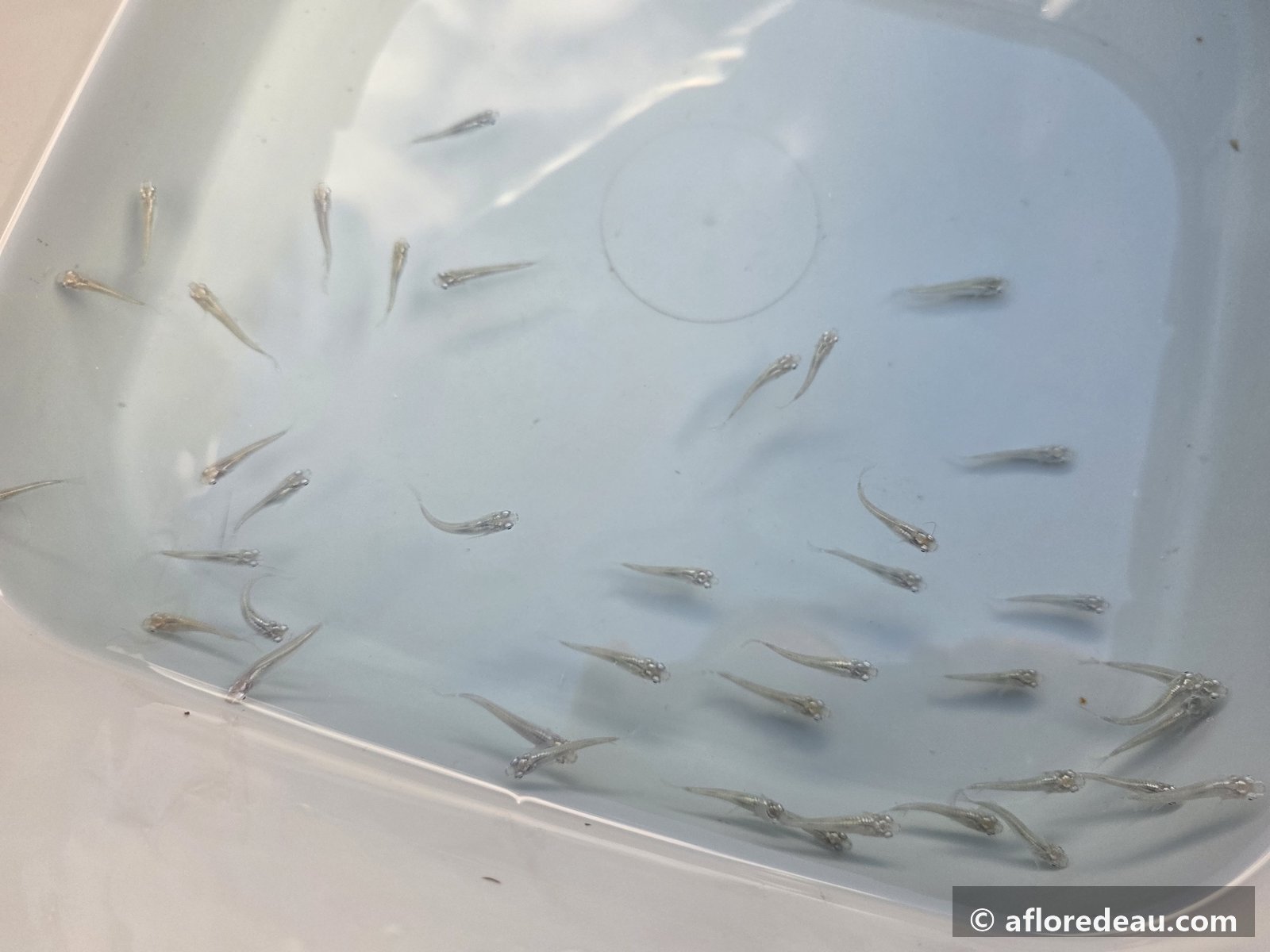
A food-grade plastic bucket or tub, clean, never used with soap or a household product. Volume: 5 L at the very least, even for a single fish. The source explains that a smaller container quickly runs short of oxygen. No substrate, no plants, no decor: a bare bottom lets you see droppings, fallen parasites and the condition of the fish. A mesh lid stops the fish jumping, which a stressed medaka readily does.
Gentle aeration, with a small air pump and a diffuser, is presented by the source as optional but useful. Without a filter in the bucket, oxygen comes only from the surface. No filter is needed: the water is renewed every day.
Temperature
The same as the tank the fish comes from. A sick medaka cannot cope with a thermal shock on top of everything else. Place the bucket in the shade, at a stable temperature, away from a radiator. For a fish taken from an outdoor tub in summer, this means the bucket outdoors in the shade, not in the house at 20 °C. For fin rot, the Japanese source recommends keeping 24 to 26 °C, which is the medaka’s comfort zone. Only raise it gradually if the fish comes from colder water.
Putting the fish in the bath
- Prepare the bucket with water from the original tank, or water left to stand at the same temperature, and the dissolved salt.
- Catch the fish with a small fine-mesh net, or better, with a cup, so as not to damage its scales and mucus.
- Place it directly in the salt water. Going from 0 to 0.5% needs no particular acclimatisation according to Tokyo Aqua Garden, and the dose is right from the start; the only gradual step is the exit, three days of dilution before returning to the tank.
- Cover, aerate gently, leave in peace.
Duration and water renewal
Five to seven days on average. Stop earlier if the fish has recovered its appetite and its swimming. Every day, or every two days at most, replace all the water with fresh 0.5% salt water, prepared in advance and at the same temperature. The source justifies this complete renewal: the bucket has no filtering bacteria, and salt does not stop ammonia rising. The simplest way is to work with two buckets, the fish moving from one to the other.
Feeding or not during the bath
Little, or not at all in the first days. A sick fish digests poorly and uneaten food rots quickly in 5 L. If the fish shows an appetite, one or two granules are enough, removed if they are not taken within a minute. If the bath continues beyond seven days, the source recommends feeding at a third of the normal ration. A fast of a few days does not endanger an adult medaka.
Taking the fish out of the bath
This is the step most often rushed. Going straight from 0.5% to the fresh water of the tank is a reverse osmotic shock. The source asks for at least three days of gradual return. In practice: at each renewal, replace the salt water with water that is less and less salty. Day 1: 3 g per litre. Day 2: 1.5 g per litre. Day 3: tank water with no salt. The fish then goes back to its tank, at the same temperature. If the original tank has been corrected in the meantime, the fish has a good chance of staying well. If not, it will fall ill again.
What the salt bath treats, and what it does not
It helps in these cases, listed by Tokyo Aqua Garden: a fish with no energy, refusal of food with no visible cause, a fish motionless on the bottom outside overwintering, fight or transport wounds, first signs of gill damage, external parasites, early fin rot, early fungus.
It is not enough for established dropsy, an infestation of gill worms, generalised white spot, spreading red patches. In these cases, salt is a supporting treatment. The underlying treatment is a job for a vet. The article on medaka diseases shows for each one where salt stops.
Mistakes to avoid
- Salting the main tank. Salt kills plants, shrimp and snails, and unbalances the tank. The bath is always done separately.
- Using iodised salt or salt with an anti-caking agent. Read the label.
- Dosing by eye or pouring dry salt onto the fish. Weigh, dissolve.
- A 1 L bucket. Too small, the fish runs short of oxygen.
- Forgetting the renewal. Without a daily change, ammonia rises and the bath does more harm than good.
- Putting the fish straight back in the tank. Three days of dilution.
- Carrying on without results. After seven days with no improvement, salt will not do any better. A diagnosis is needed.
- Salting a fish that is overwintering. A medaka motionless on the bottom below 10 °C is not ill. Do not take it out of its tank. See the overwintering guide.
The key figures
| Concentration | 0.5%, that is 5 g of pure salt per litre (TAG) |
|---|---|
| Container | 5 L minimum, food-grade plastic, bare bottom (TAG) |
| Temperature | that of the original tank; 24 to 26 °C for fin rot (TAG) |
| Duration | 5 to 7 days (TAG) |
| Renewal | 100% of the salt water every 1 to 2 days (TAG) |
| Feeding | reduced or none; a third of the ration beyond 7 days (TAG) |
| Return to the tank | 3 days minimum of gradual dilution (TAG) |
Frequently asked questions
Can you use ordinary table salt?
Only if it contains neither iodine nor an anti-caking agent. Most fine table salts contain them. Unrefined coarse grey sea salt is the safest choice.
Is the salt bath dangerous for a medaka?
At 0.5% and for a week, no. The danger comes from a badly weighed dose, a bucket that is too small or an abrupt return to fresh water.
Does salt replace a medicine?
No. It supports the fish and settles a good part of the small problems seen early. An identified disease that progresses despite the salt is a job for a vet, the only person authorised to prescribe an antibiotic or an antiparasitic in the European Union. The article treating a sick medaka without medication details the other possible treatments.
Sources
- Tokyo Aqua Garden, “メダカの塩水浴とは?容器・濃度から期間まで、具体的な方法を解説します”, https://t-aquagarden.com/column/medaka_saltwater
- Tokyo Aqua Garden, “尾ぐされ病の治療法!”, https://t-aquagarden.com/column/tailrot (temperature of 24 to 26 °C, renewal)
- medaka.fr fact base: density of 1 L per fish, temperature thresholds (WEB図鑑, Kamihata, TAG).
- Regulation (EU) 2019/6 on veterinary medicinal products.