
You lift a dead leaf from the bottom of the tank and a dozen small, flat, grey creatures scuttle away. These are water lice, or hoglice, aquatic cousins of the woodlice found in the garden. Their arrival often causes alarm. Yet water lice attack neither medakas nor their fry, and they eat what rots on the bottom. Their numbers say a lot about the state of the substrate. They raise a real question in only one place, the container where you hatch the eggs.
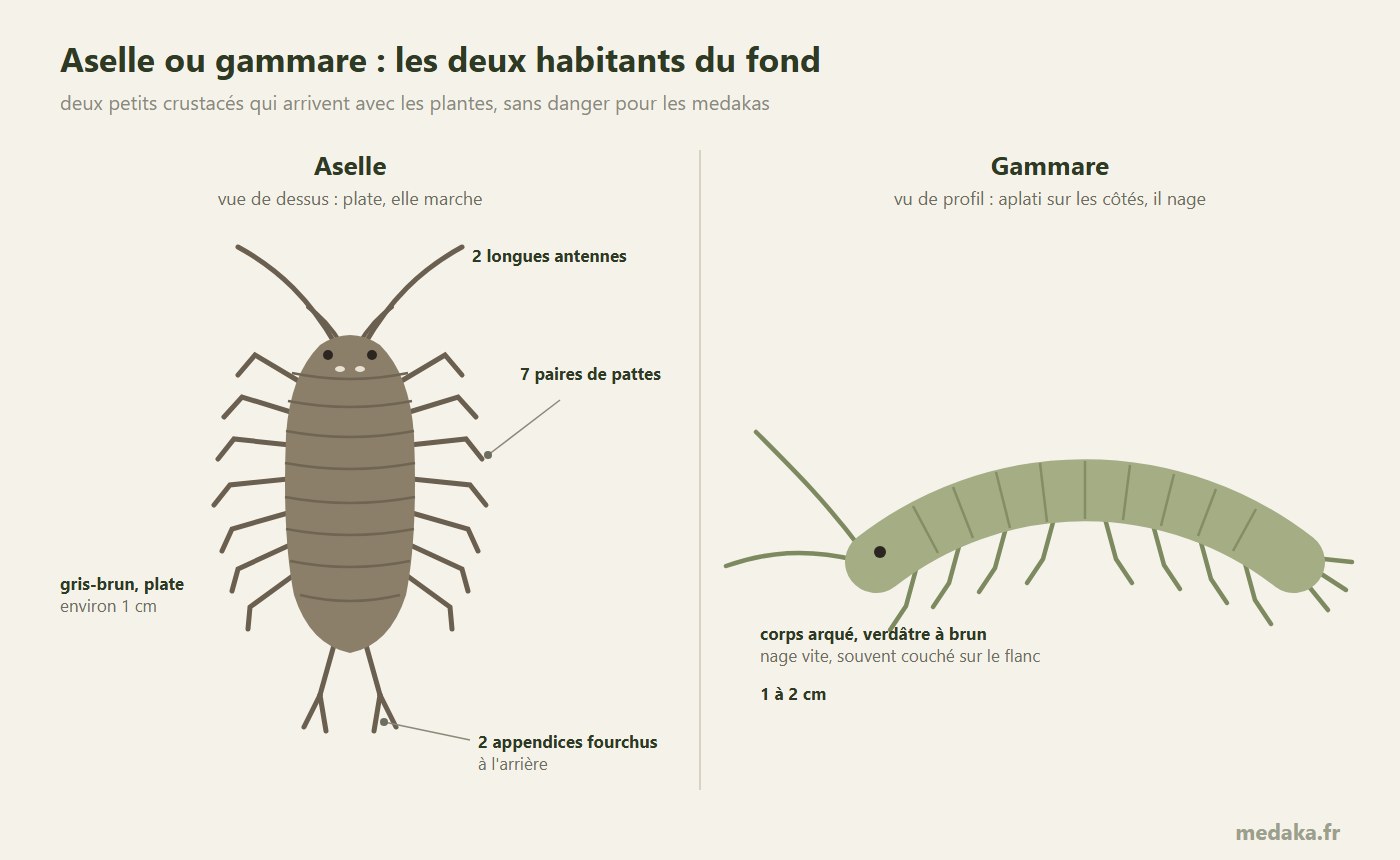
Recognising a water louse
The freshwater water louse, Asellus aquaticus, is a crustacean of the order Isopoda, like the woodlouse. It is also called the hoglouse. The largest reach 2 cm, but most adults are about 1 cm. It is flat and grey-brown, with seven pairs of legs, two long antennae and two forked appendages sticking out at the rear. It walks slowly over the bottom, leaves and glass. It hardly swims at all.
It is mostly confused with the freshwater shrimp (Gammarus), which arrives by the same routes. The shrimp is flattened from side to side, arched, and swims fast, often lying on its side. Both play the same role in the tank.
In spring and summer you often see two water lice clasped together. This is not a fight: the male carries the female for several days, waiting for the moult that will make her ready to be fertilised. The female then keeps her eggs in a pouch under her belly, the marsupium, for three to six weeks depending on temperature. The young come out fully formed and measure barely 0.8 mm. When the water is warm enough, several generations follow one another in a year, which explains populations that seem to appear all at once.
In Japan, the related species is called ミズムシ (mizumushi), Asellus hilgendorfii. The same name is also used for water boatmen, the aquatic bugs of the family Corixidae. A Japanese search for “mizumushi in a medaka tank” therefore mixes the two.
Where they come from
A water louse does not fly and does not leave the water: it breathes through gills. If it is in the tank, someone brought it in, almost always without knowing:
- with plants from a pond, a pool or another tank, with water lice and young hidden in the roots;
- with pond water or daphnia collected from the wild;
- with mosses, kokedama or mossy stones soaked in the tank. One Japanese aquarist described an invasion of his planted tank: it came from a kokedama that he watered by dipping it in the water.
In an outdoor tank full of pond plants, their arrival is almost unavoidable. It is not a sign of a mistake.
Water lice are also very hardy. We have seen plants stay out of the water for weeks, then young water lice appear soon after they were put back in. A plant that looks dry, or a potted plant stored dry, can therefore still bring them in. A simple rinse guarantees nothing.
What they eat
The water louse is a detritivore. It feeds on dead leaves, plant and animal debris, algae, and above all the fungi and micro-organisms that cover decomposing leaves. It scrapes a dead leaf down to the veins. On the bottom of a tank it does the same job as snails: it breaks up what falls and speeds up its breakdown. It also eats a little of the young shoots of aquatic plants.
It tolerates cold. It lives between about 1 and 25 °C and still mates at around 8 °C. It therefore keeps working on the leaves on the bottom in autumn and winter, when medakas hardly eat at all.
Water lice and medakas
For adult fish, water lice present no danger. They do not bite, do not cling to fish and are not parasites. An adult water louse of one centimetre, flat and armoured, is too big for a medaka’s mouth. On the other hand, the young of under a millimetre that leave the marsupium are the size of the small prey medakas hunt: the fish eat some of them. This is what limits water lice in a well-stocked tank, and it is a supplement of live food, like the larvae discussed in medaka and mosquitoes.
There is one health point to keep in mind without alarm. In the wild, the water louse is the intermediate host of parasitic worms of fish, the acanthocephalans, such as Acanthocephalus lucii. The adult worm lives in the gut of wild fish, perch for example. Its eggs leave with the fish’s droppings, the water louse swallows them, and the fish becomes infected by eating it. This cycle requires infected wild fish. In a closed medaka tank it cannot get started. We have found no case described in medaka. It is one more reason not to transfer water or plants into the tank from a pond that holds wild fish.
Water lice and eggs
This is the real question for a breeder. Medaka eggs stay attached to the roots of floating plants and to other plants for about ten days. Do water lice eat them?
A Hungarian team tested the question in 2024, in the laboratory, on zebrafish eggs. The water lice removed dead eggs, white and overgrown with fungus, the faster the more of them there were. With five water lice, none was left after 45 hours. The researchers observed no predatory behaviour, and the hatched larvae were not attacked, even without other food. They even suggest water lice as “cleaners” of dead eggs in small hatcheries, since a dead egg covered in mould can contaminate its neighbours.
The same authors remain cautious. By scraping the shells, the water lice made the eggs hatch earlier, and earlier larvae may be more fragile. They also write that numerous, large water lice could damage small, vulnerable eggs. The trial used zebrafish eggs, in small volumes. Medaka was not tested.
In practice:
- in the breeding tank, water lice are not the problem: it is the adult medakas that readily eat eggs and fry;
- for incubation, keep to the usual method, described in breeding medakas: the eggs in a small container of clean water, without pond plants or debris. You remove the white eggs yourself every day, which makes the help of water lice unnecessary;
- in a fry tank, a few water lice do not threaten the young fish. If you would rather not see any, fill this tank with new water or with tap water left to stand, without transferring plants from the parents’ tank. See which water for medaka fry.
What their numbers tell you
In Japan, the official river-survey sheets class the water louse among the indicators of water heavily loaded with organic matter, class III, “dirty water”. In Europe too it is known to tolerate organic pollution. In a tank, this ranking should not be read the wrong way round. A few water lice under the leaves of a planted tank are normal. They are even an ordinary inhabitant, as at the bottom of a pond.
What should prompt action is a population explosion: dozens of water lice on every leaf, on the glass, everywhere you look. It says that the bottom receives more than it can digest. Too much uneaten food, a layer of black sludge growing thicker, a heap of dead leaves that arrived in autumn. The water may stay clear and the fish may be doing well. This is the moment to look at the bottom.
Should you get rid of them?
No, in general. You do not try to eliminate water lice. You try to reduce what feeds them, and their numbers follow:
- Feed less, and only what the medakas eat in a few minutes, following the water temperature: see feeding medakas according to temperature.
- Thin out the sludge in places, without laying the bottom bare, as explained in sludge at the bottom of a medaka tank. On a bottom that is still heavily loaded, Aquatic Science’s Biobooster+, which we sell and have used for twenty years, helps micro-organisms digest what the siphon has not removed.
- Remove freshly fallen leaves with a net, and keep only the dry leaves that you add in small quantities: see oak leaves and dead leaves.
- Trap some if you want to go faster: a handful of dead leaves in a fine mesh bag, placed on the bottom, becomes covered in water lice in a day or two. Lift it out and shake it into a bucket. Water lice removed this way go to the compost, never into a watercourse.
What not to do:
- No chemical treatment, whether “anti-parasite” or “anti-crustacean”. A product that kills a water louse also kills shrimp, damages the useful bacteria and puts the fish at risk. The Japanese aquarist cited above suffocated his water lice by saturating the water with carbon dioxide: they died within two days, but all his plants rotted and the tank had to be redone. In a tank with fish, this is out of the question.
- Do not empty and disinfect the whole tank for a few water lice. You would destroy the biological balance that protects the medakas, for a short-lived result if the plants bring more in.
To avoid introducing them into a tank that has none, rinse bought or collected plants and watch them for a while in a bucket of water before putting them with the fish. This removes some of them, with no guarantee: a female carries her eggs for several weeks. An aquatic plant grown outdoors can always shelter a little pond fauna. For a fry tank that you really want free of water lice, the safest course is to put in no plant from a tank that has them.
Key points
| Name | freshwater water louse, hoglouse, Asellus aquaticus; ミズムシ in Japan |
|---|---|
| Size | about 1 cm as an adult, 2 cm at most; 0.8 mm at birth |
| Diet | dead leaves, debris, fungi and micro-organisms, algae |
| Danger to medakas | none for adults or fry; medakas eat the young water lice |
| Eggs | eats dead eggs; incubate the eggs separately, in clean water |
| Population explosion | sign of an overloaded bottom: feed less, thin out the sludge, remove fresh leaves |
| To avoid | any treatment, a complete water change, water and plants from ponds with wild fish |
Frequently asked questions
Can water lice get out of the tank?
No. They breathe through gills and do not leave the water of their own accord. But they survive a long time in the damp of a plant or a root ball: this is how they travel from one tank to another.
I have water lice in an indoor aquarium, is it different?
No. They do very well there, and indoor warmth lets them breed all year. The same steps apply: less food, a well-kept bottom. See keeping medakas indoors.
Can you breed them to feed the medakas?
Only the young are the size of a medaka’s prey. A water louse tank with a carpet of dead leaves produces plenty, but for medakas daphnia are a far more practical live food: see what medakas eat.
Sources
- B. Kucska, Q. Nguyễn Ngọc et al., “Removal of dead fish eggs by Asellus aquaticus as a potential biological control in aquaculture”, Scientific Reports, vol. 14, 7295, 2024, open-access article: removal of dead eggs, no predation on larvae, earlier hatching and the authors’ cautions.
- Fiche “Aselle aquatique”, b-aqua.com: names, diet, pre-copulatory guarding, marsupium and incubation time, temperatures, intermediate host of acanthocephalans.
- “Asellus aquaticus”, Wikipedia: maximum size, guarding of the female, successive generations, lifespan, tolerance of pollution.
- Vitagliano et al., 1991: size of the young, 0.8 mm on leaving the marsupium.
- Life cycle of Acanthocephalus lucii in the water louse: Journal of Parasitology, vol. 93, no. 4, 2007, BioOne.
- Kantō Regional Development Bureau of the Japanese Ministry of Land, Infrastructure, Transport and Tourism (国土交通省関東地方整備局), sheet on water-quality indicator organisms: ミズムシ, class III.
- Account by a Japanese aquarist of an invasion of ミズムシ that started from a kokedama, ITmedia Nlab.
- Observation at À Flore d’Eau: young water lice appearing in plants put back in water after several weeks dry.
- Diagram: medaka.fr.