
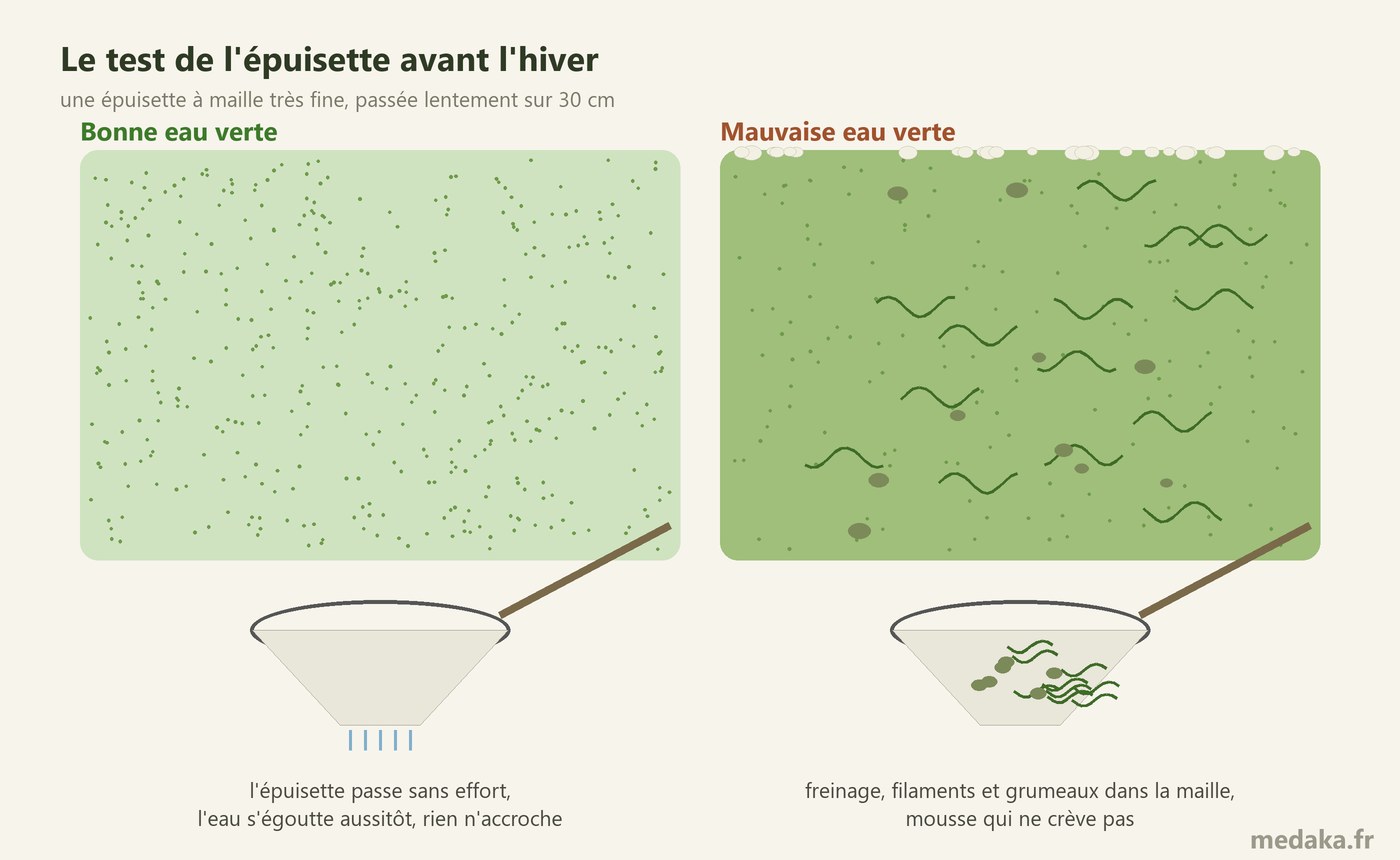
Green water is not a guarantee of good health: it only tells you who dominates the tub. Before winter, the Japanese breeder 媛めだか (Hime Medaka) does a simple test: he passes a very fine-mesh net through the water. If it glides through without resistance and comes out clean, the tub can overwinter as it is. If it catches green filaments and lumps, the water has tipped, and it is better to act while the water is still mild than to hope it holds until March. Here is the test, what it reveals, and what to do depending on where you are in the season.
Why the water tips in autumn
Hime Medaka speaks of 水変わり (mizugawari), the seasonal “change of water”: within a few weeks, the algae and micro-organisms dominating the tub change almost completely. Three causes add up in autumn.
- The light drops and comes in low. Planktonic algae that need a lot of sun recede; others take their place.
- Cold nights stir the tub. Cooled surface water, heavier, sinks and brings nutrients up from the bottom, as in a pond in autumn.
- The summer’s nutrients are still there. Everything fed from June to September has built up as nitrates and phosphates.
Changing light and nutrients put back into circulation make good ground for filamentous algae, the アオミドロ (aomidoro), best known in spring, which often have a second flush in autumn. What they are, and how to manage them in season, is in algae in a medaka tank; green water itself, how to make and dose it, is in green water.
The net test
You need a very fine-mesh net, the kind used for fry or brine shrimp, nearly as tight as a nylon stocking. Draw it slowly through the water over about thirty centimetres and look at two things: the resistance, and what stays in the mesh.
- Good green water: the net passes without effort, the water drains straight away, nothing catches. The water is fluid, and any surface foam bursts quickly. What colours it is microscopic algae evenly dispersed.
- Bad green water: you feel a drag, the water drains poorly, green filaments or gelatinous clumps stay in the mesh. The surface is sticky and the foam persists. These are fragments of filamentous algae, degrading plankton and bacterial flocs.
The point of the test is that it does not depend on colour: two tubs equally green can give opposite results. It takes ten seconds per tub, so you can sort a whole row in a morning.
Clues that complete the picture
Foam. Foam that lasts more than a few seconds after you stir the water signals an excess of dissolved organic matter. Smell. Healthy green water smells of wet grass or of almost nothing; a musty or muddy smell often betrays cyanobacteria, which turn the water green without being green algae, and can be toxic. pH. Dense phytoplankton uses up carbon dioxide by day and pushes the pH up in the late afternoon, sometimes above 8.5 in soft water, before letting it drop again at night: one more strain for fish that are going into rest. The reference values are in the water medaka need.
Clear water is not necessarily healthy
Colour only says which group dominates. Crystal-clear water can be loaded with undegraded organic matter. The same test applies: if the net brings up slime, or the foam does not burst, the tub needs the same attention. When in doubt, a drop-type ammonia test from an aquarium shop settles it.
Why bad green water harms the fish
Hime Medaka gives two reasons. The first concerns the gills. At their entrance the medaka has gill rakers (鰓耙, saiha), a row of comb-like points that stops particles before the respiratory lamellae. Fragments of filamentous algae and gelatinous clumps catch on them; the author says he observes this clogging in his own breeding. The fish then breathes less well, even in reasonably oxygenated water.
The second concerns fry. The mouth of a newly hatched fry (針子, harigo) opens to about 0.3 mm: anything larger is not food. When filamentous algae take the light and the nutrients, microplankton of the right size recedes, and you can see fry starving in water that is very green. See raising medaka fry.
And if you let it go, the winter scenario is well known. At the first real cold, the filamentous algae die all at once. This dead mass feeds the bacteria that break it down, use up the oxygen and release ammonia, which the useful bacteria, slowed by the cold, no longer convert. The resting fish suffer a slow poisoning, and the losses are counted in February or March for a cause dating back to autumn. It is the same mechanism as a green water crash.
What to do, depending on the temperature
Our winter rules apply here as elsewhere: you no longer work on the water once it falls below 10 °C in the morning, and you never empty a whole tub with the fish in it, which would put them in new water with no bacteria at the worst moment. See water changes. The decision therefore depends on the morning thermometer.
The tub passes the test
Touch nothing. Remove what floats, keep the level high, and protect the balance in place until spring. Fluid green water fades by itself in winter and restarts in spring: it is an asset, not a problem.
The net catches, and the morning water is above 10 °C
- Remove the filamentous algae by hand or by winding them round a stick, then pass the fine net to take out the lumps.
- Siphon the black sludge from the bottom, in patches only, as described in sludge at the bottom of a tub.
- Change part of the water, a quarter at most, with settled water within 2 °C of the tub, and repeat a week later if the test still catches.
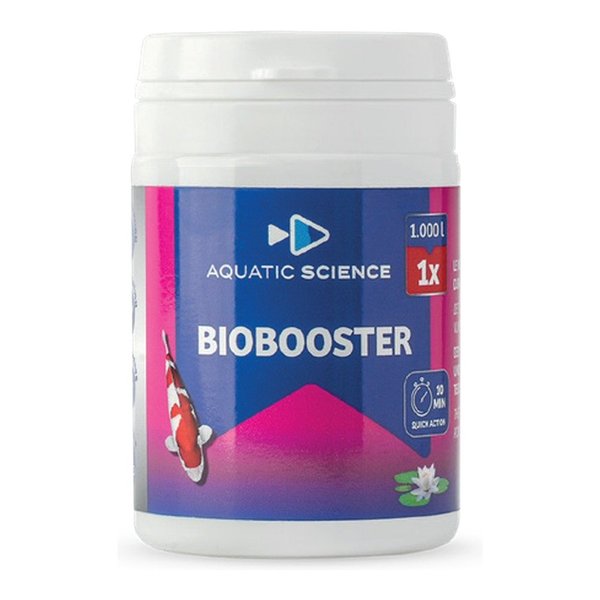
- On water loaded with organic matter, with foam that does not burst, Aquatic Science Biobooster+ helps digest what is left: we sell it and have used it for twenty years, and its effect shows within a few hours. It works better while the water is still mild.
If the tub is truly degraded, with a muddy smell, thick foam and fish staying at the surface, the reset that Hime Medaka recommends is done without emptying the tub over the fish: move them to a healthy tub that is already filled, preferably above 15 °C, while they are still eating and can tolerate the move, then clean and refill the empty tub at leisure. Overwintering reminds us that transfers are made before the fish go into rest.
The net catches, but the morning water is already below 10 °C
Do not change the water any more. Remove by hand as many filamentous algae as you can, and whatever floats, without stirring the bottom, keep an opening if ice forms, and leave the rest until spring. In a small, heavily loaded tub, moving the fish to a clean frost-free tub is still safer than working in the cold.
Next year: do the test in October
The right time for this sorting is early autumn, when the water is still at 15 °C and the fish are eating: October in continental and northern climates, up to early November in the mild Atlantic and southern ones. Dates for French regions are in our calendars (in French), for example the Brittany calendar.
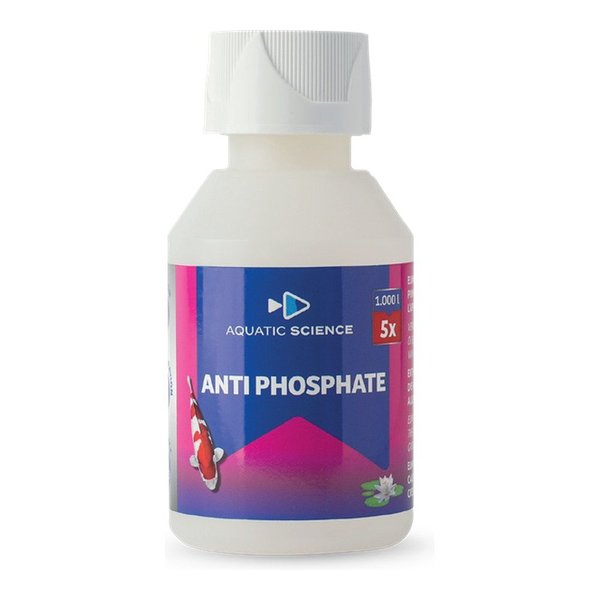
Prevention is done in season. Less food at the end of summer, fast-growing plants that use up the nutrients, and regular partial water changes. Against filamentous algae in an adult tub, a phosphate binder such as Aquatic Science Anti Phosphate takes away part of their fertiliser; it is complemented by plants and water changes, and avoided in the tub where you grow green water for fry, see algae. Hime Medaka adds light shading all year round, which slows filamentous algae; see floating plants and shade.
Frequently asked questions
Should green water be removed before winter?
No. Fluid green water, which lets the net through without resistance, gets through winter without trouble and restarts in spring. What you remove are the filaments and gelatinous clumps.
Which net should I use?
A grading net with a very fine mesh, for fry or brine shrimp. The criterion is the fineness of the mesh, not the brand: the tighter it is, the clearer the test. Failing that, a square of fine tulle stretched over a frame.
My water is transparent, should I test?
Yes. Transparency says phytoplankton is in the minority, not that the water is clean. Water that is clear but slimy, with foam that does not burst, needs the same attention.
Is removing filamentous algae by hand enough?
It is the basic step, and the only one left when the water is already cold. It leaves fragments in suspension and does not correct the excess of nutrients: while the water is above 10 °C, complement it with siphoning the bottom and a partial water change.
Sources
- 媛めだか (Hime Medaka), “放置すると冬に全滅!?メダカの冬越しに向けた「秋の水作り」と悪い青水の見分け方” (left alone, everything dies in winter? Preparing the autumn water and recognising bad green water), ameblo.jp: net test, foam, gill rakers, fry, winter scenario, permanent shading.
- medaka.fr rules for autumn and winter: no work on the water below 10 °C, no complete emptying, transfers before rest (see overwintering and water changes).