
A hardy water lily gets through winter without special help, provided two conditions are met: the rhizome must not freeze, and the dead leaves must not rot in the fish’s water. In a tub or mini-pond with medakas, the second is the real problem, far more than the cold. Prune the leaves when they turn yellow, take the debris out of the tub, then put the basket where frost cannot reach it: at the bottom if the tub is deep, somewhere else if it is not. After that, leave the tub alone until spring.
Why a water lily left as it is costs the fish oxygen
As the days shorten, a hardy water lily stops growing, lets its floating leaves die and retreats into its rhizome. The leaves would not survive frost; the rhizome, under water, does. The plant sorts this out by itself.
The problem is that those leaves fall into the water. They sink, decompose and use up oxygen during the months when the medakas stay sluggish near the bottom. In a garden pond of several cubic metres, the volume of water absorbs this load. In a 100 or 200 litre tub it does not: a small tub clogged with dead leaves can run short of oxygen before the hardest cold even arrives. It is the same mechanism as the one described for sludge in the sludge at the bottom of a medaka tub.
Rotting stems are also an entry point for bacteria and fungi, all the way to the rhizome. For the choice of species and their place in a small pond, see which aquatic plants to keep with medakas; here we only deal with the end of the season.
Prune when the leaf turns yellow, not on a fixed date
The signal is the colour, not the calendar. Cut when the leaves turn yellow and the flowers are over, often at the end of October or in November. Cutting earlier means removing green leaves that are still feeding the rhizome. Cutting too late means leaving leaves caught in the ice and leaf stalks that tear.
The first frosts arrive at very different dates depending on the climate: earlier in continental and mountain areas, later in mild Atlantic and Mediterranean areas. Your national weather service’s frost forecasts are a better guide than a date in a guide. For a local timeline, the regional calendars on this site are only available in French and describe French conditions, for example the one for Brittany or the one for the east of France; they do not apply to every country.
Pruning is done in two or three passes, not all at once:
- fish out the brown or soft floating leaves;
- cut each leaf stalk 2 or 3 cm above the rhizome, never into it;
- remove spent flowers and seed pods;
- leave the leaves that are still clearly green, and come back when they turn yellow;
- feel the stems: a soft part is cut back to white, firm tissue.
Work with clean secateurs or scissors, rinsed in hot water: a dirty cut brings rot instead of preventing it. Take the debris out of the tub, then carry it away from the edge. A pile of leaves left beside the tub always ends up in the water at the first rain. It goes on the compost heap, never into a ditch or a watercourse.
In a deep tub: lower the basket
The rhizome is the only part that can really die. It holds the reserves for spring, and everything done at the surface is meant to bring it through to March intact.
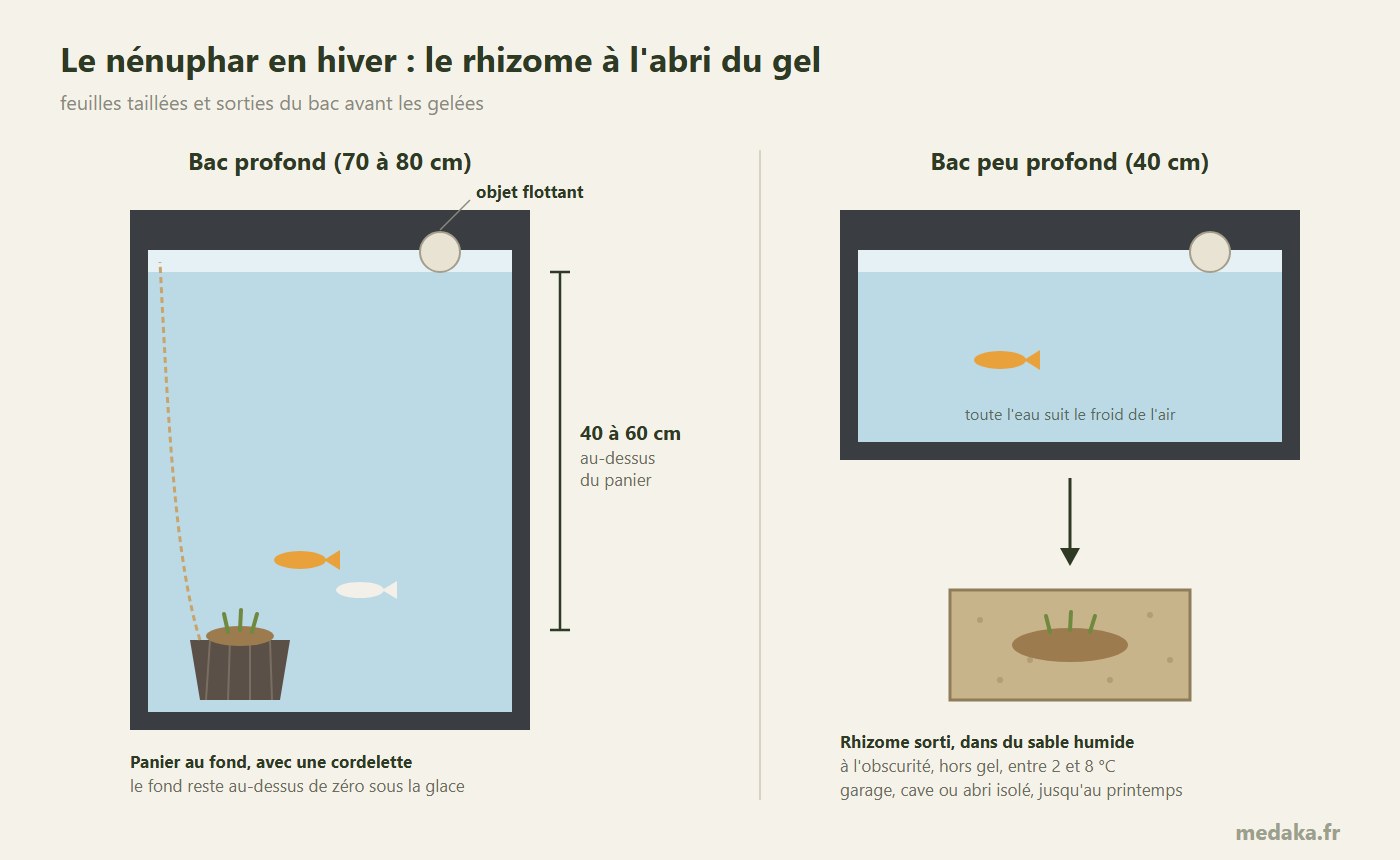
Water is densest at about 4 °C: it sinks to the bottom, and colder water stays above it, right up to the ice. In a deep container, 70 to 80 cm, the bottom therefore stays above zero even under a layer of ice. In a shallow tub, all the water follows the air temperature. So place the top of the basket 40-60 cm below the surface, before the first frost.
Two practical tips: lift a heavy basket by its rim, never by the stems, which snap cleanly; and tie a cord to the basket before lowering it, so that you can bring it back up in spring without groping about in cold water and without disturbing the fish.
When the tub is only 40 cm deep
This is the most common case: a mortar tub of 60 to 100 litres, a patio tub, a rigid plastic basin. None of them has 70 cm of depth. You then have to do things differently:
- Put the basket in a deeper container in the garden, if there is one.
- Insulate the tub: polystyrene panels around the wall, or a double tub, and a place against a south-facing wall, which gives back the day’s warmth at night. See the polystyrene tub and the double tub.
- Take the rhizome out of the basket and keep it damp, in wet sand, in the dark, in a frost-free room at between 2 and 8 °C: garage, cellar, insulated garden shed. The aim is only that it neither dries out nor freezes.
Dwarf water lilies, such as ‘Pygmaea Helvola’, are made for small tubs during the season. Their small rhizome also freezes more quickly: in a 40 cm tub, taking it out is still the safest solution.
If the tub is too small to stay outside over winter, the question arises first for the fish: see overwintering medakas outdoors in Europe and medakas in a mini-pond.
Under the ice: what to do and what not to do
The medaka tolerates cold very well. As long as the tub does not freeze to the bottom, it spends the winter outdoors without heating. What it tolerates badly is a lack of oxygen: under closed ice, exchange with the air stops, and whatever rots at the bottom uses up what is left.
Do not break the ice: the shock and the pressure waves disturb fish that need to spend as little energy as possible. To keep an air gap, place a floating object before the frost, a ball or a half-filled bottle, as described in overwintering. Below 10 °C, stop feeding: the fish hardly eat any more, and food left on the bottom rots. The thresholds are in feeding medakas according to temperature.
Do not lift the basket in mid-winter to check the rhizome: you would disturb the fish and the bottom for nothing. The check is done in spring. What damages a rhizome is mostly the alternation of freezing and thawing in a tub that is too shallow: that is why it is protected before the frosts, not after.
Starting again in spring
When the water stays above 10 °C, bring the basket back up, renew the top of the substrate and start fertilising gently again, with tablet fertiliser pushed into the basket. Never pour fertiliser into the water: in a fish tub, you pay for it in algae, see algae in a medaka tub. The first leaves rise by themselves as soon as the light returns. A rhizome that was stored out of the water goes back into its basket at this point.
The state of the rhizome gives the verdict: firm, white to cream when cut, smelling of damp earth, it is healthy. A soft, slimy part is cut back with a clean knife to healthy tissue. If only a small piece is left, buying a new plant is often simpler than trying to revive it.
Frequently asked questions
Should all the leaves be pruned at once?
No. Remove what is yellow, brown or soft, and let the still-green leaves keep working: as long as there is light, they feed the rhizome. In practice, two or three passes spread over October and November.
My tub is 40 cm deep, can I keep a water lily?
Yes during the season, but not necessarily in the same place in winter. Either insulate the tub properly so that it does not freeze to the bottom, or take the rhizome out and keep it frost-free, between 2 and 8 °C, in damp sand and in the dark, until spring.
Can a tropical water lily stay outside?
No. Tropical water lilies do not tolerate cold winters. Take out the tuber, keep it damp and protected from the cold, then replant it once the water has warmed up well. Only hardy water lilies stay at the bottom of the tub.
What do the medakas risk if I do nothing?
The foliage rots on the spot and the oxygen drops, just when the fish are sluggish and have nowhere to go. In a planted tub, this is a more serious risk than the frost itself.
Can you break the ice to aerate?
No. The shock travels through the water and disturbs the fish. Keep an air gap with a floating object placed before the water freezes over.
Sources
- Medaka.nl, “Waterlelies winterklaar maken: snoeien en dieper zakken”, medaka.nl: pruning when the leaf yellows, basket 40-60 cm below the surface, frost-free storage of the rhizome in a small tub.
- Medaka.fr rules on overwintering, feeding and ice: no food below 10 °C, no breaking the ice, floating object placed before the frost.
- Diagram: medaka.fr.