Medaka glossary: Japanese terms explained in English
The vocabulary of the improved medaka is Japanese, and the English trade translations muddy it more than they clarify. For each term, this glossary gives the Japanese word, its reading in the Latin alphabet after the middle dot, and the English term we use on medaka.fr. It follows the seven groups of the classification manual of the Japan Medaka Association, then the husbandry terms.
The fish
Term
Japanese
Definition
medaka
メダカ, 目高 · medaka
The Japanese name of Oryzias latipes, “high eyes”. The plural is medaka, with no -s.
improved medaka
改良メダカ · kairyō medaka
A variety obtained by selection from the wild form.
wild medaka
野生メダカ, ミナミメダカ · yasei medaka, minami medaka
The natural Japanese form, protected in Japan. The farmed Kuro medaka is close to it but is not the wild form.
Himedaka
緋メダカ · himedaka
The oldest variety, orange-yellow, known since the Edo period. Sold as “yellow medaka” or “golden”.
variety
品種 · hinshu
A group of medaka with distinct, recognisable traits.
line
系統 · keitō
A group descended from the same selection, by the same breeder.
fixed variety
固定品種 · kotei hinshu
A variety of which at least 30 % of the offspring reproduce the traits.
fixation rate
固定率 · koteiritsu
The share of offspring that match the parents. Determines the price and how easy selection is.
house name
ハウスネーム, 屋号 · hausu nēmu, yagō
A commercial nickname given by the breeder who created it: Youkihi, Miyuki, Orochi, Saboten, Neptune.
seller’s name
—
An English name from the import trade (Platinum, Black Dragon, Orange Black). Says nothing about the line or the breeder.
Pigment cells
Term
Japanese
Definition
melanophores
黒色素胞 · kokushikisohō
Cells of black pigment. Their density makes black, their absence makes an albino.
xanthophores
黄色素胞 · ōshikisohō
Cells of yellow to orange pigment. The Himedaka and the Youkihi depend on them.
leucophores
白色素胞 · hakushikisohō
Cells of white pigment.
iridophores
虹色素胞 · kōshikisohō
Reflective cells. They make lamé, external light, internal light and blue.
background reaction
背地反応 · haichi hannō
The medaka lightens its colouring on a light background and darkens it on a dark one. Orochi lines do not react.
colour-up
色揚げ · iroage
Strengthening of colour through diet (carotenoids, astaxanthin), background and sunlight.
Group 1: body colours
Fixed English term
Japanese
Note
brown
茶 · cha
The wild form.
yellow
黄 · ki
Himedaka.
white
白 · shiro
Shiro medaka.
blue
青 · ao
Ao medaka, bluish grey.
black
黒 · kuro
From dark grey to Orochi black.
gold
黄金 · ōgon
Metallic yellow.
amber
琥珀 · kohaku
Translucent orange-brown. A homophone of Kōhaku 紅白, not to be confused with it.
vermilion
朱赤 · shuaka
The orange-red of the Youkihi.
orange
オレンジ · orenji
Pure orange.
pink
ピンク · pinku
Pale pink.
Groups 2 and 3: scales and eyes
Fixed English term
Japanese
Definition
transparent scales
透明鱗 · tōmeirin
Translucent gill covers that look red. The base of the panda and of internal light.
semi-transparent scales, Aurora
半透明鱗, オーロラ · hantōmeirin, ōrora
Between transparent and opaque. The base of the Aurora line and of most recent lamés.
albino
アルビノ · arubino
No melanin, red eyes, more sensitive to sun.
panda
パンダ · panda
Black outline round the eye on transparent scales, so the eye looks ringed.
ruby eye
ルビーアイ · rubī ai
Red iris on a non-albino fish.
small eye
小眼 · shōgan
Reduced eye.
bulging eye
出目 · deme
Globular eye, as in some goldfish.
frontal eye
目前 · memae
Eye shifted forwards.
big eye
ビッグアイ · biggu ai
Enlarged eye.
bubble eye
水泡眼 · suihōgan
Fluid sac under the eye.
earth eye
アースアイ · āsu ai
Blue or silver iris, like a planet.
platinum eye
プラチナアイ · purachina ai
Light metallic iris. Added to the manual in 2025.
Group 4: iridophores, the lights
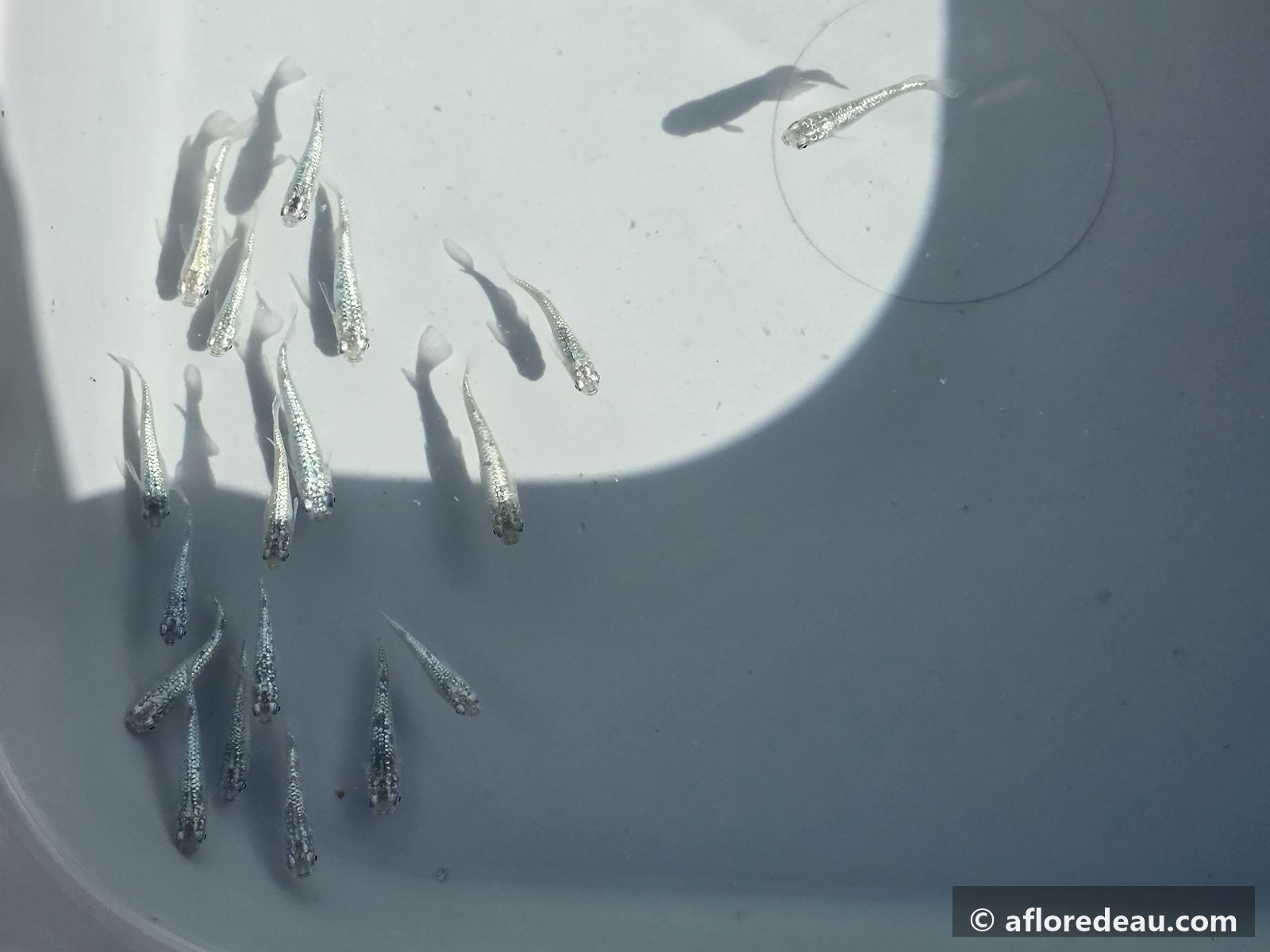
Lamé and external light seen from above, on Saboten in a holding tank in Lesneven.
Fixed English term
Japanese
Definition
lamé
ラメ · rame
Scattered glittering scales, like sequins. The word comes from the fabric.
external light
体外光 · taigaikō
Continuous reflective band on the back. The trait of the Miyuki.
Miyuki
幹之 · miyuki
House name of the line that fixed external light: presented by Kan Takashi (Ehime) at the first JMA contest in 2007, fixed by Medaka no Yakata in 2008, named after Kan’s daughter. Used as a synonym for the trait.
weak, strong, super light
弱光, 強光, スーパー光 · jakkō, kyōkō, sūpā-kō
Grades of external light according to its length on the back.
iron mask
鉄仮面 · tekkamen
External light that reaches the head.
full body
フルボディ · furu bodi
External light along the whole length.
internal light
体内光 · tainaikō
Coloured sheen visible through the body, on transparent scales.
whole-body glow
全身体内光 · zenshin tainaikō
Internal light extended over the whole body.
peritoneal light
腹膜光 · fukumakukō
Reflective abdominal membrane, blue or gold, seen from the side.
fin line
ヒレ光 · hire-kō
Reflective edge of the fins.
Sapphire
サファイア · safaia
Line with blue lamé on a dark body.
Group 5: patterns
Fixed English term
Japanese
Definition
patches
斑 · buchi
Distinct zones of colour on the body.
black rim
ブラックリム · burakku rimu
Black edge of the scales.
Kōhaku
紅白 · kōhaku
White and vermilion. Official JMA name: white vermilion transparent scales (白朱赤透明鱗). The koi word, kept as it is. Sold as “Red White”.
Sanshoku
三色 · sanshoku
White, vermilion and black. Sellers say “Sanke” by analogy with koi; the Japanese for medaka says Sanshoku.
Tanchō
丹頂 · tanchō
A red patch on the head alone, like the crane.
Group 6: fins
Fixed English term
Japanese
Definition
Longfin
ロングフィン · rongu fin
All fins evenly lengthened.
Real Longfin
リアルロングフィン · riaru rongu fin
Lengthening more marked and more even than the Longfin.
Hirenaga
ヒレ長 · hirenaga
Long fins of the Matsui line (松井ヒレ長).
Swallow
スワロー · suwarō
Some rays lengthen into irregular filaments.
Samurai
サムライ · samurai
Dorsal fin split in two.
Maruko
マルコ · maruko
No dorsal fin.
Wide fin
ワイドフィン · waido fin
Broadened fins.
diamond tail
菱尾 · hishio
Four-cornered tail, typical of the Hikari type.
Meller
メラー · merā
Fin rays split into points.
Morpho
モルフォ · morufo
Broad, iridescent fins, named after the butterfly.
tufted fins
フサヒレ · fusahire
Multiplied rays, feather-duster look.
narrow fins
ナローフィン · narō fin
Narrowed fins.
rarities
珍種 · chinshu
Three traits outside the groups in the manual: melanoma (メラノーマ), iron mask (鉄仮面), lion head (獅子頭).
Group 7: body shapes
Fixed English term
Japanese
Definition
normal type
普通体型 · futsū taikei
Wild silhouette. Not written in the name.
Hikari
ヒカリ体型 · hikari taikei
Anal fin symmetrical with the dorsal, diamond tail, reflective back. A shape, not a colour.
Daruma
ダルマ体型 · daruma taikei
Shortened vertebrae, short round body. Expressed when the eggs incubate above 28 °C.
semi-Daruma
半ダルマ · han-daruma
Partial shortening. A better breeder than the full Daruma.
Hikari-Daruma
ヒカリダルマ · hikari daruma
Both traits together.
Husbandry
Term
Japanese
Definition
biotope
ビオトープ · biotōpu
A planted outdoor tub, without a filter, where balance establishes itself.
water-lily bowl
睡蓮鉢 · suirenbachi
The traditional Japanese container, in terracotta or resin.
black tub
黒容器 · kuro yōki
A dark container that brings out colours through the background reaction.
green water
グリーンウォーター · gurīn wōtā
Suspended phytoplankton. Feeds the fry, sought after in Japan.
top-up
足し水 · tashimizu
Making up evaporation without changing the water. The rule outdoors.
water change
水換え · mizukae
Partial renewal. A quarter to a third per week in the season, never during overwintering.
aged water
汲み置き · kumioki
Tap water left to stand 24 h outdoors or 2 to 3 days indoors to remove the chlorine.
overwintering
越冬 · ettō
Getting through the winter at a slow pace, with no food below 10 °C.
reed screen
すだれ · sudare
A reed screen laid over half of the tub against the summer sun.
dragonfly larva
ヤゴ · yago
The first predator of medaka outdoors.
mixed keeping
混泳 · kon’ei
Keeping with other species. Not advised with goldfish and koi.
Breeding
Term
Japanese
Definition
breeders
種親 · taneoya
The pair or trio chosen for breeding.
spawning medium
産卵床 · sanranshō
Plant, moss or mop where the female lays her eggs.
egg collection
採卵 · sairan
Removing the eggs to incubate them separately.
degree-days
積算温度 · sekisan ondo
The sum of daily temperatures. An egg hatches at about 250 °C·days: 10 days at 25 °C.
harigo
針子 · harigo
“Needle fry”, the first days after hatching. To be fed from day 3.
fry, juvenile, adult
稚魚, 若魚, 成魚 · chigyo, wakauo, seigyo
The three following stages.
culling
選別 · senbetsu
Selection of the young according to the standard, by size then by traits.
F1
F1
First generation of a cross.
contest
品評会 · hinpyōkai
A judged show. The JMA organises them in spring and autumn.
JMA
日本メダカ協会 · Nihon Medaka Kyōkai
Japan Medaka Association, publisher of the classification manual.
WEB図鑑
改良メダカWEB図鑑
Online encyclopedia of Medaka no Yakata, 909 varieties in 2026.
Sources
Japan Medaka Association, classification manual of improved medaka, 5th edition, September 2025.
Medaka no Yakata, 改良メダカWEB図鑑: list of the 56 terms, “basic terms: genetics and pigments”, “basic terms: varieties and keeping”, medakazukan.net/category/term/
Tokyo Aqua Garden, メダカの種類・品種・体型・鱗とは, t-aquagarden.com/column/medaka_variety