
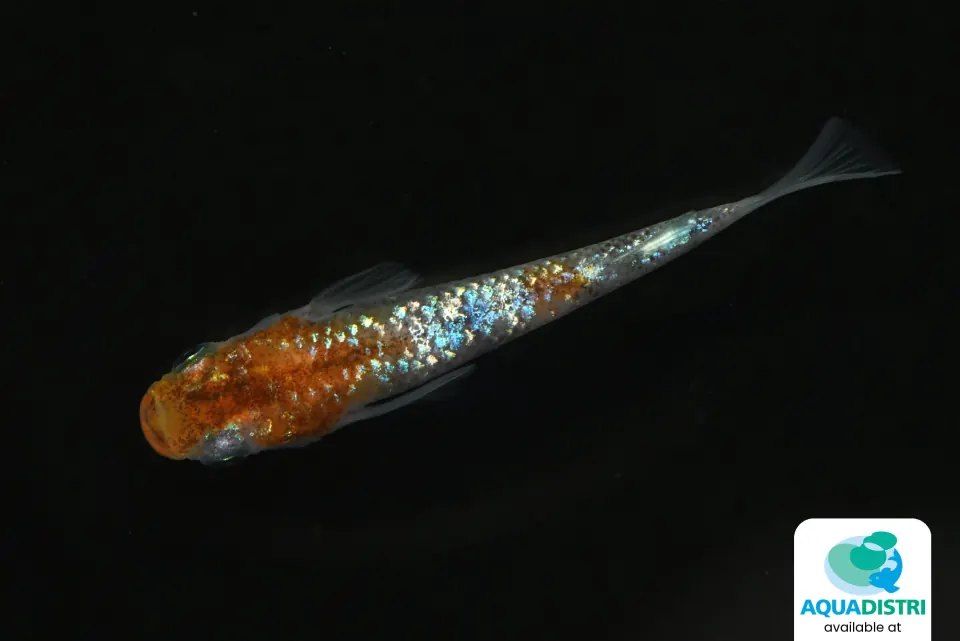
A Japanese medaka name is not a fancy name. It is a description, assembled in a fixed order, which the Japan Medaka Association (JMA) has codified in a classification manual of seven groups and 45 traits. Once you know how to read it, “Sanshoku lamé Miyuki Daruma” tells you exactly what the fish looks like. This page explains the grammar of the names, group by group, and serves as the reference for every medaka sheet on medaka.fr.
Why a standard
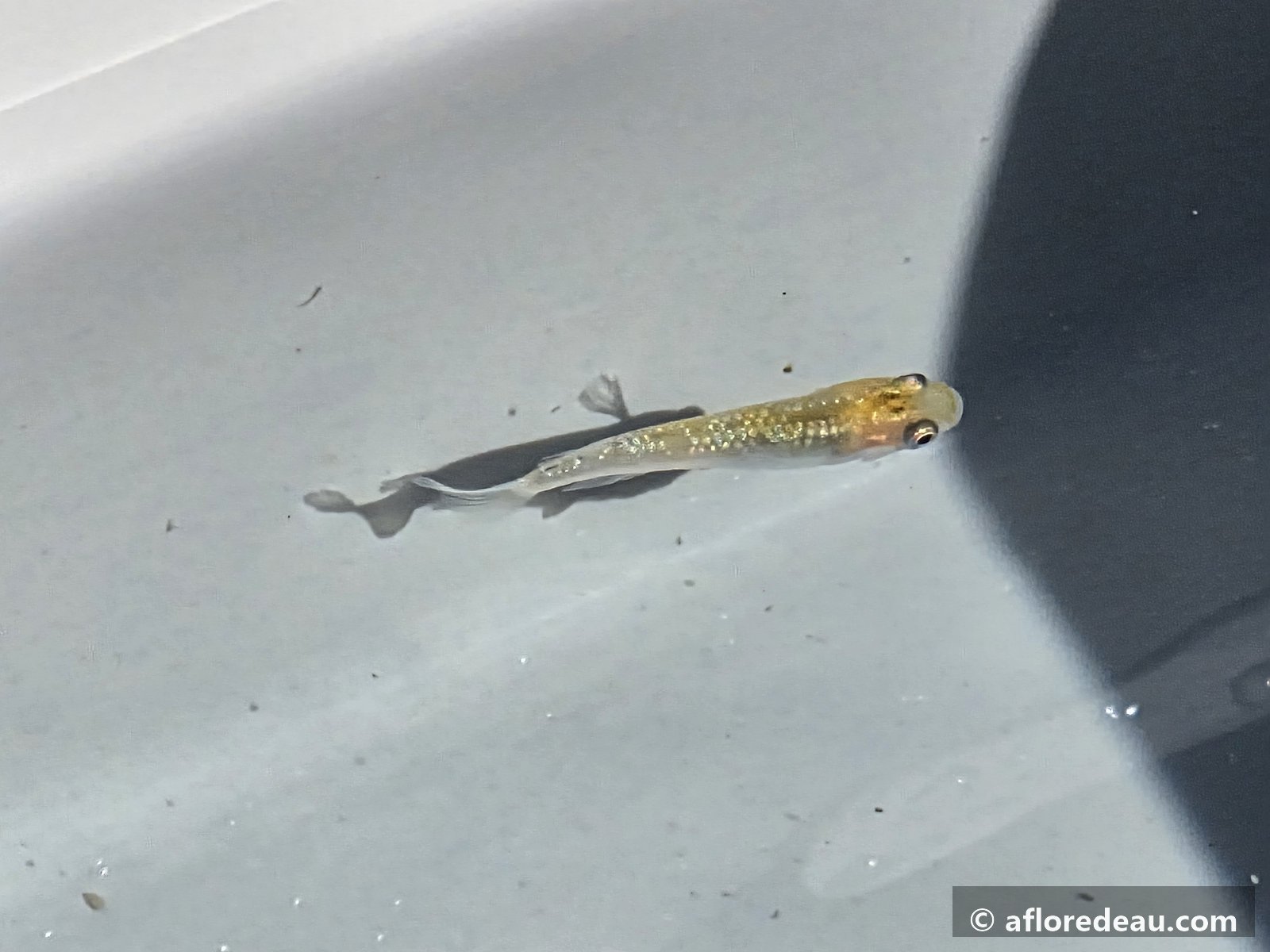
The improved medaka (改良メダカ) was born from the selection of the wild form of Oryzias latipes. Around the year 2000, Japan had about twenty varieties. In April 2019, the online encyclopaedia of Medaka no Yakata listed 552. In September 2026, it lists 909. Each breeder baptises their creations with a house name, and the same fish can circulate under three different names. So that competitions can judge and enthusiasts know what they are buying, the JMA has for several years published an official classification manual. The fifth edition dates from September 2025. It can be downloaded free of charge and used freely, and it is the one we follow.
The principle is simple. A medaka is described by seven groups of traits, always in the same order. The variety name is obtained by putting together the traits that are present. A trait that is absent is not written. The house name, for its part, is a commercial nickname that is added to or replaces the variety name.
The seven groups, in order
1. Body colour (体色)
Ten base colours. They result from the combination of four types of pigment cell: melanophores (black), xanthophores (yellow), leucophores (white) and iridophores (reflections). A variety has only one base colour, except bicolours and tricolours, which are handled by the pattern group.
| Japanese | English name used here | What you see |
|---|---|---|
| 茶 (cha) | brown | the wild form, olive brown, the farmed Kuro medaka |
| 黄 (ki) | yellow | the Himedaka, the oldest variety, orange-yellow |
| 白 (shiro) | white | milky white body, without yellow |
| 青 (ao) | blue | bluish grey, more or less intense depending on the background |
| 黒 (kuro) | black | from anthracite grey to the deep black of the Orochi line |
| 黄金 (ōgon) | golden | yellow with metallic reflections |
| 琥珀 (kohaku) | amber | translucent orange-brown; not to be confused with Kōhaku 紅白, red and white |
| 朱赤 (shuaka) | vermilion | the orange-red of the Youkihi |
| オレンジ | orange | pure orange, less red than vermilion |
| ピンク | pink | pale pink, often on transparent scales |
2. Scales (鱗)
Two traits. Transparent scales (透明鱗, tōmeirin) let you see the opercula, which appear red, and the deeper pigments. Semi-transparent scales (半透明鱗) are the basis of the Aurora (オーロラ) line, intermediate between transparent and opaque, which gives gradients of colour on the body and serves as the base for many recent lamé varieties.
3. Eyes (目)
Ten traits, which the manual sorts into two families. Three of colour: albino (アルビノ, no melanin, red eyes), panda (パンダ, black outline of the eye on transparent scales) and ruby eye (ルビーアイ). Seven of shape: small eye (スモールアイ), protruding eye (出目, deme), front eye (目前, memae), big eye (ビッグアイ), bubble eye (水泡眼), earth eye (アースアイ, blue or silver iris) and platinum eye (プラチナアイ). The panda is by far the most widespread in Europe.
4. Iridophores (虹色素胞)
This is the group that made the modern medaka. Six traits describe where and how the reflective cells express themselves.
| Japanese | English name used here | What you see |
|---|---|---|
| ラメ (lamé) | lamé | scattered shiny scales, like glitter |
| 体外光 (taigaikō) | external light | reflective band along the back, from the dorsal fin towards the head; this is the trait of the Miyuki |
| 体内光 (tainaikō) | internal light | coloured reflection seen through the body, on transparent scales |
| 全身体内光 | full-body light | internal light over the whole body |
| 腹膜光 (fukumakukō) | peritoneal light | reflective abdominal membrane, blue or golden |
| ヒレ光 | fin line | reflective edge of the fins |
Breeders read external light by grades: weak (弱光), strong (強光), super (スーパー光) and full body (フルボディ). The manual, for its part, notes its colour (white, blue, golden, green, bicolour), its position (head light 頭光, side light 横光) and its shape (scale by scale, in dots). The iron mask (鉄仮面), where the light covers the head down to the snout, appears in the manual among the three “rarities” (珍種), with melanoma (メラノーマ) and the lion head (獅子頭). Miyuki fry are born dark. The light rises with age and with sunlight.
5. Patterns (柄)
Two traits: spots (斑, buchi, which the manual also calls 錦, nishiki) and the black rim (ブラックリム). Bicolours and tricolours are combinations of colour and spots. The JMA’s table of nicknames shows it: Kōhaku (紅白) is officially called “white vermilion transparent scales”, and Sanshoku nishiki (三色錦) “white vermilion transparent scales spots”. The vocabulary comes from koi, but medaka Japanese says Sanshoku, not Sanke.
6. Fins (ヒレ変化)
Twelve traits. The most common in Europe:
- Longfin (ロングフィン): all the fins elongated, evenly.
- Hirenaga (ヒレ長): long fins of the Matsui line, often more tapered.
- Swallow (スワロー): some rays lengthen irregularly, like filaments.
- Samurai (サムライ): dorsal fin split in two.
- Maruko (マルコ): no dorsal fin.
- Wide fin (ワイドフィン): widened fins.
The manual also lists the diamond-shaped tail fin (菱尾, that of the Hikari type), the Meller (メラー, fin rays split into points), the Real Longfin (リアルロングフィン), the Morpho (モルフォ, wide, iridescent fins), bushy fins (フサヒレ) and narrow fins (ナローフィン).
7. Body shape (体型)
Three traits, plus the normal type, which is not written.
- Normal type (普通体型): the wild silhouette.
- Hikari (ヒカリ): the anal fin has the shape and size of the dorsal fin, the tail fin is diamond-shaped, and the back carries a reflection. It is a mutation of symmetry, not a colour.
- Daruma (ダルマ): shortened vertebrae, short and round body. The gene exists in all medaka and is expressed when the eggs incubate above 28 °C. The semi-Daruma (半ダルマ) is intermediate.
- Hikari-Daruma: both at once.
Reading a full name
You read in the order of the groups. A few examples of names in circulation in Europe:
| Name | Breakdown |
|---|---|
| 幹之 Miyuki | white or blue colour, external light, normal type; a house name that has become a common name |
| 三色ラメ Sanshoku lamé | white + vermilion + black (tricolour pattern), lamé |
| 幹之ダルマ Miyuki Daruma | external light, Daruma type |
| オーロラ黄ラメ Yellow lamé Aurora | yellow, semi-transparent scales, lamé |
| 楊貴妃パンダ Youkihi panda | vermilion, transparent scales, panda eye |
| 三色ラメ幹之ダルマ | tricolour, lamé, external light, Daruma type |
Variety name and house name
Every improved medaka carries two names. The variety name follows the grammar above. The house name (ハウスネーム or 屋号) is the nickname given by the breeder who created or fixed the line: Youkihi, Miyuki, Orochi, Saboten, Neptune are house names. They designate a specific line, with its creator, its year and its history. When a fish reaches Europe under an English name such as “Platinum”, “Black Dragon” or “Orange Black”, that is a third level: the seller’s name. It tells you neither the line nor the creator. Our sheets always point out which level a name belongs to, and give the JMA equivalent when it is certain.
Line, variety, fixed variety
The Medaka no Yakata encyclopaedia distinguishes three statuses. A line (系統) is a group coming from the same selection. A variety (品種) has distinct, recognisable traits. A fixed variety (固定品種) reproduces its traits in at least 30% of its offspring. This figure is called the fixation rate (固定率). A Neptune is given at about 70%, a Sanshoku far lower, because the pattern is distributed at random. It is the fixation rate that explains the price differences between varieties, and it is what you should look at before obtaining breeders.
The figures to remember
| Groups of traits | 7 |
|---|---|
| Traits described | 45, plus 3 rarities (JMA manual, 5th edition, September 2025) |
| Varieties listed | about 20 in 2000, 552 in 2019, 909 in 2026 |
| Threshold for a fixed variety | 30% of the offspring true to type |
| Temperature that expresses the Daruma | above 28 °C during incubation |
Frequently asked questions
Is Miyuki a colour?
No. Miyuki (幹之) is the house name of the line that fixed external light. We speak of white Miyuki, blue Miyuki, black Miyuki: the colour changes, the trait stays.
What is the difference between lamé and external light?
Lamé is made of shiny scales scattered over the body. External light is a continuous band along the line of the back. The same fish can have both.
Does Hikari mean shiny?
The word means light, but in the classification, Hikari designates a body shape: symmetrical dorsal and anal fins, diamond-shaped tail fin. A yellow Hikari is a Himedaka of Hikari type, not a shinier Himedaka.
Where can I find the JMA manual?
On the website of the Japan Medaka Association, as a PDF, with a table linking commercial nicknames to variety names. It is in Japanese. Our glossary gives its terms in English.
Sources
- Japan Medaka Association, 改良メダカ品種分類マニュアル (improved medaka variety classification manual), 5th edition, September 2025, jma-medaka.com/medaka-variety-classification-manual/
- Medaka no Yakata, 改良メダカWEB図鑑, search page by traits and “how to read the WEB図鑑”, medakazukan.net/varietyofmedaka/ and medakazukan.net/mikata/
- Medaka no Yakata, 改良メダカの分類方法 (classification method for improved medaka), medakanoyakata.jp/?mode=f57
- Tokyo Aqua Garden, メダカの種類・品種・体型・鱗とは (medaka types, varieties, body shapes and scales), t-aquagarden.com/column/medaka_variety