
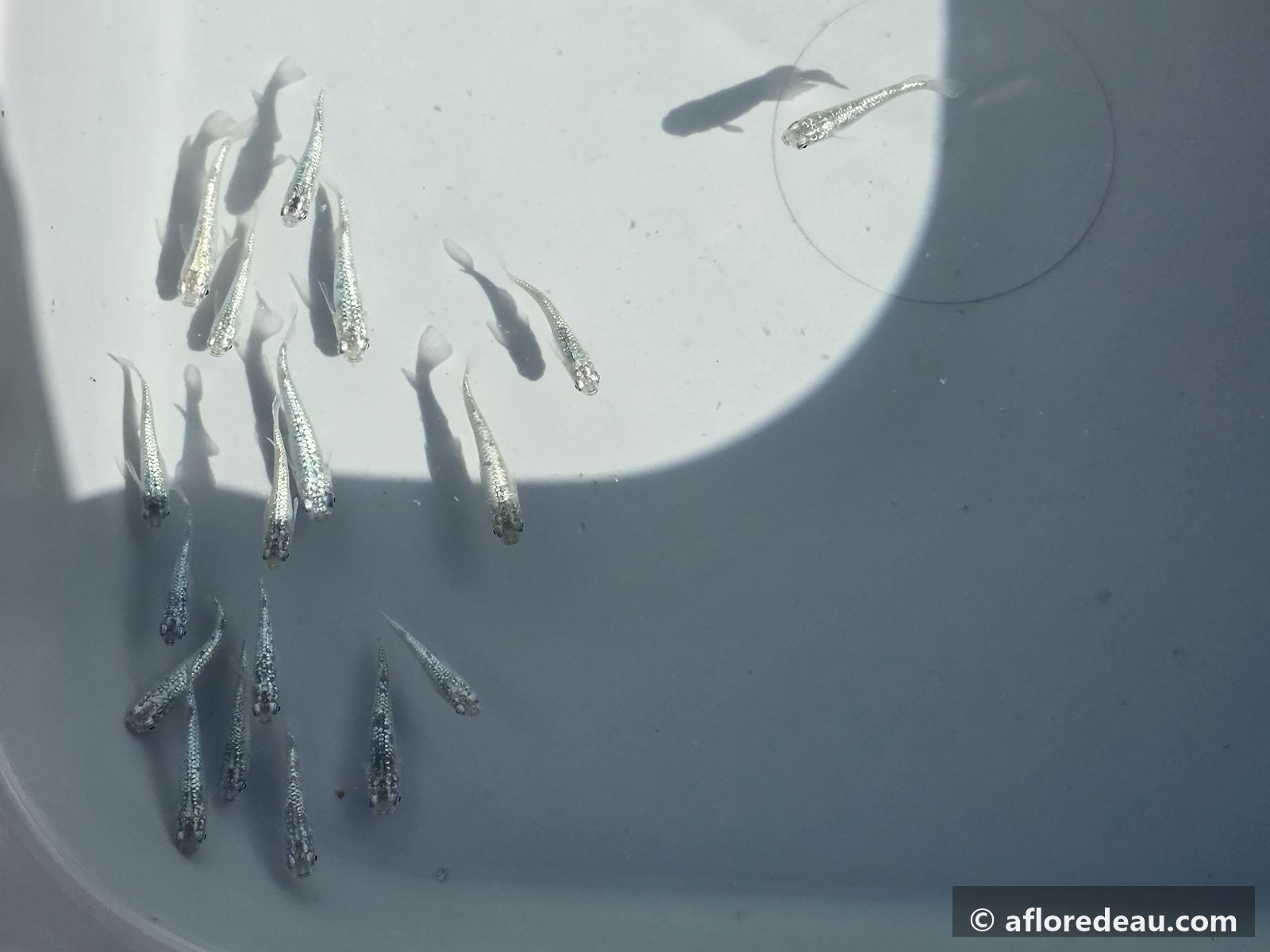
There are genetically modified medaka that glow green, red or pink under blue or ultraviolet light. They are legal in Taiwan, where in 2003 they became the first transgenic pets sold anywhere in the world. They are banned in the European Union: no import, no sale. In Japan, simply breeding them led to arrests in 2023. This page explains where they come from, why they are banned, what a buyer risks, and how not to be caught out.
Where fluorescent medaka come from
The medaka is, with the zebrafish, the most widely used laboratory animal among fish: small, prolific, with a transparent embryo and a fully known genome. Since the 1990s, researchers have been inserting fluorescence genes into it, borrowed from a jellyfish (green protein, GFP) or a sea anemone (red protein), to make tissues or genes visible under the microscope. It is not breeding; it is a research tool.
The move to the market happened in Taiwan. A team at National Taiwan University, led by Professor Huai-Jen Tsai, described a uniformly green fluorescent medaka in 2001. An aquarium company, Taikong, marketed it under the name TK-1: in spring 2003, Taiwan became the first country to allow the sale of a genetically modified organism as a pet, and a hundred thousand fish were sold in less than a month. Red and bicolour lines followed. The same year, in the United States, GloFish, fluorescent zebrafish, arrived in pet shops.
Japan provides the second episode, which is more revealing. A red fluorescent medaka had been created at the Tokyo Institute of Technology for research. Around 2009, a student took eggs out of the laboratory. The fish multiplied among hobbyists, were swapped, then sold: one of the sellers had renamed them “Royal Pingu” and offered them at exhibitions at around 100,000 yen a pair. In March 2023, five hobbyists and dealers were arrested and four more prosecuted, for breeding and selling a genetically modified organism without authorisation. It was the first criminal application of Japan’s so-called Cartagena law, which makes the import, breeding and sale of any modified organism subject to state approval.
What the law says in Europe
In the European Union, any genetically modified organism intended to be released into the environment or placed on the market falls under Directive 2001/18/EC. A transgenic animal cannot be imported or sold without a marketing authorisation, issued after a risk assessment. No producer of fluorescent fish has ever applied for it, and no authorisation has been issued. The American producer of GloFish itself says it will not apply, the procedure being too long and too costly.
These fish circulate nonetheless. The French aquarium federation notes that transgenic fish were found on sale in specialist shops in the United Kingdom, Germany, the Czech Republic, the Netherlands, Norway, Ireland and Belgium between 2006 and 2015. The European rapid alert system does not track them, because it monitors only what is intended for food. They arrive through badly declared imports and through private individuals, and are resold in small ads under names that tell you nothing: “neon”, “glow”, “fluo”, “TK”.
In France, the directive is transposed into the Environment Code, articles L. 533-1 and following and R. 533-25 to R. 533-51. Questioned by a member of parliament, the French ecology ministry stated that the ban covers import, sale and also possession, with no exception for personal use. The penalty provided for the deliberate release of genetically modified organisms without authorisation is one year’s imprisonment and a fine of 75,000 euros (Environment Code, article L. 536-4), plus seizure and destruction of the animals. In practice, a private individual who bought a fluorescent fish without knowing what it was is not the services’ first target; the seller, the importer and the person who breeds and distributes them are.
Why the ban
Three reasons, which also hold for a breeder who did not care about the law.
Ecological risk. A medaka lives in a ditch, a pond, a garden tub, exactly the habitats from which it escapes most easily. A medaka released in Europe survives the winter. A released transgenic medaka passes its gene to its offspring, and nobody knows what a fluorescence gene does in a wild population over twenty years, because nobody is allowed to study it in the open. In Brazil, GloFish escaped from farms have been found breeding in rivers. This is the scenario the directive wants to avoid, and it is why the Japanese court expert judged that the 2023 medaka had probably already been released.
Contamination of strains. A fluorescent medaka crossed with an ordinary medaka gives young that carry the gene, fluorescent or not depending on the case. A breeder who lets a single transgenic fish into his tanks can no longer guarantee any of his lines, and what he sells afterwards becomes illegal itself. For a selective breeding programme, it is the ruin of twenty years of work.
The image of the medaka. The improved medaka is the product of selection: nine hundred varieties obtained by crossing, without genetic manipulation, with a standard and competitions. The fluorescent fish is the opposite, a gene added in a laboratory. Confusing it with a Miyuki or a Youkihi is exactly what Japanese breeders fear, and Japanese law now punishes the confusion.
Recognising a transgenic medaka
- It glows in the dark under a blue or ultraviolet lamp, an even green, red or pink, right into the fins and the eye. No selectively bred medaka does this: the external lights and the lamés are reflections, which disappear without incident light.
- Its colour is flat, saturated, identical on every fish in a batch, without the nuances of a Youkihi or a blue.
- It has no Japanese variety name. It is sold as “neon medaka”, “glow”, “fluo red”, “TK”, sometimes “pink medaka”.
- The seller can neither name the line nor give classification characteristics.
A medaka that is pink, pinkish white, orange or bright red in daylight is not suspect in itself: pink (ピンク) and vermilion are recognised selected colours. The test is the lamp: a true medaka does not light up.
What to do
- Do not buy. Not in a pet shop, not from a small ad, not from abroad, whatever the price. A seller offering them in the European Union is acting illegally.
- Never release, never give away. Dissemination is what the law punishes most severely, and the most serious act for the environment.
- If you have one without having known: isolate it, do not let it breed, and report it to the competent environmental or biodiversity authority in your country, which will tell you what to do. A good-faith report has nothing to do with selling.
- On our forum, any thread offering a fluorescent fish is removed and the author warned; it is written in the charter.
The key points
| First transgenic pet | green TK-1 medaka, Taiwan, 2003 (Taikong, National Taiwan University) |
|---|---|
| Japanese case | red medaka taken from a Tokyo laboratory around 2009; 5 arrests and 4 prosecutions in March 2023, Cartagena law |
| European text | Directive 2001/18/EC; no authorisation requested or issued for a fluorescent fish |
| French text | Environment Code, L. 533-1 and following, R. 533-25 to R. 533-51 |
| Prohibited | import, sale, possession, breeding, release |
| Penalty for dissemination without authorisation (France) | 1 year’s imprisonment and a fine of 75,000 € (L. 536-4), seizure of the animals |
| Simple test | a true medaka does not glow under a blue or UV lamp |
Frequently asked questions
Are fluorescent medaka dangerous to health?
Nothing indicates it for anyone who handles or keeps them. The danger is ecological and genetic, not health-related.
And GloFish sold on the internet, is it the same?
Yes. Zebrafish, tetra, barb or medaka, any transgenic fluorescent fish is banned in the European Union in the same way.
Is a “pink” or “platinum” medaka a GMO?
No. These are colours and reflections obtained by selection. The difference shows under a blue lamp: a selectively bred fish does not light up.
Why does Taiwan allow them and not Europe?
Taiwan assessed the risk as low for a tropical fish that does not survive its winters, and Korea and Taiwan also have an industrial interest. Europe applies a precautionary principle and requires an assessment that nobody has wanted to fund. The medaka, for its part, survives a European winter, which makes the case more serious here than in Taiwan.
Sources
- Kansai TV, “そもそもナゼ広まった?遺伝子組換えで誕生“赤く光るメダカ””, 15 March 2023; Newsweek Japan, “カルタヘナ法違反で初逮捕”, March 2023; Nikkei Biotech, “組換えメダカで逮捕者”, March 2023.
- Wikipedia, GloFish: marketing of the TK-1 medaka by Taikong in Taiwan in 2003, a hundred thousand fish sold in a month; work of Huai-Jen Tsai, National Taiwan University.
- Assemblée nationale (France), written question no. 87368 (13th legislature) on transgenic fish and the reply of the ecology ministry: Directive 2001/18/EC, Environment Code R. 533-25 to R. 533-51, absence of authorisation, ban on possession.
- Code de l’environnement (France), articles L. 533-1 and following, L. 536-4 (Légifrance).
- Fédération française d’aquariophilie, “Poissons transgéniques”; Inf’OGM, “Des poissons d’aquarium OGM dans des rivières brésiliennes”.