
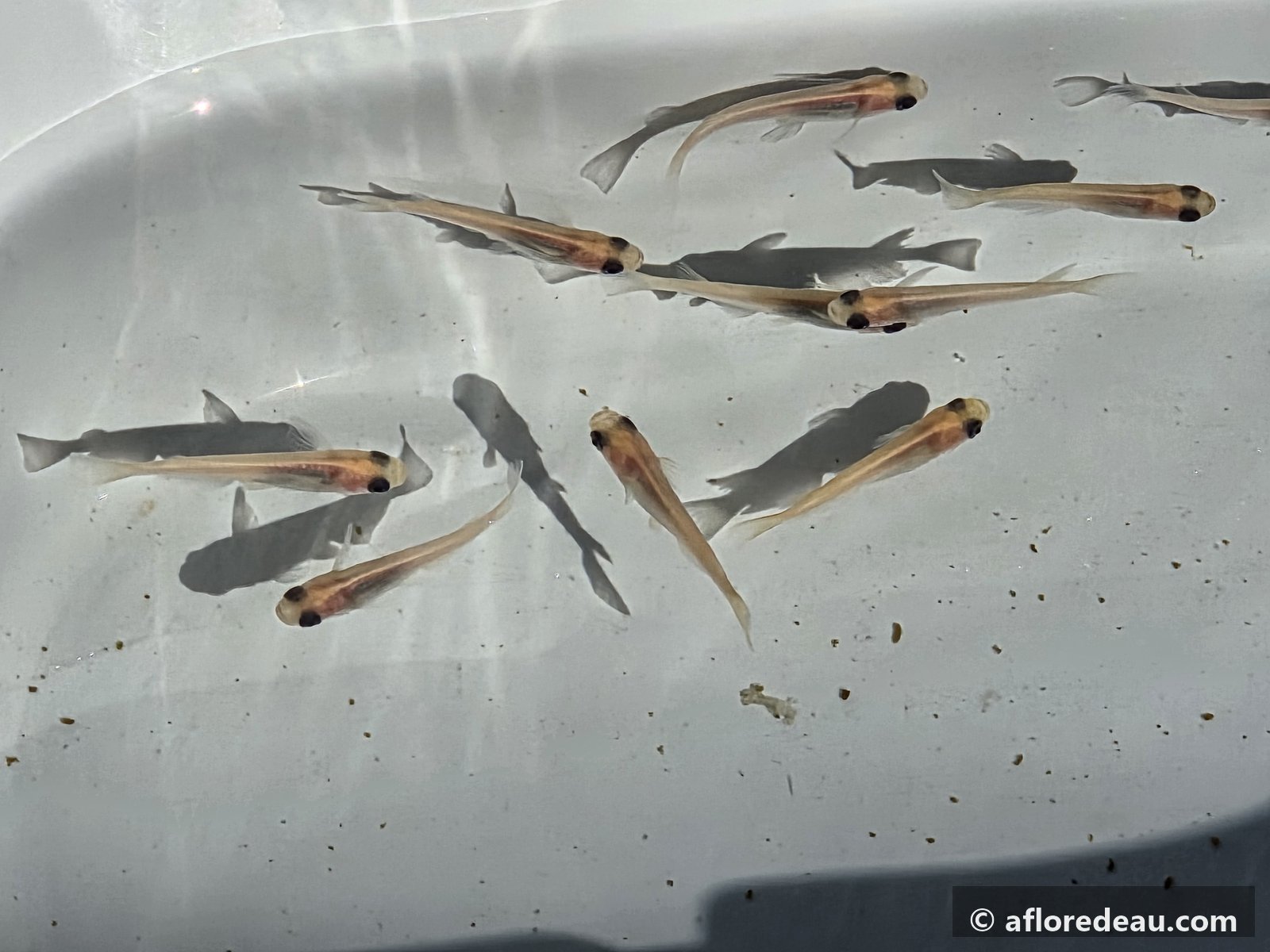
No, not in the same body of water. Goldfish and medaka both live in cold water, are sold on the same shelf and seem made to get along; it is the most common beginner’s mistake, and Japanese breeders put it at the top of the pairings to avoid. A goldfish chases medaka as soon as they are together, even at equal size, and swallows them as soon as they fit in its mouth. What works is giving each its own water: the pond for the goldfish, a basin or tank for the medaka, alongside.
Why it does not work
The goldfish is a predator in practice. It is omnivorous and readily takes animal prey. An adult medaka measures 3 to 4 cm; a pond goldfish reaches 15 to 25 cm within a few years, a comet more, and its mouth swallows a fish of that size without effort. Tokyo Aqua Garden sums up the rule: any species whose mouth can hold a medaka is to be excluded. Eggs and fry are eaten in every case, whatever the size of the goldfish.
It harasses before it eats. The point Japanese breeders stress is less well known: even when the two fish are the same size, the goldfish, livelier and more territorial, chases the medaka as soon as they are put together. The medaka hide, eat less, weaken, and die of stress or disease before being swallowed. A group of medaka that “disappears” from a pond has not necessarily been eaten: it has often simply wasted away.
It steals the food. The goldfish rushes at anything that falls on the surface. The medaka, slower and more timid, arrives afterwards and finds the place taken. In a pond, you cannot feed one without the other.
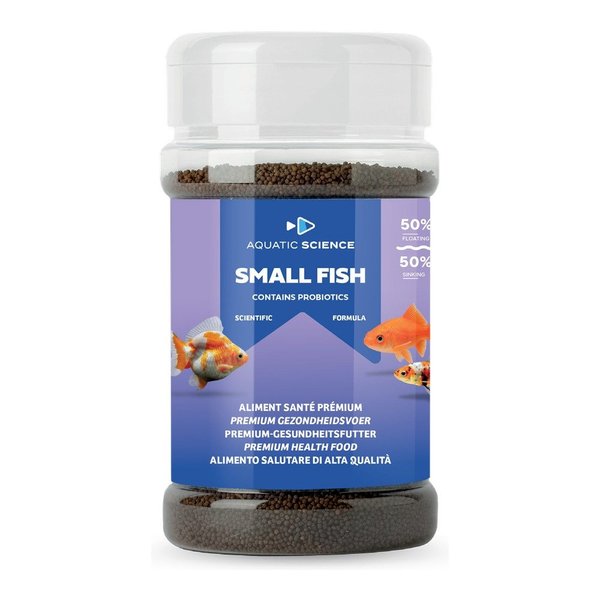
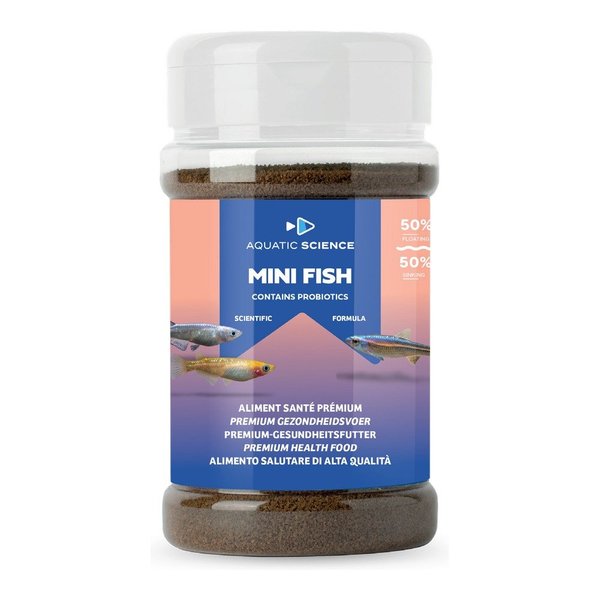
If the two species share a large pond anyway, feed in two places, with two grain sizes: Aquatic Science Small Fish, at 1.1 mm, is meant for goldfish, and Mini Fish from the same brand, at 0.3 mm, for medaka. See our introduction to the Aquatic Science range.
It does not have the same water needs. A goldfish makes a lot of mess, digs through the bottom, uproots plants and needs sustained filtration and water movement. The medaka wants calm, planted water with no current, where it can spawn on floating roots. The pond that suits one does not suit the other.
And koi?
It is worse. An adult koi exceeds 50 cm, constantly rummages through the substrate and swallows a medaka like a flake of food. Tokyo Aqua Garden does not even list it separately: it falls into the category of medium-sized and larger fish, excluded as a matter of principle. A koi pond is no place for medaka, and many garden ponds in Europe contain a few koi.
The cases where it “seems to work”
You read accounts of medaka living in a pond with goldfish. There are three explanations, none of them reassuring. Either the goldfish are still small, and the cohabitation lasts a season. Or the pond is very large and very heavily planted, and a few medaka survive at the edges in shallow zones where the goldfish do not go, without ever breeding; you no longer see them, and you do not know how many are left. Or nobody counts: twenty medaka went in, you see three, and you decide it works. Plants offer young fish temporary hiding places, writes Tokyo Aqua Garden, but this is not enough and the cohabitation remains inadvisable.
What really works
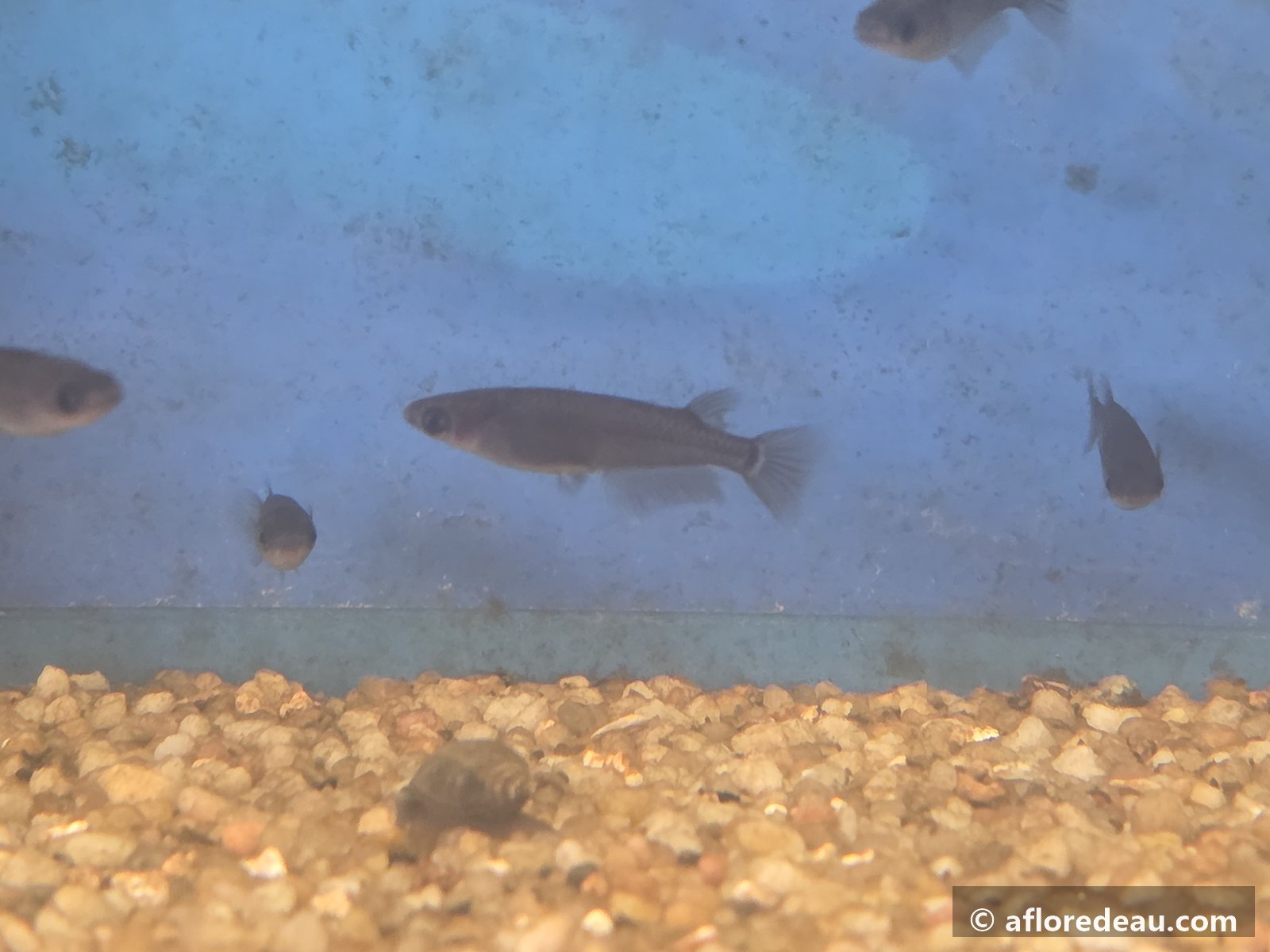
- A basin next to the pond. A container of 20 litres or more, planted, unfiltered, placed at the edge of the pond in partial shade: this is the setup described in keeping medaka outdoors. The medaka live there, spawn there, overwinter there, and the pond keeps its goldfish. Many Japanese gardens are arranged this way: the pond for the koi, basins for the medaka.
- A dedicated pond. A small garden pond with no other fish, with a well-planted zone 20 to 30 cm deep, makes an excellent medaka tank. It needs neither pump nor filter, and the medaka play the goldfish’s role against mosquitoes, only better: see medaka and mosquitoes.
- A separate zone. In a large pond, you can isolate a shallow cove with a low wall or a liner rising above the surface, with its own water. It is a pond within the pond, and it must be truly watertight: a simple grille lets fry through to the goldfish, and the reverse never happens.
In all three cases, fit a fine net over the top, because an isolated medaka tank attracts the same visitors as a pond: see medaka predators.
Good companions for a medaka
Acceptable companions are those that are peaceful, too small to swallow a medaka, and want the same water: dwarf shrimp, ramshorn, pond and mystery snails (the dojō loach of Japanese guides has been banned in the European Union since August 2025; everything is in which animals to keep with medaka). Tokyo Aqua Garden mentions small peaceful tropical fish for the heated aquarium, which does not apply to a pond. No common pond fish in Europe, goldfish, comet, shubunkin, koi, ide, crucian carp, belongs on this list. A medaka pond is a medaka pond.
Key points to remember
| Goldfish, comet, shubunkin | no: harassment even at equal size, predation later, eggs and fry eaten in every case |
|---|---|
| Koi | no, all the more so |
| Very large, heavily planted pond | a few survivors at the edges, no breeding; this is not keeping medaka |
| Solution | basin of 20 L or more next to the pond, or a small dedicated pond, or a watertight cove |
| Possible companions | dwarf shrimp, snails; no pond fish |
Frequently asked questions
My goldfish are 5 cm long. Can I put medaka in for now?
They will chase the medaka from the first day, and they will be 10 cm before the end of the summer. It is not a question of size at the start.
What if I add a lot of plants?
Plants hide the young for a while, but change neither the appetite nor the character of the goldfish. Japanese breeders who have tried say so: it delays, it does not prevent.
Can I put medaka in a pond with no goldfish but with frogs and newts?
An adult newt or a large frog eats fry and sometimes small medaka, and above all their larvae share the water with them. A natural garden pond with amphibians is not a breeding tank, but adults generally live in it; do not expect to harvest fry there.
My medaka survived all summer with the goldfish. Why?
Count them. And check whether you have seen a single fry. A pond where adults survive without ever breeding is not a pond where they live well.
Sources
- Tokyo Aqua Garden, メダカと混泳できない生き物5種: the goldfish harasses the medaka even at equal size, eats what fits in its mouth, plants are not enough, t-aquagarden.com/column/medaka_not_together.
- Tokyo Aqua Garden, メダカと一緒に飼える魚や生き物は何がいる?: “medaka and goldfish are not kept together”, criteria for a good companion, t-aquagarden.com/column/medaka_mix_breeding.
- Medakaya Base, メダカと金魚の混泳はできる?, medakayabase.com.