
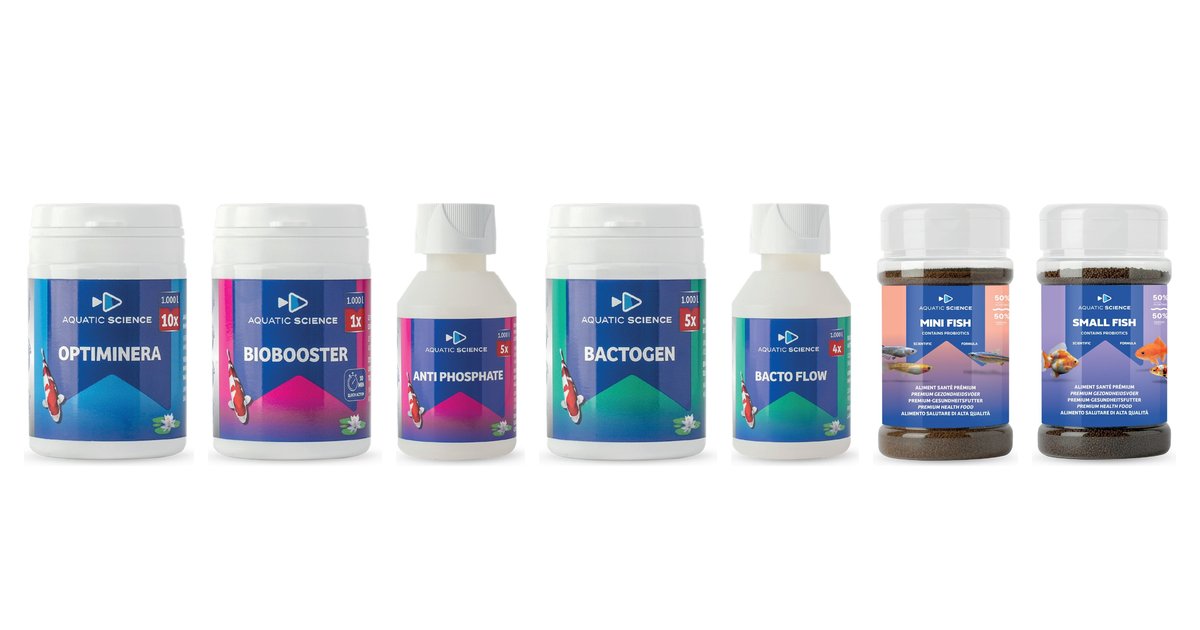
Aquatic Science, a Belgian maker of water treatments and pond fish food, well known to koi keepers, is releasing for 2027 a range designed for small volumes: Small Pond, five water treatments in small tubs, and two foods for small fish, Small Fish and Mini Fish. Here is what the range contains, when each product is useful in a medaka tub, and how to dose for 50 or 100 litres.
A pond brand that comes down to small volumes
Aquatic Science is based in Verviers, Belgium. Its two trades are water treatment and ornamental fish food. Until now, its sizes were aimed at volumes of several cubic metres: garden ponds and koi ponds. Its 2027 catalogue announces two novelties: a range for small ponds and balcony ponds, and a patented nitrate reducer.
The brand organises its products into a four-step programme: mineralise, clean, maintain, feed. The Small Pond range reproduces this programme in small sizes. Each tub is designed for a 1,000 litre pond, which is still a lot for a medaka tub: a single tub holds many doses for a 50 litre tub.
We distribute Aquatic Science in our shop, and we have used its products for years. We sell them, and we say here in which case each one is most useful to a medaka tub.
Mineralise: Optiminera 1.000
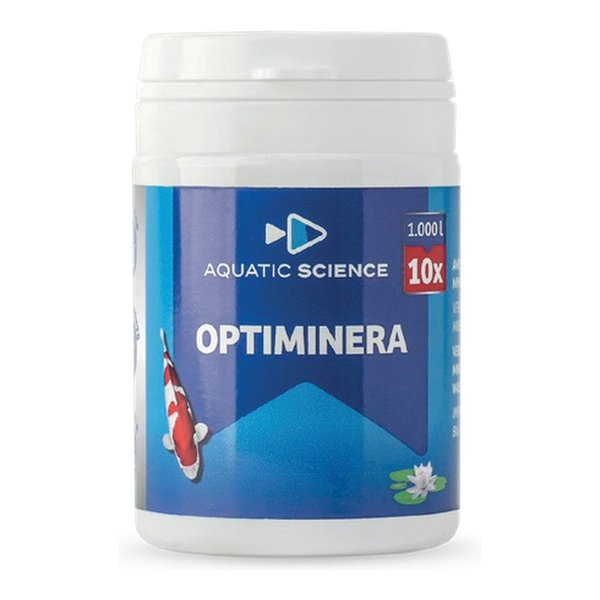
A blend of natural minerals and trace elements that raises and stabilises pH, GH and KH. The manufacturer presents it as ideal for small volumes of water. Dose: 5 g per 1,000 litres. At the scale of the large size, one kilo keeps 20 m³ going all season.
For medaka, it is most useful in soft water, such as that of Brittany, and in a tub filled largely with rainwater, with no carbonate reserve: that is where the pH tips towards acid. In tap water that is already hard, as in limestone regions, it mainly serves to stabilise the water after heavy rain. It does the job of crushed oyster shell, but in a measurable way: shell dissolves quickly in acid water and hardly at all in neutral or hard water, so its effect varies a great deal with the pH of the tub. With Optiminera, you know what you are adding. See water parameters. Optiminera 1.000 product page.
Clean: Biobooster+ 1.000 and Anti Phosphate 100 ml
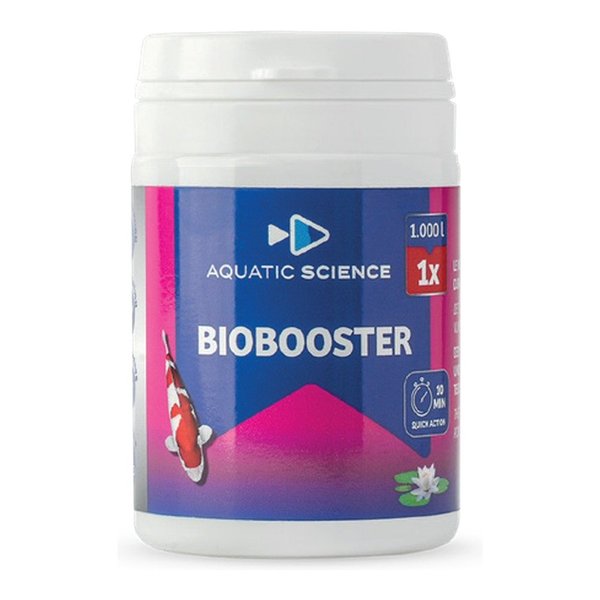
Biobooster+ is a micro-organism activator. It speeds up the breakdown of organic waste, the kind that forms the sludge on the bottom and fouls the water. Dose: 60 g per 1,000 litres, that is the whole tub. It is a safe bet: we have sold and used it for twenty years, and we see its effect after a few hours.
For medaka, it has its place in a tub that has built up sludge over the season, as long as the water is warm enough for the micro-organisms to work. On a very heavily loaded bottom, you start by siphoning out the worst, and Biobooster+ finishes the job. Biobooster+ 1.000 product page.
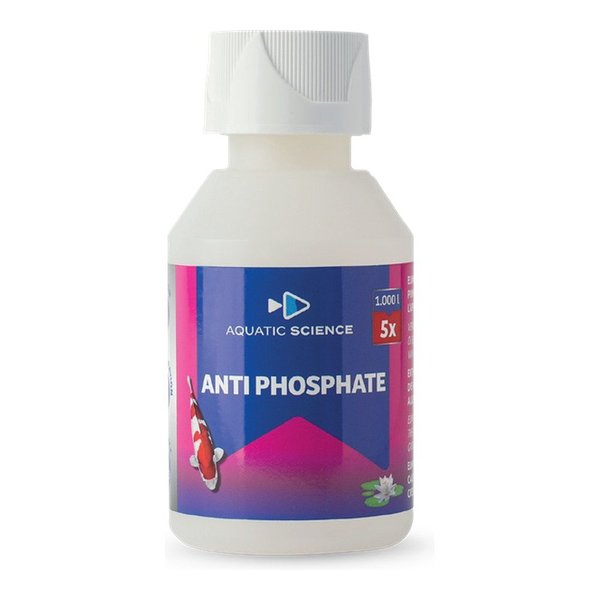
Anti Phosphate binds the phosphate dissolved in the water. Phosphate is the fertiliser of filamentous algae and green water. It is not an algicide: it kills nothing, it removes part of what feeds the algae. Dose: 20 ml per 1,000 litres.
For medaka, it helps a tub overrun with filamentous algae to make a fresh start. It does its best when complemented by fast-growing plants, which take up the rest of the nutrients, and by regular water changes. One reservation: if you want to produce fry in quantity, avoid it in their tub, because the green water that feeds them needs this phosphate. See algae in a medaka tub and green water. Anti Phosphate 100 ml product page.
Maintain: Bactogen 1.000 and Bacto Flow 100 ml
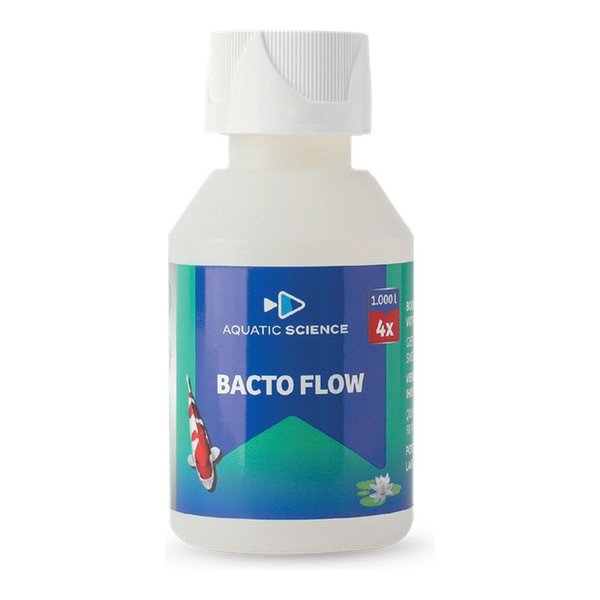
Bacto Flow is a liquid concentrate of sporulated nitrifying bacteria with a fast effect. In spore form, they keep better than live bacteria in a bottle. The manufacturer intends it for starting up and maintaining filtration. Dose: 25 ml per 1,000 litres.
Bactogen is a powder blend of bacteria, minerals and trace elements, for maintaining biological filtration through most of the year. Dose: 5 g per 1,000 litres.
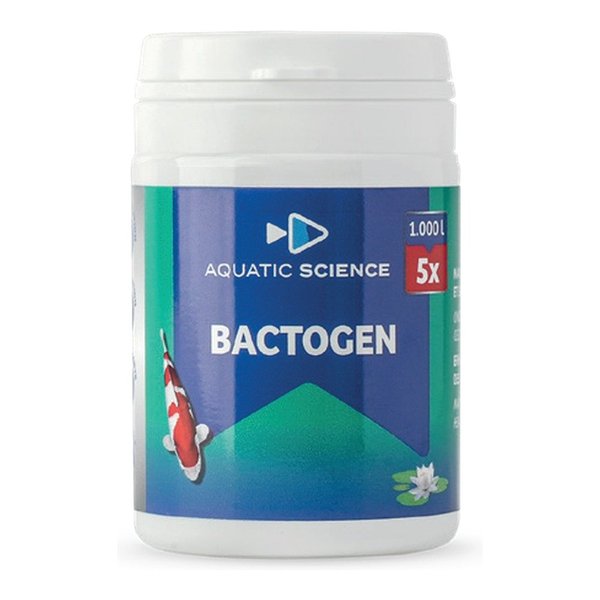
For medaka, very often you start an extra tub in a hurry: a spawning to put somewhere safe, fry to separate, young that have become too numerous. This new tub has no bacteria yet, and that is where the bottles are most useful. Bactogen, the reference in the koi world, suits these young medaka tubs well. Bacto Flow, being liquid, acts quickly at start-up. They shorten the three or four weeks when ammonia and nitrites rise; even so, you introduce only a few fish at the start. Like all bacteria, these work little in cold water: Aquatic Science advises starting a filter when the water is above 10 °C. In a tub that has been running for months, Bactogen maintains the flora, especially after a cleaning or a large water change. See cycling a medaka tub. Bacto Flow 100 ml product page, Bactogen 1.000 product page.
Feed: Mini Fish and Small Fish
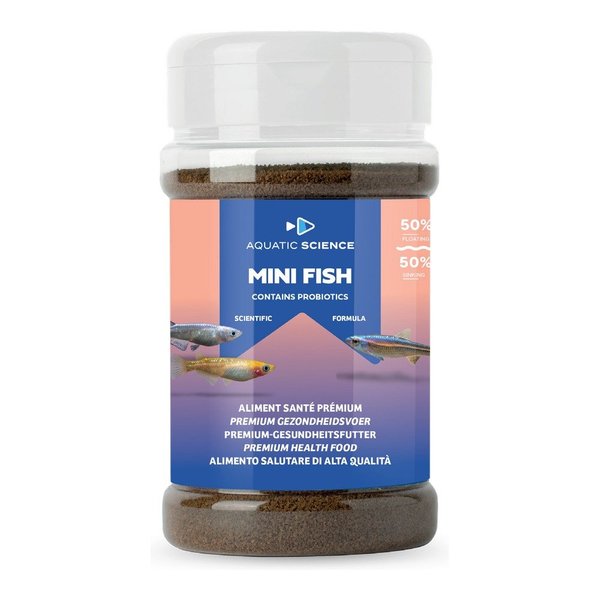
The two foods have the same formula, in two grain sizes: Mini Fish in 0.3 mm, 180 g tub, and Small Fish in 1.1 mm, 220 g tub. The manufacturer states 43% protein, 8% fat, probiotics, and vitamins A, D3, E and C. The base is fish and squid meal, with wheat, broad bean and soya. A particular feature: half the grains float, the other half sink. The instructions advise several small meals a day.
For medaka, it is the Mini Fish. Its 0.3 mm grain falls within the range for young fish of 1 to 2.5 cm, and adults eat it without difficulty.
The part that sinks needs attention. The medaka feeds at the surface, and what falls to the bottom is not eaten: it rots. In a tub of medaka alone, give small pinches and look at what is left on the bottom after three minutes. In a tub that also holds snails or shrimps, the part that sinks feeds them. See feeding medaka. Mini Fish product page.
Grain size, from fry to adult
The grain follows the fish’s mouth. Before one centimetre, a fry swallows 0.2 mm at most, and Mini Fish is still too big for it. For that stage, we sell Hikari’s medaka range, which comes in three grain sizes by age, each shown on the pack:
- Hikari Medaka Baby, 0.2 mm at most, for fry from the first meals;
- Hikari Medaka Next, 0.21 to 0.37 mm, for young of 1 to 2.5 cm, the same range as Mini Fish;
- Hikari Medaka Breed, 0.38 to 0.6 mm, for adults and breeders in the spawning season.
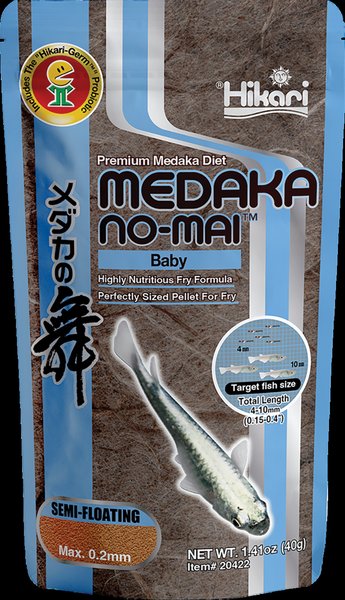
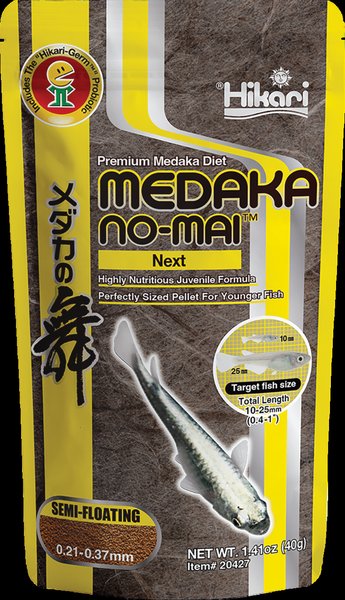
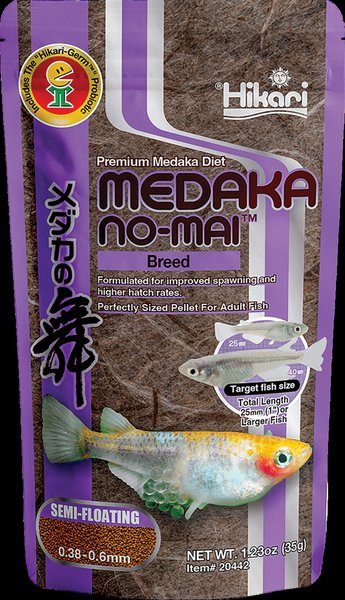
All three are semi-floating, like Mini Fish: the same attention to the bottom applies to them. Moving from one grain to the next is done gradually, by mixing the two for a few days.
Small Fish, for Notropis chrosomus and goldfish
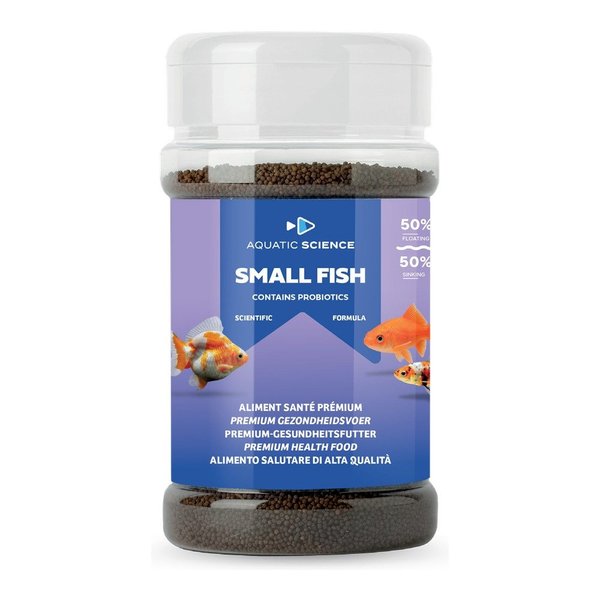
Small Fish, in 1.1 mm, is intended for Notropis chrosomus and goldfish. Notropis, those small American minnows of 5 to 8 cm that live in shoals, live alongside adult medaka in a large pond: you feed them at their own feeding spot, and the medaka keep their fine grain. See medaka and Notropis chrosomus in the same pond and medaka and goldfish. Small Fish product page.
Anti Nitrate: when the replacement water is already loaded
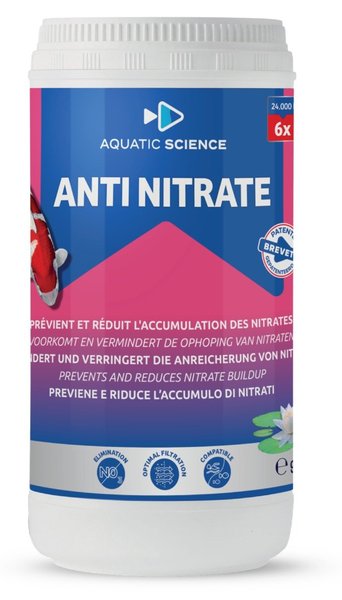
This is the other Aquatic Science novelty for 2027: a patented bacterial formula that prevents and reduces the build-up of nitrates. The manufacturer puts the fish stress threshold above 75 mg/l. Dose: 30 g per 1 m³, that is 3 g for a 100 litre tub. It exists only in large sizes, starting with the 12,000 litre tub, which lasts a long time on one tub.
For medaka, nitrates are normally removed by plants and water changes. That remedy stops working when the water used for the changes is itself loaded: you are then replacing loaded water with loaded water. This is the case with well or borehole water in farming areas, and with some mains supplies whose water is near the drinking-water limit of 50 mg/l. The nitrate level of your tap water appears in the analysis results published by your water supplier. In that case, Anti Nitrate takes over. Elsewhere, plants and water changes do most of the work. Anti Nitrate 12000 product page.
Dosing for a small tub
The manufacturer’s doses are given for 1,000 litres. For a 50 or 100 litre tub, that means fractions of a gram. A kitchen scale will not weigh them: you need a small scale accurate to a centigram, or a graduated syringe for liquids. If in doubt, a little less is better than too much. The frequency of application is shown on each label.
| Product | Manufacturer’s dose | 50 L tub | 100 L tub |
|---|---|---|---|
| Optiminera 1.000 | 5 g per 1,000 L | 0.25 g | 0.5 g |
| Biobooster+ 1.000 | 60 g per 1,000 L | 3 g | 6 g |
| Anti Phosphate 100 ml | 20 ml per 1,000 L | 1 ml | 2 ml |
| Bactogen 1.000 | 5 g per 1,000 L | 0.25 g | 0.5 g |
| Bacto Flow 100 ml | 25 ml per 1,000 L | 1.25 ml | 2.5 ml |
| Anti Nitrate | 30 g per 1,000 L | 1.5 g | 3 g |
The points to remember
| New tub or one set up in a hurry | Bactogen and Bacto Flow |
|---|---|
| Soft water or rainwater | Optiminera, more consistent than oyster shell |
| Sludge | Biobooster+, effect visible within a few hours |
| Filamentous algae | Anti Phosphate, complemented by plants and water changes; avoid it in the fry tub if you want to produce fry in quantity |
| Food for medaka | Hikari Medaka Baby before 1 cm; Mini Fish 0.3 mm or Hikari Medaka Next from 1 to 2.5 cm; Mini Fish or Hikari Medaka Breed after that |
| Notropis and goldfish | Small Fish 1.1 mm, at a separate feeding spot |
| Anti Nitrate | only if the water for changes is already loaded with nitrates |
Frequently asked questions
Do you need to use the whole range?
No. A well-planted, lightly stocked medaka tub that is fed sparingly can run without any product at all. The range adds security at delicate moments: a tub set up in a hurry, water that is too soft, sludge, algae, replacement water loaded with nitrates. You choose the product that answers the situation of the tub.
Are these products safe for medaka?
They are bacteria, minerals and a phosphate binder, not medicines or algicides. The risk comes from overdosing, which is easy in a small volume: hence the scale and the syringe.
Is Mini Fish suitable for fry?
From about one centimetre. Before that, the 0.3 mm grain is too big: you need Hikari Medaka Baby, paramecia or green water. See raising medaka fry.
Can you keep a tub open from one season to the next?
The best-before date is on the packaging. A 1,000 litre tub lasts a long time in a 50 litre tub: close it well and store it dry, away from heat.
Sources
- Aquatic Science, 2027 catalogue “Traitement naturel de l’eau et aliments pour poissons d’ornement”, Verviers, pages 12 to 41: four-step programme, Small Pond range, Small Fish and Mini Fish foods, Anti Nitrate, doses and compositions.
- Kyorin (Hikari), Medaka Baby, Next and Breed packs: grain size by stage, semi-floating food.
- Directive (EU) 2020/2184 on the quality of water intended for human consumption: nitrate limit of 50 mg/l.
- Aquatic Science, aquatic-science.com.
- medaka.fr fact base: grain size by fish size, surface feeding, cycling a tub, soft water and pH.