
A new tank is not ready on the day it is filled. It takes about four weeks for the bacteria that turn the ammonia in droppings into barely toxic nitrates to establish themselves in sufficient numbers. During that time, the water poisons the fish with nothing visible to show for it. This guide explains the nitrogen cycle in simple terms, how to tell when the tank is ready, how to speed up the start-up, and which actions break an established cycle.
The nitrogen cycle in three steps
A medaka eats, digests, excretes. Its droppings, leftover food and dead leaves break down into ammonia. Ammonia is the first poison in the tank. In small amounts, it burns the gills and skin. In larger amounts, it kills within a few days.
A first family of bacteria consumes this ammonia and turns it into nitrite. Nitrite is less toxic than ammonia, but still dangerous. It blocks the transport of oxygen in the blood. A fish breathing fast just under the surface in clear water is often suffering from nitrite poisoning.
A second family of bacteria turns nitrite into nitrate. Nitrate is only weakly toxic. Plants absorb it as fertiliser. What is left is removed by water changes. The complete chain reads like this: droppings, ammonia (strong toxicity), nitrite (medium toxicity), nitrate (low toxicity). This is nitrification (t-aquagarden). A “cycled” tank is one where this chain runs smoothly.
Ammonia is even more dangerous when the pH is high, which is the case with hard, limy tap water. See water parameters.
Why a new tank kills
In a tank that has just been filled, these bacteria exist only in traces. The first fish produce ammonia from their first meal, and nothing consumes it. Then the first family multiplies, ammonia falls, and nitrite rises in its turn, because the second family is slower to establish. The tank goes through two successive peaks. t-aquagarden places the most toxic period in the first three weeks and gives a complete cycle in about four weeks.
The trap is that the water stays clear. The fish die one by one between the fifth and the twentieth day, and the beginner concludes it is a disease or a bad strain. This is “new tank syndrome”. A balcony bowl filled on Saturday and stocked on Sunday goes through the same scenario.
How long start-up lasts
Allow four weeks at seasonal temperature. Tokyo Aqua Garden places the activity of nitrifying bacteria between 20 and 30 °C, at its best around 25 °C; below that range everything slows down, and at 0 °C they survive without working. An outdoor tub started in March in a mild Atlantic climate, with water at 10 or 12 °C, therefore takes clearly longer than one started in May, though no number of weeks can be given.
The best schedule is to prepare the tank before the fish: filled in March, planted in April, stocked in May. For a filterless biotope, t-aquagarden advises 7 to 10 days with the water in before the first fish, then a month of observation with only a few fish before increasing the population. If the fish are already there, compensate with water changes: a third of the volume every two to three days for the first three weeks, with water at the same temperature and dechlorinated (t-aquagarden).
Speeding up start-up

Mulm from a healthy tank. A handful of substrate, a filter medium squeezed out in a bucket, or the brown deposit from the bottom of a tank that has been running for months contain millions of bacteria ready to work. Transfer them to the new tank without letting them dry out. Check that the donor tank is healthy: no sick fish, no treatment under way.
A substrate and supports. Bacteria live attached to surfaces, not in open water. Sand, gravel, terracotta, ceramic, filter foam, roots, stones: the more porous surface the tank offers, the larger the colony (t-aquagarden).
Plants. They arrive with their own bacteria and consume part of the ammonia and nitrate. Elodea, Ceratophyllum, Najas, frogbit at the surface. Never water hyacinth or water lettuce, which are banned in the European Union.
Oxygen. Nitrifying bacteria need a lot of oxygen (t-aquagarden). Gentle surface movement speeds up start-up. Without a pump, a large area of open water and plants do the job.
Bottled bacteria. Commercial strains seed the tank. They do not remove the need to wait, but they shorten the delay and cushion the peaks. Medaka PSB is added when starting a new tank and after a heavy clean. In a small format for tubs and balcony ponds, Aquatic Science’s Small Pond range also offers Bacto Flow 100 ml, spore-forming nitrifying bacteria for start-up, and Bactogen 1.000 for maintenance. Quite often you set up an extra tank in a hurry, for a spawning to shelter or fry to separate: Bactogen, the reference in the koi world, suits these young medaka tanks well. See our introduction to the range, with doses for 50 and 100 litres.
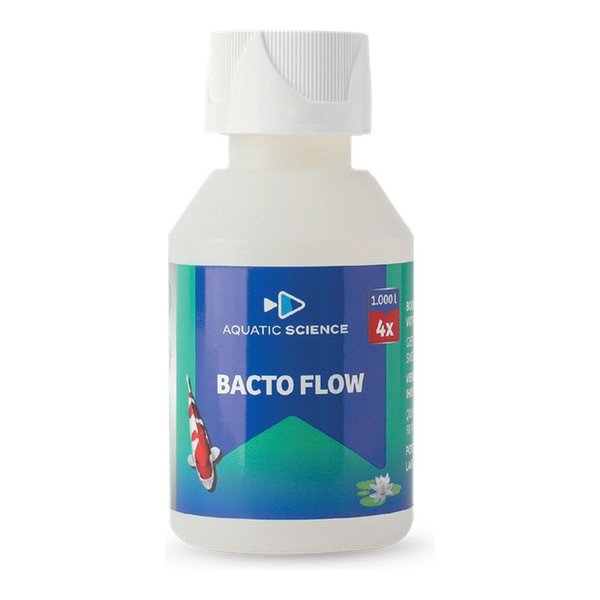
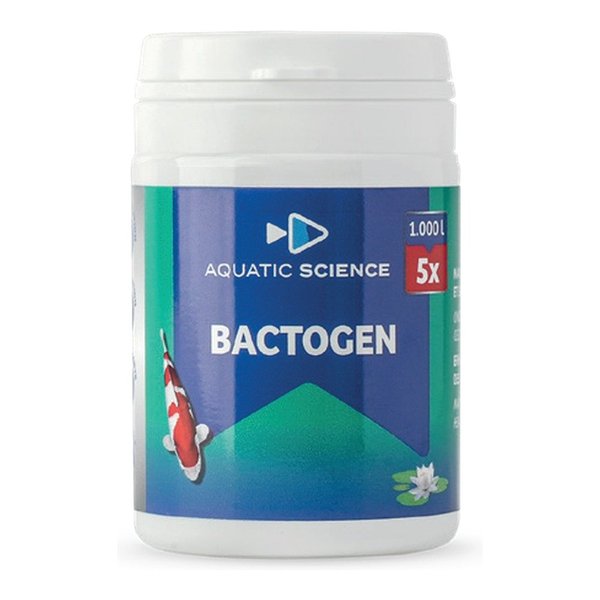
Feed little. One light meal a day during start-up: every extra pinch becomes ammonia.
Knowing the tank is ready
The only reliable method is testing. Strips or drop tests for ammonia, nitrite and nitrate take a minute. The tank is cycled when ammonia and nitrite are at zero two days running while the fish eat normally, and nitrate has started to rise. Nitrate is the proof that the complete chain is working.
Without a test, observe: water that stays clear between changes, a light brown deposit on the bottom, plants that grow, fish swimming at mid-height instead of staying glued to the surface. Whitish water in the first few days is a sign of start-up, not of failure: it is a peak of free-floating bacteria that calms down by itself, without a water change.
Actions that break the cycle
An established cycle is robust, but a few common actions destroy it within an hour.
- Rinsing the filter under tap water. The chlorine kills the bacteria in the filter medium. Rinse a foam in a bucket of tank water, never under the tap, and never all the media at once.
- Changing too much water at once. A change of more than half the volume, or a complete wash of the bottom, removes a large share of the colony and changes the parameters abruptly. A third at a time is enough. See water changes.
- Treating in the tank. Many medicines, salt at a high dose and methylene blue also kill the bacteria. A sick fish is treated in a hospital tank. See medaka diseases.
- Leaving the filter off. Without circulation, the bacteria in the filter medium die from lack of oxygen, which harms them more than cold does according to Tokyo Aqua Garden. No time limit is published; as a precaution, after a breakdown of several hours, rinse the medium in tank water before restarting and watch the ammonia over the following days.
- Overstocking all at once. Doubling the population doubles the ammonia, and the colony follows several days behind. Add the fish in small groups.
Without a filter, where the bacteria live
Most outdoor medaka tubs have no filter, and they work. Bacteria need surface and oxygen, not a device. In a tub, they colonise the substrate, the walls, the plants and the deposit on the bottom. Plants complete the work by absorbing nitrate, which partly replaces water changes (t-aquagarden).
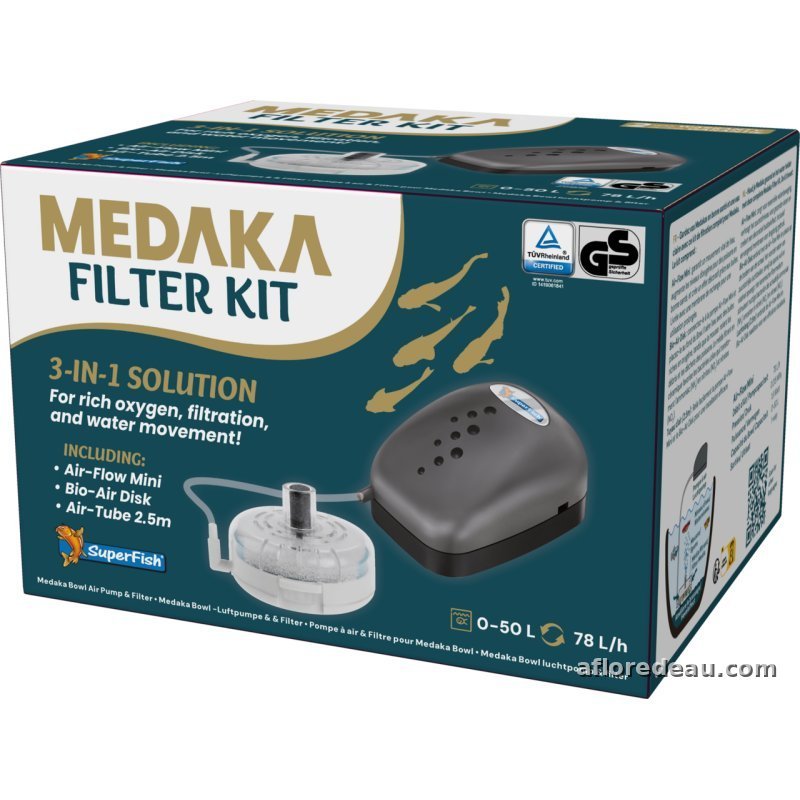
The counterpart is density: fifteen medaka at most for a 60 cm tank without a filter, against twenty to thirty with one (t-aquagarden). The site’s benchmark remains one litre per fish at the minimum, preferably two outdoors without a filter. Indoors, a lightly planted aquarium with no pump degrades fast, and t-aquagarden does not recommend it. There, a small filter is the simple solution. The Medaka Filter Kit is designed for a small medaka tank: we recommend it up to about fifty litres, with plants and a substrate on the bottom of the tank, which serve as additional bacterial support.
See also the set-up guide and the tub, the bowl and the biotope.
The figures to remember
| Duration of a complete cycle | About 4 weeks at 20 to 26 °C (t-aquagarden) |
|---|---|
| Most toxic period | Weeks 1 to 3, ammonia peak then nitrite peak |
| Temperature favourable to the bacteria | 23 to 26 °C (t-aquagarden) |
| Water changes if the fish are already there | A third every 2 to 3 days for 3 weeks |
| Filling a biotope before the fish | 7 to 10 days, then 1 month of observation before increasing the population |
| Density without a filter | 1 litre per fish at the minimum; 15 medaka at most in a 60 cm tank (t-aquagarden) |
| Tank ready | Ammonia 0, nitrite 0, nitrate rising, fish fed normally |
Frequently asked questions
Can you cycle a tank without fish?
Yes, it is the safest method. A pinch of food every two days breaks down into ammonia and feeds the bacteria. When nitrite is at zero and nitrate rising, change a third, then add the first fish.
Does an outdoor tub need cycling?
Yes. Sun and plants help, but the bacteria need the same amount of time. Fill in March, plant in April, stock in May.
The tank is cloudy after a week. Should I change the water?
No. It is a peak of free-floating bacteria that clears by itself; feed little and wait. Green water is something else: see green water.
Should I remove the brown deposit on the bottom?
Not entirely. This mulm houses part of the colony. Siphon out the excess, never all of it, and never on the same day as a filter rinse.
Sources
- t-aquagarden, column “medaka_bacteria” (bacteria in keeping medaka), https://t-aquagarden.com/column/medaka_bacteria
- t-aquagarden, column “medaka_goldfish_filter_need” (do medaka and goldfish need a filter), https://t-aquagarden.com/column/medaka_goldfish_filter_need
- t-aquagarden, column “medaka_no_pump” (keeping medaka without a pump), https://t-aquagarden.com/column/medaka_no_pump
- medaka.fr fact base (WEB図鑑, Kamihata): density of one litre per fish.