
The medaka is an outdoor fish. A tub of 30 L or more, in the sun for part of the day, planted, without a filter and with no more than one fish per litre, is enough for it to live, develop its colours and breed. Upkeep comes down to topping up the water, one water change a month and a net against predators.
Why outdoors
Oryzias latipes comes from the rice paddies and ditches of Japan. It evolved in shallow water, warmed by the sun by day, cooled at night, with no current. An outdoor tub reproduces these conditions far better than an aquarium. Japanese breeders note that the sun strengthens both the colour and the health of the fish, and that outdoor keeping does away with the need for a filter. This is also how we breed at home in Lesneven: the breeding tubs are outside from March to October.
The sun brings two specific things. First, colour: a Youkihi (楊貴妃) raised outdoors on a dark background is redder than an aquarium Youkihi, because natural light and a dark background stimulate colour-up. Second, breeding: spawning is triggered by 13 to 14 hours of daylight, which the sun provides for free from April to August.
Choosing the container: tub, bowl or biotope
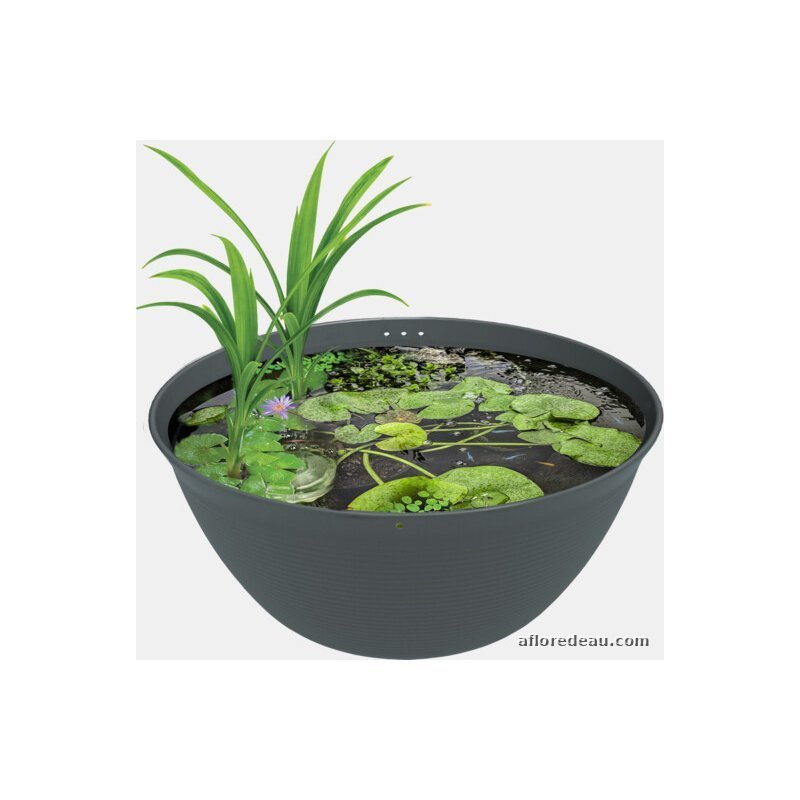
There are three families of container, all of them valid.
The polystyrene or plastic tub. This is the breeders’ choice: light, insulating, opaque and inexpensive. A 30 to 60 L tub in expanded polystyrene keeps the temperature stable and gets through the winter. It is not pretty, but the fish do not care.
The bowl. The water-lily pot (睡蓮鉢, suirenbachi) is the traditional Japanese bowl, in ceramic or resin, wide and shallow. It is viewed from above, which is the right way to look at an improved medaka. Resin models are light and hold up to the cold better than ceramic. Self-supporting containers such as the Medaka Bowl 420 (16 L) and Medaka Bowl 600 (36 L) are in the same spirit: the 420 suits a small group in the growing season, and the 600 is the minimum for overwintering outdoors.
The balcony biotope. For a balcony, choose a light container of large volume, in resin rather than ceramic. Japanese sources mention containers of 40 × 40 cm. Stand it against the wall of the building, sheltered from the wind, and check that the floor can bear the weight: 40 L of water is 40 kg, plus the container and the substrate. Avoid any spot where it could overflow onto the neighbour below.
In every case, avoid glass outdoors: it heats up, it freezes, it breaks. A dark bottom and dark sides bring out the colours of most varieties, except greens and lamé types, which are shown off by white. A Black Dragon that is not of the Orochi line fades on a light background.
Position: sun and shade
The right spot gets sun for part of the day, 6 to 8 hours according to balcony-biotope breeders, with shade in the hot hours. Intermittent sun is better than full midday sun from noon to four o’clock. Outdoors, the water in a tub can climb to 35 °C in summer, while the medaka is stressed from 30 °C. A reed screen laid over half of the tub is the simplest solution.
In a mild Atlantic climate such as ours in Brittany, you look for sun: a south-facing wall, no cast shade. In Mediterranean and other hot-summer regions, you look for afternoon shade: an east-facing wall, a pergola. In continental and northern climates, do as we do in Brittany, while watching for the July heat peaks. Everywhere, avoid the spot under a deciduous tree, which fills the tub with leaves in autumn, and any place where rainwater from the roof pours into the tub.
No filter: plants and bacteria do the work
A well-designed outdoor tub has no filter. Nitrifying bacteria, settled on the substrate and the sides, convert the ammonia in the droppings into nitrites and then nitrates, and the plants consume those nitrates. The medaka does not like current, and a powerful filter tires it.
The bacteria take about 4 weeks to establish. During the first 3 weeks, the water accumulates toxic compounds. They work well between 23 and 26 °C, slow down below 18 °C, and give way to other microbes above 27 °C. Two consequences follow. Start the tub in spring, as the water warms up, not in the middle of winter. And during the first month, change a third of the water every 2 to 3 days, or a fifth to a third regularly over the first 3 weeks, while the cycle establishes itself. Introduce only a few fish at the start, because their droppings feed the bacteria. Never clean everything at once. Bottled bacteria, Bactogen or Bacto Flow from Aquatic Science, shorten this delay: see cycling a medaka tub and our presentation of the Aquatic Science Small Pond range, designed for small volumes.


A substrate helps. Akadama, the red Japanese clay in 3 to 6 mm granules, laid 5 cm deep if you plant, gives the bacteria a large surface and suits plants. Fine gravel or river sand will also do.
Plants
They shade, oxygenate, absorb nitrates, serve as spawning support and hide the fry. Kamihata’s Japanese ratio is 10 cm of plant for 1.5 L of water. The species that work outdoors in Europe: hornwort, mare’s tail and spiked water-milfoil, which grow fast and overwinter; Java moss on a stone; and, as a floating plant, frogbit. Cabomba, once common, is banned in Europe. The species-by-species detail is in which plants to put with medaka. For floating plants, the Japanese use water hyacinth, but its sale has been banned in the European Union since 2016 (invasive species): replace it with frogbit (Hydrocharis morsus-ranae), a native floating plant that overwinters on the bottom as buds. Water lettuce (Pistia) is banned as well. Duckweed quickly covers the whole surface and can be skimmed off with a net.
Never cover the whole surface: the bottom needs light and the surface needs gas exchange. A third to a half of the surface planted is a good measure.
Green water: an ally to dose carefully
Green water (グリーンウォーター) is water laden with phytoplankton. In Japan it is sought after: it feeds the fry continuously, stabilises the temperature and hides the fish from aerial predators. It appears on its own in a sunny tub without plants within 2 to 3 months. You can speed it up to a few days with concentrated chlorella, at 1 mL per 10 L, in a sunny, aerated tub with no substrate or plants.
The right density is judged by eye: you should still be able to make out the bottom of the tub. Too dense, and it uses up oxygen at night and the fish gasp at the surface in the morning. It also hides dragonfly larvae. It breaks down above 30 °C. If it smells bad, that is a sign of a drift towards cyanobacteria, and you change part of the water. Dilute it with successive water changes, never all at once. For fry, light green water is better than opaque water.
Topping up rather than changing
This is the maintenance principle of the outdoor tub. Summer evaporation lowers the level, and you top it up. The added water is dechlorinated, meaning left to stand for 24 hours outdoors in a bucket, and at the same temperature as the tub. Pour slowly, in the morning or around midday, never at dawn or dusk, and stop before it overflows. Do not add water during a treatment or a salt bath, as that dilutes the product.
Topping up keeps the quality stable and avoids shocks. It does not replace everything: a water change of a quarter to a third, about once a month in the season, removes what the plants have not consumed. In winter, no water changes, only top-ups.
Density and feeding
The rule is a minimum of 1 L per fish. A 60 cm tank, about 55 L, takes 50 to 60 medaka at most, and far fewer if you want fish in top condition and clean water. At our place, a 36 L Medaka Bowl 600 comfortably houses about fifteen adults.
Feeding is set by temperature: one to two meals a day, two in summer, in an amount eaten in two to three minutes, and nothing below 10 °C. Outdoors, the fish also find mosquito larvae, daphnia and algae, and eat less dry food than in an aquarium. The detail is in the feeding guide.
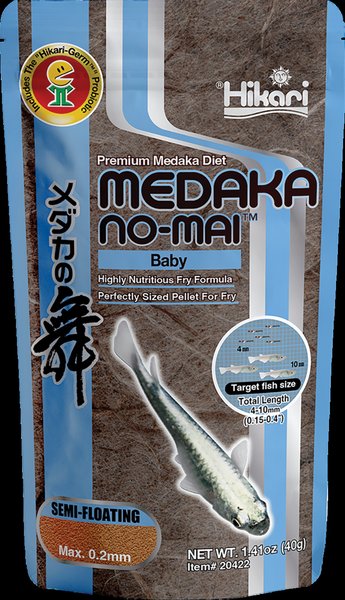
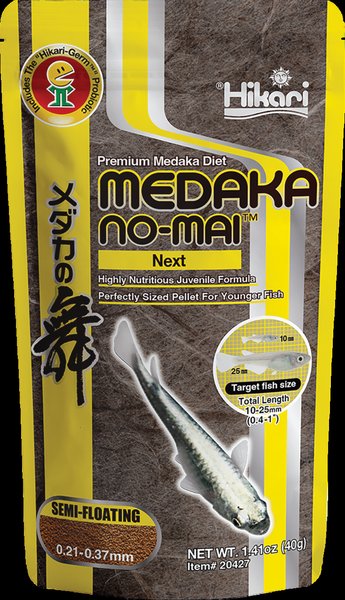
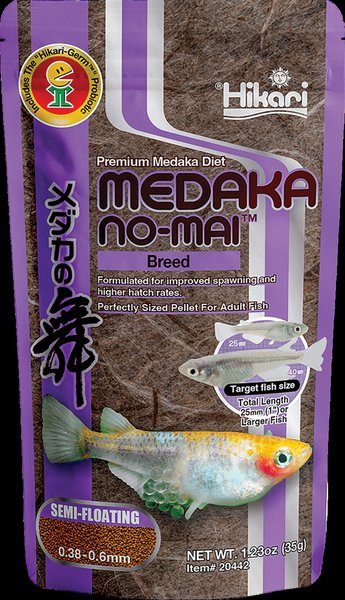
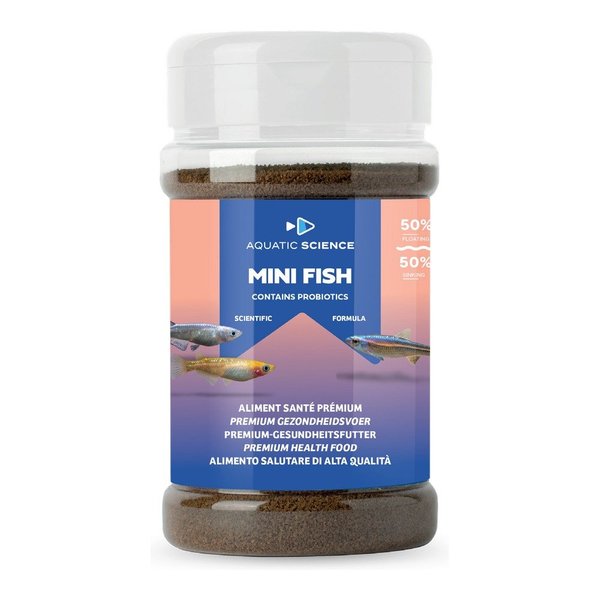
As for food, Hikari’s medaka range covers every age: Medaka Baby for fry, Medaka Next for juveniles, Medaka Breed for adults in the spawning season. Aquatic Science’s Mini Fish, in 0.3 mm, suits juveniles and adults alike. See our presentation of the Aquatic Science range.
Protecting the tub
The first predator is the dragonfly larva (ヤゴ, yago). Dragonflies lay through a net placed over the water, so raise the net by 5 cm. Next come cats, herons, kingfishers, crows and, for the fry, newts and hydra. A fine-mesh net on a frame, such as the Medaka Cover Net, deals with most of it. The predator guide goes through each case.
The net also keeps out leaves and limits evaporation. It goes on in April and stays until the frosts.
The figures to remember
| Volume | 16 L for a small group in the season; 30 L and a deep zone to overwinter outdoors |
|---|---|
| Density | 1 L per fish at a minimum |
| Sunshine | 6 to 8 hours, with shade in the hot hours; reed screen over half of the tub in summer |
| Bacterial cycle | about 4 weeks; changes of a third every 2 to 3 days at start-up |
| Plants | 10 cm of plant per 1.5 L; a third to a half of the surface |
| Green water | 1 mL of chlorella per 10 L; the bottom must stay visible |
| Upkeep | top-ups of dechlorinated water at the same temperature; one change a month in the season; none in winter |
| Net | raised by 5 cm against dragonflies |
Frequently asked questions
Do you need an air pump outdoors?
Not usually. The plants and the surface are enough. Gentle aeration helps only in summer, in a heavily stocked tub or in dense green water. A strong current tires medaka.
Is rainwater suitable?
It is chlorine-free and often soft, which is an advantage. It can be acidic or carry whatever it has washed off the roof. Use it for top-ups, avoiding the first rains after a long dry spell.
My water is cloudy and brown, not green: what should I do?
It is usually too much food or decomposing leaves, often in the first month. Reduce feeding, remove the debris, and change a third of the water every 2 to 3 days until the water clears.
Can you mix several varieties in an outdoor tub?
They live together without trouble, but they interbreed. If you want to breed a variety, keep one tub per variety. See the breeding guide.
Where should I start?
A tub of 30 L or more, a substrate, two or three plants, four weeks of patience, then a small group of a hardy variety such as the Youkihi. The complete step-by-step is in the set-up guide.
Sources
- Tokyo Aqua Garden, “メダカの屋外飼育”: https://t-aquagarden.com/column/medaka_outdoor_breeding
- Tokyo Aqua Garden, “ベランダビオトープ”: https://t-aquagarden.com/column/biotope_balcony
- Tokyo Aqua Garden, “グリーンウォーター”: https://t-aquagarden.com/column/green_water
- Tokyo Aqua Garden, “メダカとバクテリア”: https://t-aquagarden.com/column/medaka_bacteria
- Tokyo Aqua Garden, “足し水”: https://t-aquagarden.com/column/medaka_water_injection
- medaka.fr fact base (Kamihata, WEB図鑑): density, plant ratio, dark background, predators.
- Medaka-keeping guide, afloredeau.com (À Flore d’Eau, Gabriel Gayrin): 30 L and a deep zone for winter.