

Black Dragon is a trade name. It describes an all-black medaka, from snout to fins, sold under that name in Europe without reference to any specific Japanese variety. Behind the name sit several Japanese black lines, Orochi (オロチ), Black Diamond or Pure Black, which do not behave the same way in a pale tank. It is a fish for beginners, provided you know what you are buying.
Identity card
| Name | Black medaka · 黒メダカ / オロチ · Kuro medaka / Orochi depending on the line |
|---|---|
| Trade name | Black Dragon (a seller’s name, not a JMA variety) |
| JMA classification | black · transparent scales if Orochi line · black eyes · no iridophores, or lamé if Black Diamond line · no pattern · normal fins · normal type |
| Origin | Trade name; our batch is imported from the Netherlands, and the supplier does not document the original Japanese line. Candidate lines: Orochi (2016, Nara Prefecture), Black Diamond (February 2018, Kanagawa), Pure Black (2001, Ōba Sachio). |
| Adult size | 3 to 4 cm |
| Temperature | 5 to 30 °C tolerated; breeding from 18-20 °C; shade it in summer, as black absorbs heat |
| Difficulty | Beginner: the Orochi and Black Diamond lines are robust and spawn well |
| Recommended background | Makes no difference for our batch, which stays black on a white background; dark to be safe for a batch of unknown origin |
Recognising a Black Dragon
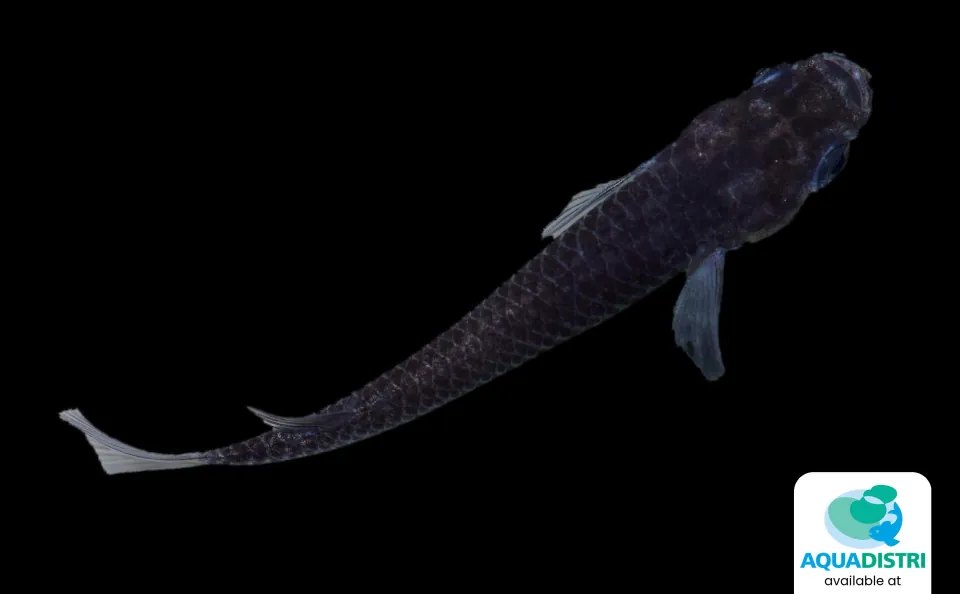
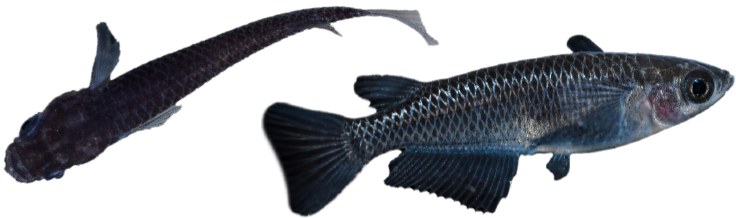
An ordinary black medaka is brown-black on the back and paler under the belly. It is the cultivated form closest to the wild fish, called Kuro medaka in Japan. The Black Dragon sold in pet shops is darker than that. It comes from one of the lines selected in Japan for a deep, uniform black.
Three lines share the market. The Orochi appeared in 2016 in Nara Prefecture, by selecting the darkest individuals among the so-called super-black medaka. Its eyes, fins and belly are black, and its transparent scales strengthen the colour. Its particularity is that it does not react to the background: placed in a white container, it stays black. Other black medaka turn pale in these conditions, because the fish adapts its colour to its surroundings.
The Black Diamond was born in February 2018 at the breeder Nakasato, in Kanagawa Prefecture. It is a cross between Orochi and Seiga, a blue lamé Miyuki known in Europe as Star River. It keeps the Orochi’s background-proof black and adds scattered blue-violet lamé scales on the back. Its fixation rate is close to 80% according to JASMA.
The Pure Black, or Kurobee, is older: created in 2001 by Ōba Sachio, the author of the Youkihi, it carries number 0446 in the WEB図鑑. Its black holds on a pale background for another reason: its pupils are very small, its sight is poor, and it does not perceive the colour of the container. This line is not fixed, it is rare and difficult to feed. A commercial batch is unlikely to come from it.
To find out which line a batch belongs to, simply place a few fish in a white container for a day. If they turn grey, they are ordinary blacks, to be kept on a dark background. If they stay black with glitter on the back, it is a Black Diamond. If they stay black with no glitter and eyes of normal appearance, it is an Orochi or a close relative. The old product page in our shop described the Black Dragon with shiny scales, which points towards the Black Diamond.
We ran the pale-background test on our September 2026 batch, in a white holding tank: the fish stay black, at most slightly lighter than in a dark tank, fins included. An ordinary black would have paled clearly within a few minutes. This is the behaviour of a line that does not react to the background, hence of Orochi ancestry.
Keeping the Black Dragon
Nothing sets its care apart from that of other medaka: at least 1 litre per fish, water at pH 7 to 8, weekly water changes of 10 to 20%. The tank setup guide covers all of this.
One point deserves attention: a black body absorbs solar radiation. In an outdoor container, shade half of the surface in summer, with a reed screen for instance. The 30 °C limit remains the recommended ceiling for all medaka, and black reaches it sooner.
On the choice of background, the test described above settles it. A batch that keeps its black can live in a pale tank or a white basin, where it stands out by contrast. A batch that turns pale must stay on a dark background, otherwise it goes dull within a few days.
Breeding the Black Dragon
The Orochi and Black Diamond lines have a high fixation rate. Pairs spawn abundantly and the offspring stay mostly black. The general breeding method applies: spawning mop, egg collection, incubation at 250 degree-days, or about ten days at 25 °C.
When sorting, keep the young whose black also covers the belly and fins. If the batch is of the Black Diamond type, also keep those carrying the most lamé on the back. Fry that turn pale in a light container are kept away from the breeders. The current batch has not yet spawned with us; we will complete this page with the first generation born in Lesneven.
Our Black Dragon in photos and video
Black Dragon 2.7-3 cm, September 2026 batch in a holding tank. On a white background, they stay black. Photos and video taken at our shop in Lesneven.


Similar varieties
- Panda: transparent scales and a black ring around the eye, but a pale body.
- White Black: white spotted with black, the black is only a pattern.
- Orange Black: the same principle on an orange base.
- Blue: pale grey-blue, often mistaken for a faded black.
Frequently asked questions
My Black Dragon is turning grey. Is it ill?
No. An ordinary-line black medaka adapts its shade to the colour of the background. On a pale background it fades, on a dark background it darkens again. Only the Orochi and its derivatives keep their black everywhere.
Is the Black Dragon an Orochi?
Black Dragon is a seller’s name that matches no JMA variety. The white-container test tells you, and our September 2026 batch passed it: it stays black, which ties it to the Orochi line.
Can it winter outdoors?
Yes, like other medaka, in a container of at least 30 litres with a deep zone, stopping feeding below 10 °C. See the page on overwintering.
How much does it cost in Japan?
An Orochi sells for 400 to 1,000 yen each in Japan, a Black Diamond a few hundred yen in ordinary quality. These are orders of magnitude, not a reference for European prices.
Sources
- Tokyo Aquagarden, “オロチメダカとは”, t-aquagarden.com/column/orochi_medaka
- JASMA, “ブラックダイヤ メダカ”, jasma.sc/medaka/blackdaia/
- 改良メダカWEB図鑑, “黒べえ(ピュアブラックメダカ) No.0446”, medakazukan.net/0446_kurobee/
- TAG, medaka breeding guide, cited via the medaka.fr editorial base (Orochi 2016, Black Diamond = Orochi × Star River, background and colour)
- afloredeau.com medaka guide (water parameters, overwintering in Brittany)