
The white medaka, Shiro medaka (白メダカ), is one of the oldest varieties of improved medaka, known in Japan since the Edo period. It has lost the black pigment and the yellow pigment; all that remains is white, which is rare in a fish. Of normal type, with no reflection or pattern, it is gentle on the eye and easy to live with.
Identity card
| Name | White medaka · 白メダカ · Shiro medaka; WEB図鑑 entry no. 0043 |
|---|---|
| Trade name | White medaka; “White medaka” or “Pearl” at some importers |
| JMA classification | white (白) · normal scales · normal eyes · no particular iridophore · no pattern · normal fins · normal type |
| Origin | Edo period, no attributed creator. Two modern stages: the “Milky”, a more intense white, around 1969; the Pure White (雪小町), in which males and females are all pure white, selected from 2003 by Ōba Sachio after the discovery of a male among several thousand fish (WEB図鑑). |
| Adult size | 3 to 4 cm |
| Temperature | Tolerates 5 to 30 °C; breeding from 18-20 °C, optimum 20-25 °C |
| Difficulty | Beginner: its reputation for fragility is not confirmed |
| Recommended background | Dark: the white stands out; shade part of the tank in summer |
Recognising a white medaka
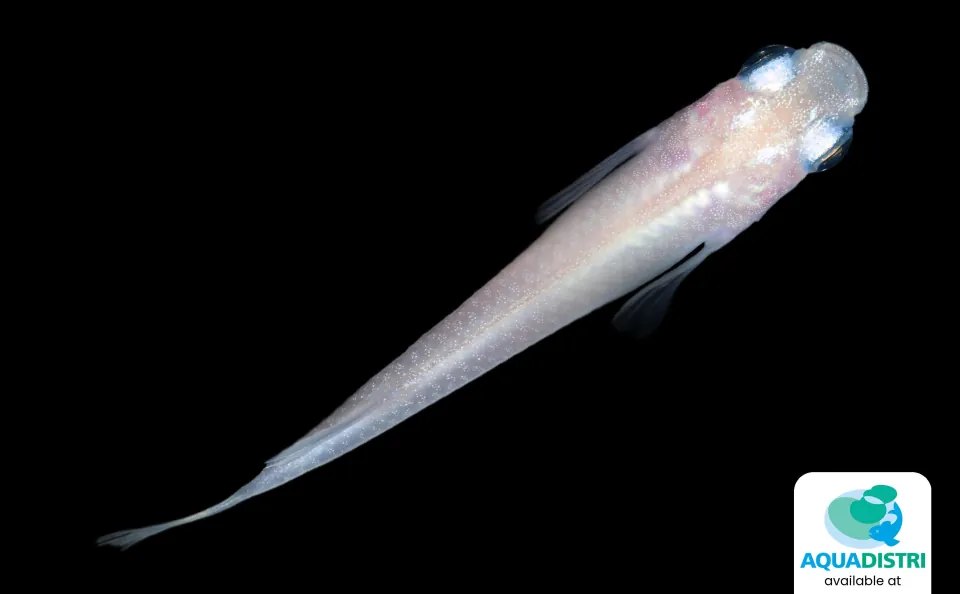
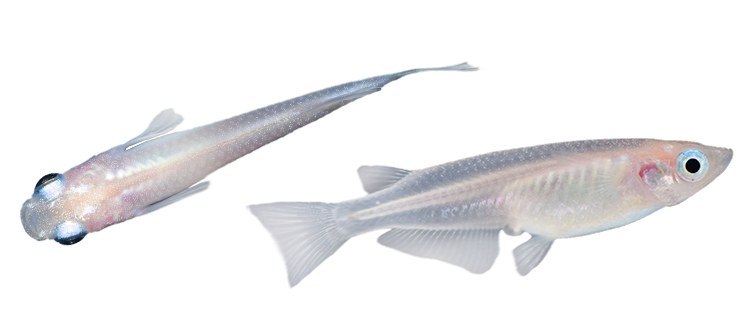
A white medaka is white from head to tail, with transparent fins and black eyes. The black eyes are the point to check: a white fish with red eyes is an albino, another category in the JMA classification. The body is of normal type, the cheeks opaque, the back without a shiny band.
Where does this white come from? Besides black and yellow pigments, the medaka has white-pigment cells, the leucophores, which few fish have. In the white, black and yellow are missing; only white remains. The WEB図鑑 notes that a fish poor in leucophores looks pale pink, the flesh showing through.
There are two whites. The “milky”, a pure white, and the “silky”, which keeps a touch of yellow and leans towards cream. To tell them apart, the WEB図鑑 gives a simple cue: in the silky, the fins are yellower than the body. A fine milky fish is a uniform white, with no pink on the belly and no yellow on the fins. White is sometimes confused with the Platinum, which is a white with strong external light: from above, the Platinum shines, the white stays matt.
Keeping the white medaka
Care is that of our setup guide: at least 1 litre per fish, pH 7 to 8, plants, water settled for 24 hours outdoors. It tolerates 5 to 30 °C and winters outdoors in 30 litres with a deep zone; feeding stopped below 10 °C (see overwintering). Feeding according to our guide.
The white carries a reputation as a fragile fish. A Japanese breeder who looked into the question does not confirm it: he finds the white no weaker than the others, and attributes the deaths to fish bought in poor condition from non-specialist stores. The only verifiable point is the absence of black pigment, which may make the fish more sensitive to full sun. The answer is simple: floating plants or a reed screen over half the tank in summer, which we advise for all medaka anyway.
The dark background is obvious here: a white on a white background no longer exists. On a black background, a group of whites is visible from afar, including to the heron and the cat: a net raised 5 cm above the water outdoors.
Breeding the white medaka
Spawning, collection and incubation follow our breeding page: 250 degree-days, ten days at 25 °C, fry fed from the third day.
Two white parents give white fry. The white combines the two known recessive mutations of the medaka, the b locus that suppresses black and the r locus that suppresses yellow; a white has no hidden dominant allele to pass on. What varies is the shade: in a batch you find milky, silky and pinkish fish. The history of the Pure White shows it: around 2003, only the females expressed pure white, and a rare male had to be found and selection made over several generations to obtain a line in which both sexes do. At our scale, sorting takes place at about 2 cm on a black background: keep the whitest, set aside the pinkish ones and, if aiming for the milky, those with yellow fins. More females than males in the spawning tank.
White also serves as a base. The WEB図鑑 lists white Hikari, white Daruma, whites with transparent scales and with long fins; the Platinum is its external-light derivative.
Similar varieties
- Platinum medaka: white with strong external light, shiny.
- Blue medaka: has lost only the yellow, hence the grey-blue.
- Champagne medaka: trade name of a pale gold, close to a silky white.
- White Black medaka: white with black spots.
- White Orange medaka: white with orange patches.
- Kōhaku medaka: white and vermilion.
Frequently asked questions
Is the white medaka an albino?
No. The albino has no melanin at all and has red eyes. The white has black eyes; it has lost the black and yellow pigments of the body, not those of the eye.
Is the white more fragile than the others?
Nothing proves it. A Japanese breeder who examined this reputation does not confirm it. Buy healthy fish, shade in summer, and the white lives as long as the others: 2 to 3 years, sometimes 4.
My white looks pink. Is it ill?
Not necessarily. A white poor in white cells shows the flesh and looks pinkish, especially on the belly. If the fish eats and swims normally, it is a shade, not a symptom.
Sources
- medaka.fr fact base (section 4 of the SOCLE): TAG, WEB図鑑, Kamihata, afloredeau.com guide.
- 改良メダカWEB図鑑, “白メダカとは 改良メダカWEB図鑑No.0043”, https://medakazukan.net/0043_siro/
- 改良メダカWEB図鑑, “白体色 ~メダカの体色の特徴~” (trait 3/44), https://medakazukan.net/%E7%99%BD%E4%BD%93%E8%89%B2%E3%80%80%EF%BD%9E%E3%83%A1%E3%83%80%E3%82%AB%E3%81%AE%E4%BD%93%E8%89%B2%E3%81%AE%E7%89%B9%E5%BE%B4%EF%BD%9E%E3%80%80%E3%83%A1%E3%83%80%E3%82%AB%E3%81%AE%E7%89%B9%E5%BE%B43/
- めだかやベース, “白メダカの値段から生態まで”, https://medakayabase.com/blog/white/
- 大分めだか日和, “白メダカってどんなメダカ?”, https://oitamedakabiyori.com/contents/post-304.html