
Introduction: feeding, the key to medaka health
The medaka (Oryzias latipes) is an omnivorous fish with relatively simple dietary needs, but its vitality and longevity depend directly on the quality and variety of its ration. A balanced diet supports vivid colours, resistance to disease and breeding success. Understanding what medaka eat, how to feed them according to their age and what frequency to adopt is essential for any breeder wanting good results.
Dry foods: the basis of daily feeding
Dry foods are the practical basis of medaka feeding. Available in different forms, they provide complete nutrition and are easy to measure out and store.
Medaka-specific pellets
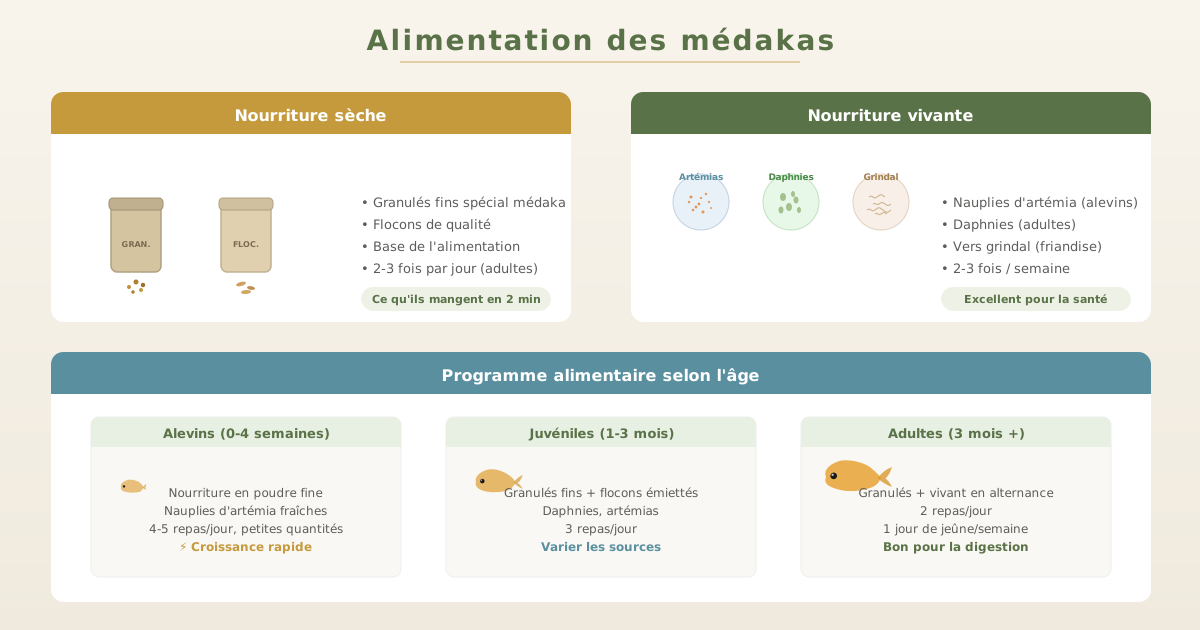
Pellets formulated specifically for medaka are the most recommended solution. They are made in a very small size (micro-pellets of 0.1 to 0.5 mm) to suit the small mouth of these fish. Rich in animal protein (shrimp, fish, worms), vitamins and carotenoids, these pellets meet all the nutritional needs of adult medaka.
Among the well-known brands are Japanese ranges such as Hikari Medaka and specialist foods such as Sera Micron. These pellets float or sink slowly, which suits medaka that feed mainly at the surface and in the middle of the water column.
Flakes for small fish
Fine flakes for small tropical fish can also be used, provided they are crushed finely to suit the size of the medaka’s mouth. They offer good nutritional variety and are very palatable. The drawback is that they break down quickly in water and can pollute the tank if too much is given. Give only the amount your fish can eat in 2 to 3 minutes.
Live food: an asset for breeding and colour
Live food provides incomparable nutrition and strongly stimulates hunting instincts and breeding. It is particularly recommended during the spawning season or to bring weakened fish back into condition.
Artemia nauplii
Artemia nauplii (freshly hatched larvae of Artemia salina) are considered the ideal live food for medaka. Very rich in protein, essential fatty acids and vitamins, they are particularly suited to fry and to adults during the breeding season. You can easily produce them yourself from artemia cysts: all you need is a simple hatchery, salt water and 24 to 48 hours of waiting. The nauplii are then rinsed in fresh water before being fed.
Daphnia
Daphnia (water fleas) are small crustaceans that are an excellent source of protein and fibre. They also have slightly laxative properties that help prevent constipation in fish fed a diet too rich in dry foods. Medaka chase them with enthusiasm, which is excellent for their behavioural stimulation. They can be found in pet shops (fresh, freeze-dried or frozen) or raised yourself in a separate tank.
Grindal worm (Enchytraeus buchholzi)
The grindal worm is a white micro-worm of 5 to 15 mm, ideal for adult medaka. Extremely rich in fat and protein, it should be fed in moderation to avoid weight gain. On the other hand, during the breeding season, feeding it two to three times a week effectively stimulates spawning. Grindal worms are simple to culture and can be raised in a plastic box with damp foam and oatmeal or wholemeal bread.
Other live and fresh foods
Beyond the classics, other live or fresh foods can occasionally enrich your medaka’s diet:
- Rotifers: ideal for very young fry under a week old
- Bloodworms (freeze-dried chironomids): gladly accepted, to be used as a supplement
- Tubifex: much liked but to be used with caution (risk of disease if collected from the wild)
- Moina: an alternative to daphnia, even smaller, perfect for fry
Feeding frequency by age
Meal frequency varies with the age and size of the medaka:
- Fry (0 to 3 weeks): 4 to 6 meals a day of very small quantities. Favour rotifers for the first 5 days, then freshly hatched artemia nauplii and hard-boiled egg yolk powder
- Juveniles (3 weeks to 2 months): 3 to 4 meals a day. Micro-pellets, artemia nauplii, daphnia
- Adults (over 2 months): 2 meals a day, morning and evening. A mix of dry foods and live food 2 to 3 times a week
The golden rule is never to give more than your fish can eat in 2 to 3 minutes. Uneaten leftovers decompose and degrade water quality.
The weekly fast
A practice often overlooked by beginners but very beneficial is the weekly fast. Once a week, not feeding your medaka lets their digestive system empty completely, prevents obesity and reduces the organic load in the tank. Healthy adult medaka cope very well with 24 hours without food, especially if their tank contains algae and micro-organisms that they can nibble at will.
This feeding break is particularly recommended in winter, when the temperature drops and the fish’s metabolism slows.
Conclusion
A varied diet, carefully measured and suited to the age of your medaka, is the secret of a thriving stock. Combine quality foods for medaka with regular supplements of live food for fish to obtain vigorous, colourful, breeding animals. A weekly fast will complete this feeding routine to keep your fish in excellent condition over the long term.