
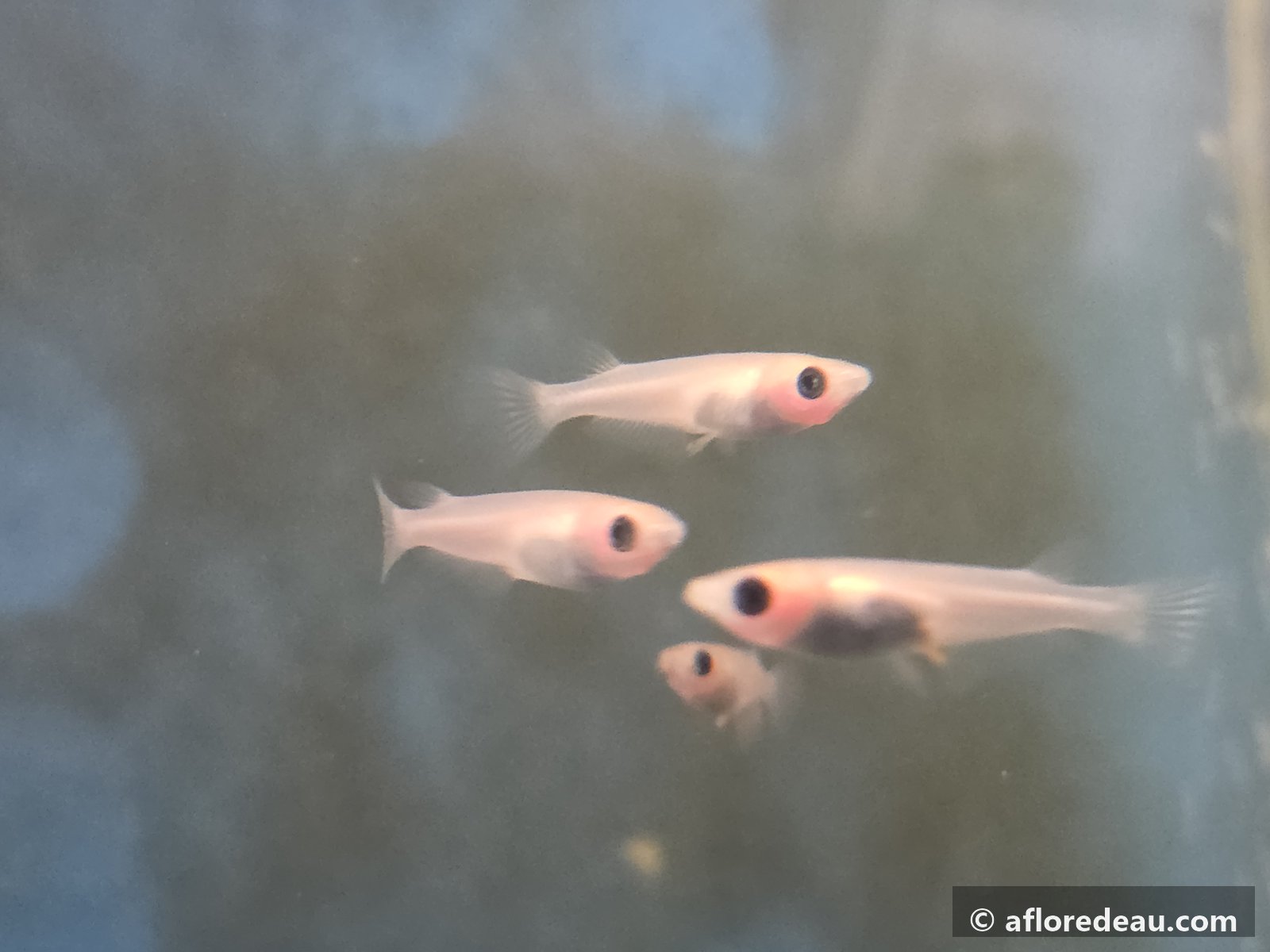
A new fry tub filled with bottled water because it is “pure”, renewed every day because “clean water means health”, and ten-day-old fry sinking to the bottom: the scene is a classic, and it comes from a wrong idea of what good water is for a fry. A medaka fry does not need clean water in the human sense; it needs water that is stable, alive and chlorine-free, which most often means water from its parents’ tub. Here is what the four waters within reach are worth, tap, rain, bottled and tub, with figures.
What a fry asks of its water
Three things. First, no chlorine: at 0.1 or 0.2 mg per litre, chlorine kills 100 % of fish by asphyxiation, according to the French food safety agency ANSES, and that is precisely the dose maintained in French drinking-water networks. Second, stability: fish larvae do not yet have the regulation of adults, their skin and yolk sac do the work of the gills, and it has been shown in a medaka close to ours that a larva tolerates far less salinity variation than an adult. Water that changes every day is, for it, a shock every day. Third, life: for the first two weeks, a medaka fry feeds on the microfauna and phytoplankton of its tub, and the waste it produces is only converted by bacteria that live on surfaces, not in the water. New water, however clean, has neither.
Tap water
In most cases it is the right base, on one condition. In France, the network is dosed to keep at least 0.1 mg of chlorine per litre at every point, 0.3 at the treatment plant outlet. This dose is lethal to a fish: never pour tap water straight into a fry tub. There are two ways of removing it:
- The conditioner, based on sodium thiosulphate: instant, at the dose on the bottle. This is what Japanese breeders use for fry, because only it gives a sure result.
- Standing, in a wide, uncovered container: free chlorine evaporates. In full summer sun, a few hours are enough; in overcast weather or in winter, a day or two; indoors without sun, two to three days, one day with an air stone stirring the water. Rested water does not keep, it loads up with bacteria; and in summer, networks chlorinate more heavily, so one night is not always enough. Japanese breeders check with a reagent for fry.
As for chloramine, the chlorine combined with ammonia that does not evaporate and worries American aquarists, it is a North American practice: it is not among the disinfection processes authorised in France, and we have found no French network that uses it. What you find here are small amounts of chloramines formed by the chlorine and the natural ammonium in the water, which conditioners also neutralise. Check with your own water supplier for what applies where you live.
Hardness depends on the ground. On the granite bedrock of Brittany, tap water is soft, 13 to 17 °f (French degrees of hardness) in Finistère; in sedimentary basins it is hard, 22 to 30 °f in Paris, with nearly 300 mg of bicarbonates per litre. Both suit the medaka. Hard water even has an advantage for a fry tub: its buffering capacity holds the pH in place. See pH, hardness and temperature.
Rainwater
It has no chlorine, it is free, and it has everything else against it for fry. Its pH is 5 to 6, its mineral content almost nil, 20 to 80 microsiemens against several hundred for tap water, and its buffering capacity zero: nothing holds the pH, which moves with the respiration of plants and fish. Collected from a roof, it also carries what the roof gives it: zinc by the hundreds of milligrams per square metre per year from a zinc roof, lead from flashings and gutters, copper from slates, droppings, dust, and, in eight cisterns out of ten tested in Belgium, faecal bacteria. Japanese breeders do not recommend it for filling a tub; their concern is rather the rain that falls into outdoor tubs, where a heavy downpour on poorly buffered water causes a sharp drop in pH and hardness.
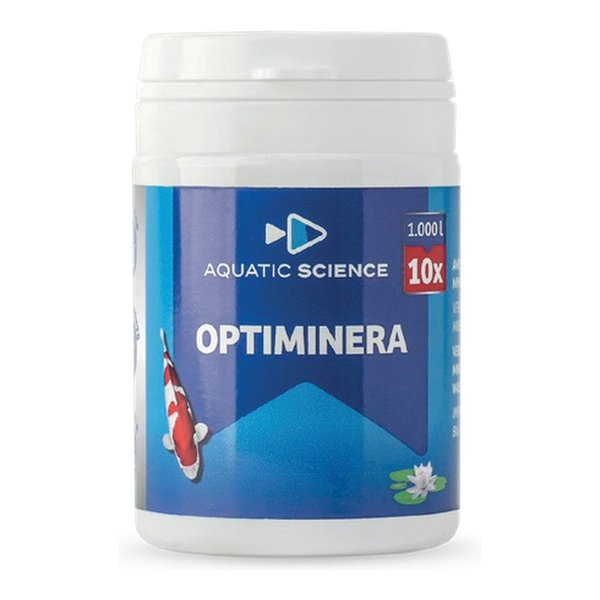
If you insist on using it, never pure and never for fry: cut half and half with dechlorinated tap water, the first flush of the shower discarded, and a carbonate hardness raised to at least 3 or 4 °dKH, for example with crushed oyster shell in the tub, or measurably with a mineraliser such as Aquatic Science’s Optiminera 1.000, whose effect does not depend on pH as the shell’s does.
Bottled water
Two criticisms, and a trap. The first criticism is that it brings nothing that dechlorinated tap water does not, at a price out of all proportion, and Japanese breeders advise against it for that reason. The second is that it is sterile: no bacteria, no microfauna, a tub that starts from zero. The trap is the composition, which varies tenfold depending on the brand.
| Water | Dry residue | Calcium | Bicarbonates | pH | What it gives for a tub |
|---|---|---|---|---|---|
| Volvic | 130 mg/L | 12 mg/L | 74 mg/L | 7 | soft but buffered, about 3.5 °dGH and 3.4 °dKH: acceptable |
| Evian | about 345 mg/L | 80 mg/L | 360 mg/L | 7.2 | hard, about 17 °dGH: suitable, to be cut with soft water for varieties that prefer less |
| Mont Roucous | 33 mg/L | 2.6 mg/L | a few mg/L | 5.8 | almost demineralised, acidic, unbuffered: the same as clean rainwater, the least suitable despite its image |
| Cristaline | variable: some thirty sources under the same label | read the label of the bottled source before using it | |||
A bottled water with a decent carbonate hardness, such as Volvic, makes a suitable starting water if you have nothing else, provided you seed it and do not renew it. A very weakly mineralised water, chosen because it is “for babies”, is the worst choice on the shelf. The brands above are French; for others, compare the figures on the label.
The parents’ tub water, and green water
This is the one Japanese breeders take, and the one we take in Lesneven. The surface water of a healthy breeding tub has the exact chemistry in which the eggs developed, so no shock; it is populated with the phytoplankton and rotifers that feed a fry before it even eats powder; and a light green water, the colour of green tea, bottom still visible, does both at once: permanent food and buffer. Japanese school studies comparing green water and fresh water find better survival and better growth in green water. Too dense, on the other hand, it consumes all the oxygen at dawn, and fry withstand it less well than adults: dilute by a quarter to a third, never by half. See green water.
For bacteria, water is not enough: they live on surfaces, gravel, walls, plants, not in free water. A handful of gravel or a piece of filter media taken from the parents’ tub seeds a new tub immediately, whereas a tub started from fresh water takes two to six weeks to convert ammonia, and commercial bacterial products give uneven results; in a trial on three new systems, the one that received 10 % used media started nitrifying straight away, while the one that received a commercial product kept high ammonia and nitrites. Bacterial cultures such as Medaka PSB or Medaka Care help keep a tub going; they do not replace a handful of live gravel at the start. The detail of the cycle is in cycling a tub.
And water changes?
Japanese breeders do not all agree on the rhythm, but they all agree on the principle: no massive renewal until the fry is 1 cm for some, 2 cm for others. In the meantime, top up evaporation with surface water from the parents’ tub, and siphon the bottom with a pipette. Those who change water at the needle stage do so in small amounts, a fifth to a quarter, from the bottom, pouring along the wall, with water within 2 °C of the tub’s. The test to run is not the nitrite test, which stays at zero in a tub without bacteria, but the ammonia test: it is ammonia that rises first, and 10 micrograms per litre of the un-ionised form is enough to do harm. All this is detailed in raising fry indoors.
The figures to remember
- Tap-water chlorine: 0.1 mg/L at minimum in the French network, lethal to a fish; conditioner or 24 h standing, a few hours in summer sun.
- Rainwater: pH 5 to 6, no buffering capacity, metals from the roof; never pure for fry.
- Bottled: Volvic is suitable, Mont Roucous is not; none has bacteria.
- Parents’ water: identical chemistry, live food; gravel from a mature tub for bacteria.
- No large water change before 1 cm; top up with the parents’ water; test ammonia, not nitrites.
Frequently asked questions
My tap water is very hard, 30 °f. Is that a problem for fry?
No, the medaka lives in hard waters in Japan too, and the buffering capacity of hard water is an advantage for a small tub. Dechlorinate, that is all.
Can I fill my fry tub with Volvic and add bottled bacteria?
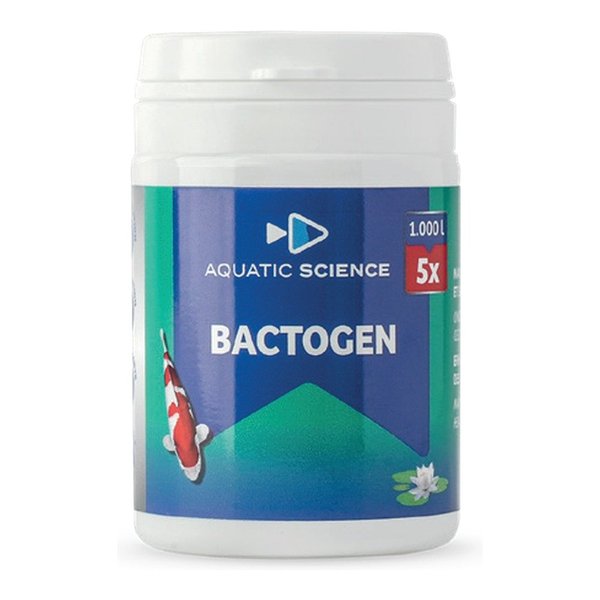
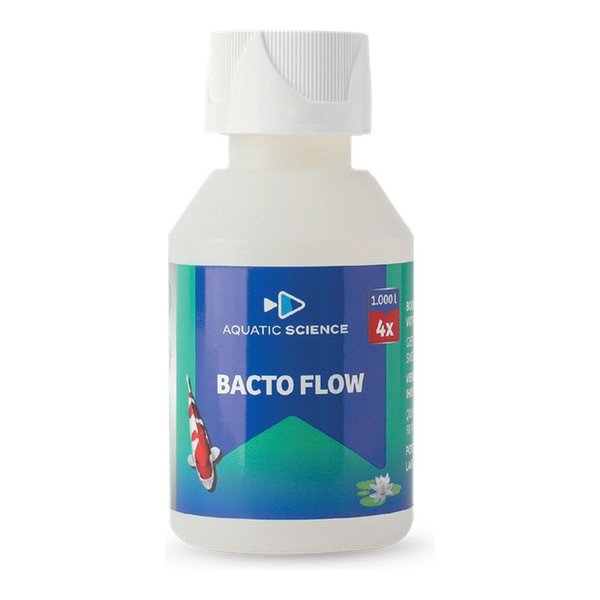
Yes, it is the solution when you set up a fry tub in a hurry with no mature tub to hand. Bottled bacteria, Bactogen or Bacto Flow from Aquatic Science, seed new water that has none. A ladle of water and a handful of gravel from the parents’ tub, if you have them, can be added to it very well. In every case, run an ammonia test in the first days.
I collected rainwater in a clean cistern, with no zinc roof. Can I use it?
To top up a well-buffered adult tub, yes, in small amounts. For fry, cut half and half with dechlorinated water and with carbonate hardness raised; pure, no.
Sources
- ANSES, opinion 2010-SA-0169 of 27 July 2010 on a trout mortality linked to a chlorinated discharge, anses.fr: 0.1 mg/L recommended at every point of the network, 0.3 at the plant outlet, 0.1 to 0.2 mg/L lethal to fish; ANSES, “Chlore dans l’eau du robinet”, 2026, anses.fr.
- Revue EIN no. 480, “La désinfection de l’eau potable, quelles possibilités ?”, 2025: processes authorised in France; Martinez C. et al., “Chlorine, friend or foe?”, University of Florida IFAS FA171, 2010, ask.ifas.ufl.edu: dissipation in 24 h of aeration, persistent chloramine.
- ARS Île-de-France, health monitoring of Paris water, 2021: hardness and bicarbonates; 2026 ARS data for Finistère, as reproduced by Selectra.
- Rocher V. et al., “Hydrocarbons and metals in atmospheric deposition and roof runoff in central Paris”, Water, Air, and Soil Pollution 159, 2004; ASEES, quality of cistern waters, 1999; Dennerle, remineralisation leaflet for osmosis water.
- Composition sheets for Volvic, Evian and Mont Roucous published by the brands; Test Achats for the variability of Cristaline sources.
- Cho Y. S., Lee S. Y., Kim D. S., Nam Y. K., “Tolerance capacity to salinity changes in adult and larva of Oryzias dancena”, Korean Journal of Ichthyology 22, 2010; Fridman S., “Ontogeny of the osmoregulatory capacity of teleosts”, Frontiers in Marine Science 7, 2020.
- DeLong D. P., Losordo T. M., “How to start a biofilter”, SRAC Publication 4502, 2012, srac.msstate.edu; Bischoff A. et al., Global Aquaculture Advocate, 2015: used media against commercial product; Haywood G. P., “Ammonia toxicity in teleost fishes”, 1983: 10 µg/L of NH3.
- Tokyo Aqua Garden, “メダカのカルキ抜きとは” (dechlorinating for medaka), t-aquagarden.com; “水道水の正しいカルキ抜きの方法” (the right method), t-aquagarden.com; “水道水じゃない水でアクアリウムはできるのか” (rain, well, bottled), t-aquagarden.com.
- 日淡といっしょ, “梅雨の長雨で屋外メダカが酸性雨ダメージ” (acid rain and tubs), nittanwith.com; “グリーンウォーターで針子が全滅” (green water and fry asphyxiation), nittanwith.com.
- メダカの飼い方.com, “グリーンウォーターの水換え”, medaka.papa77.com: top-up with surface water from the parents’ tub, no renewal before 1 cm; ほぼメダカのブログ, “稚魚の水換え”, hobomedaka.com: no change before 2 cm; めだか友水, “水道水のカルキ抜きは本当に必要か”, medakayusui.com.