
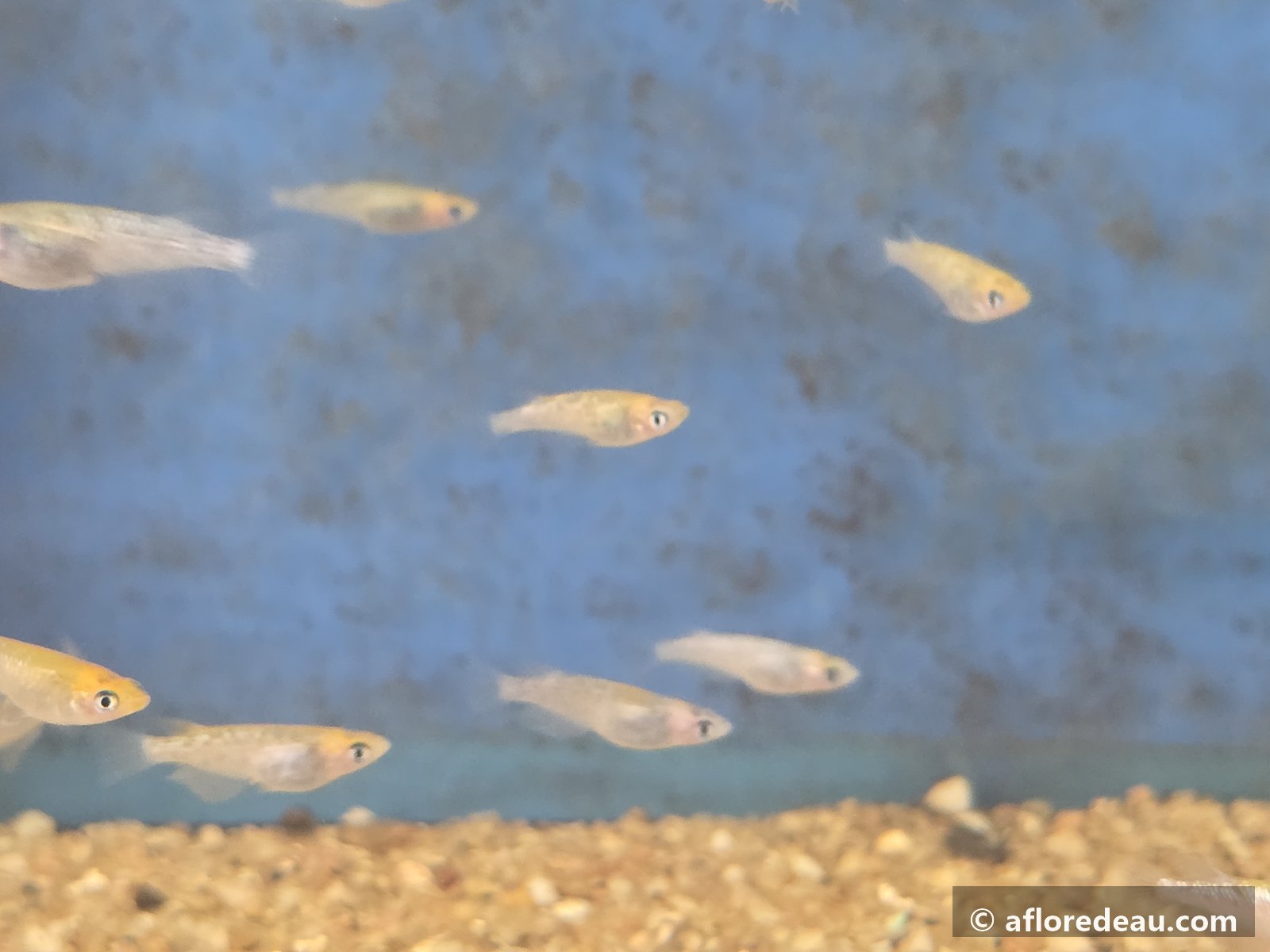
A medaka tub with no plants is a tub heading for trouble: no shelter, no shade, nothing to spawn on, and nitrates building up. Japanese breeders have a basic trio, water hyacinth, hornwort and Egeria, and they have worked out how much to use. But water hyacinth is banned in Europe, and a 30 to 100 litre container on a terrace is not a rice paddy. This page explains what plants do for medaka, which species suit a small pond, which ones you must never use, how many to put in, and how to look after them through the year.
What plants do for medaka
Tokyo Aqua Garden sums it up in four words: “hiding place, spawning support, shade, purification”. In detail:
- Spawning. The female attaches her eggs to fine roots or finely divided leaves. The roots of floating plants are the ideal support, and a sprig of hornwort can be cut with its eggs and moved to hatch. A Japanese shop notes that in a tub where adults and fry live together, floating plants “clearly raise the survival rate of eggs and fry”.
- Shade. Partial cover over the surface limits summer overheating and sunburn, and holds back excessive green water.
- Shelter. “Outdoors, insects and birds lie in wait for medaka”; leaves hide the fish from above, roots hide them in the water.
- Purification. Plants take up ammonia and nitrates, “which nothing but water changes removes”. Kamihata notes that they limit green water by depriving the phytoplankton of ammonia.
- Oxygen, with a downside. By day plants produce it; at night they use it. Medaka no Yakata warns that “too many hyacinths for the volume of water kill medaka by suffocation at night”, and a fully covered surface also blocks gas exchange. The rule that follows: never more than a third to a half of the surface under floating plants.
The three families, and what they are worth in a small pond
Floating plants: spawning and shade
The Japanese favourite is water hyacinth, Eichhornia crassipes: roots for eggs, strong purification, shade. It is banned from sale and keeping throughout the European Union as an invasive species, and in any case it dies below 13 °C. Do not replace it with water lettuce, Pistia stratiotes, which is banned too and is listed in Japan among the species whose cultivation and transport are prohibited. The substitutes:
- Frogbit, Hydrocharis morsus-ranae. Native, with small round leaves 2 to 3 cm across, fine roots where medaka spawn, and above all hardy: in autumn it forms buds that sink, overwinter on the bottom and rise again in spring. It is the floating plant for the small pond. Beware of the name: the “Amazon frogbit”, Limnobium laevigatum, sold under a similar common name, is tropical and does not survive the winter outdoors; the Japanese keep it indoors. It does the same job in season, provided you never release it into the wild.
- Floating fern, Salvinia natans. A native floating fern with short roots and no tangling; a Japanese breeder prefers it for small tubs. It is an annual, disappears in autumn and re-seeds from spores.
- Water chestnut, Trapa natans. Native floating rosettes, annual, attractive and harmless.
- Ivy-leaved duckweed, Lemna trisulca. It floats between the surface and the bottom, feeds the microfauna, and does not form the smothering mat of common duckweed, which is best avoided.
Submerged plants: oxygen, hiding places, and the plant for the eggs
One Japanese breeder writes that this is the only category that is “absolutely necessary”: it oxygenates, takes up nitrogen and hides the fry. Hornwort, Ceratophyllum demersum, is the reference plant: it has no roots, floats between the surface and the bottom, can be cut into portions, carries the eggs, and passes the winter “even where ice forms, folded down on the bottom until spring”. The Japanese Egeria, Egeria densa, grows everywhere and fast, too fast: it is invasive in French waters, and native plants that do the same job are preferable: spiked water milfoil, Myriophyllum spicatum; mare’s tail, Hippuris vulgaris; curled pondweed, Potamogeton crispus; water violet, Hottonia palustris, which flowers in May. For an indoor tub, vallisneria, Vallisneria spiralis, tolerates down to 16 °C. Needle spike-rush, Eleocharis acicularis, makes a lawn in 5 to 20 cm of water where fry can hide.
Marginal plants: height, and winter
Emergent plants add height, shelter dragonflies and frogs, and their submerged parts persist through winter when everything else has died back. In a small pond, choose dwarf forms:
- Typha minima, the dwarf reedmace: 50 to 70 cm, round brown heads, hardy, in a basket to contain the rhizome. The common reedmace, Typha latifolia, grows beyond 2 m and pierces liners: never in a small tub.
- Juncus ensifolius, the iris-leaved rush, 30 to 40 cm, and Scirpus cernuus, the fibre-optic grass, in a drooping tuft of 20 cm.
- Equisetum japonicum or Equisetum scirpoides, horsetails: the Japanese like water horsetail but find it too tall beyond 50 cm, and recommend the dwarf kind.
- Mentha aquatica, Veronica beccabunga, Myosotis palustris: creeping edge plants that flower, in 0 to 10 cm of water.
- Caltha palustris, marsh marigold, the first flower of spring, and Iris versicolor, a 60 cm iris that stays manageable in a basket where the yellow flag, Iris pseudacorus, would become a bush a metre across.
- Sagittaria japonica, the Japanese arrowhead, whose submerged leaves shelter fry and which spreads by stolons.
The water lily: yes, but dwarf and potted
The Japanese plant the “hime-suiren”, the dwarf water lily, in their biotopes: leaves of 5 cm, flowers of 2 to 3 cm, hardy, set under 10 to 15 cm of water. But a professional breeder warns: “in ordinary breeding containers, a water lily is a little too big”, its leaves end up covering the surface and blocking oxygen, and its soil acidifies the water over time. The rule: a single dwarf water lily, Nymphaea ‘Pygmaea Alba’, ‘Pygmaea Helvola’ or ‘Tetragona’, in a basket that can be lifted out and repotted every spring, from about 60 litres upwards. Below that, do without. Fringed water lily, Nymphoides peltata, a native with small leaves and yellow flowers, is a lighter alternative.
How many plants
- Submerged: Kamihata gives the only figure, “a 10 cm stem of hornwort for 1.5 litres of water”. For 30 L, about twenty stems; for 100 L, about sixty. A Japanese breeder counts “five stems for ten fish” indoors.
- Floating: a third of the surface, half at most, in midsummer. Beyond that, light no longer gets through, the fish feed poorly and the water lacks oxygen at night.
- Marginals: two or three baskets per 100 L, leaving at least 10 to 15 cm of open water above the pots for swimming.
- Water lily: one, from 60 L.
Start with half of what you plan, let the tub settle for seven to ten days before adding the fish, and top up according to what grows.
Plants never to use
The European list of invasive alien species bans the sale, keeping and transport of several pond plants that are still common in old catalogues and in exchanges between hobbyists. For medaka ponds, the main ones are:
- Water hyacinth, Eichhornia crassipes, and water lettuce, Pistia stratiotes.
- Parrot’s feather, Myriophyllum aquaticum, and the variable-leaf milfoil, Myriophyllum heterophyllum.
- Cabomba caroliniana, the oxygenating plant of the Japanese.
- Nuttall’s waterweed, Elodea nuttallii, and Lagarosiphon major.
- Water primroses, Ludwigia grandiflora and peploides; floating pennywort, Hydrocotyle ranunculoides.
- Lysichiton americanus and Gunnera tinctoria, also sold as Gunnera chilensis, for pond edges.
To be handled with care, though not banned: Brazilian waterweed, Egeria densa, invasive in French rivers, and tropical floating plants such as Limnobium or giant salvinia, which must never end up in a ditch. The Japanese themselves point out that “releasing into a river or a neighbouring pond is strictly forbidden”, and that a surplus plant is destroyed by drying it out.
Preparing a plant before it goes in the tub
- Rinse and inspect. Plants sold outdoors carry snail eggs, pond snails and ramshorn snails, and sometimes dragonfly larvae. Keep them two or three days in a bucket in the shade, in water from the tub, before introducing them.
- Pesticides. Imported plants are often treated for quarantine. Tokyo Aqua Garden observes that “medaka are relatively resistant to them”, but that shrimps “die after nervous symptoms”: with shrimps, choose plants guaranteed pesticide-free or grown in vitro, or soak them for two to three weeks in settled water.
- Remove the rock wool and the lead strips from bunched plants, which foul the water.
- Plant in baskets, in heavy clay soil, with the surface covered in gravel: the plant can be lifted out and divided, and its rhizomes pierce nothing.
- No fertiliser in an inhabited tub, or bury it at the bottom of a water lily’s pot.
Care through the year
- Spring: repot the water lily in late March or April, divide the marginals, put the submerged plants back in place when the water passes 15 °C.
- Summer: thin the floating plants every week, trim the hornwort, remove dead plants before they rot, cut off floating-plant roots that grow too long and trap the fish.
- Autumn: remove faded emergent growth and fallen leaves; tropical floating plants come indoors or are lost; frogbit sinks by itself.
- Winter: touch nothing. The hornwort folded on the bottom, the frogbit buds and the bases of the marginal plants wait for spring. Tokyo Aqua Garden advises leaving plants that “withstand the cold” for shelter, and adding a branch or a piece of pottery. See overwintering medaka.
The figures to remember
| Submerged plants | 10 cm of hornwort per 1.5 L of water |
|---|---|
| Floating plants | a third of the surface, half at most |
| Dwarf water lily | only one, potted, under 10 to 15 cm of water, from 60 L |
| Open water above the baskets | at least 10 to 15 cm |
| Before the fish | 7 to 10 days with plants alone |
| Anti-pesticide soak | 2 to 3 weeks, if you keep shrimps |
| Hardy outdoors | frogbit, hornwort, spiked water milfoil, mare’s tail, Typha minima, rushes, horsetails, dwarf water lily |
| Not hardy | Limnobium, tropical salvinias, Hydrocleys; indoors or lost in autumn |
Frequently asked questions
My medaka do not spawn on the plants. Why?
They need roots or fine leaves, and water of at least 18 °C with 12 to 14 hours of daylight. A spawning mop does the same job as floating-plant roots, and is removed together with the eggs.
Can I put aquarium plants in an outdoor tub?
In summer, yes: vallisneria, anubias and Java moss live there. They will not survive the winter outdoors, except Java moss, which tolerates cold water.
Are plants enough to replace a filter?
In a lightly stocked outdoor tub, yes. That is the Japanese method: plants, snails, patience, and one fish per 1.5 to 2 litres. The details are in keeping medaka outdoors.
Is duckweed a problem?
It covers the surface within a few weeks and smothers everything else. Skim it off with a net, and prefer frogbit or ivy-leaved duckweed, which stays between the surface and the bottom.
Where to find these plants
The species on this page are grown for ponds and, depending on the season, available from the À Flore d’Eau shop in Lesneven.
- Floating plants: the Amazon frogbit, Limnobium laevigatum, available all season, to bring indoors or replace in autumn; the native frogbit, Hydrocharis morsus-ranae, hardy, when in stock; Salvinia natans, water chestnut, Lemna trisulca. The whole category: floating plants.
- Submerged plants: hornwort, mare’s tail, curled pondweed, needle spike-rush, vallisneria. The whole category: oxygenating plants.
- Marginal plants: Typha minima, Juncus ensifolius, Scirpus cernuus, Equisetum japonicum, Equisetum scirpoides, water mint, brooklime, marsh marigold, Iris versicolor, Sagittaria japonica. The whole category: marginal plants.
- Dwarf water lilies: ‘Pygmaea Alba’, ‘Pygmaea Helvola’, ‘Tetragona’; all the water lilies.
- And the planting baskets to go with them.
Sources
- Tokyo Aqua Garden, “メダカにおすすめの水草15選” (fifteen plants for medaka), 2021, updated in 2026, t-aquagarden.com; “メダカと浮草” (floating plants), 2025, t-aquagarden.com; “ビオトープに人気でおすすめの水草10選”, t-aquagarden.com; “ビオトープで花を育てよう”, t-aquagarden.com; “水草の残留農薬” (pesticides), 2023, t-aquagarden.com: roles, basic trio, temperature thresholds, surface cover, dwarf water lily, fertiliser, pesticides and shrimps.
- Kamihata, “趣味のメダカ 飼育のしかた” (how to keep medaka), kamihata-online.com: “a 10 cm stem of hornwort for 1.5 L”, plants and green water.
- Hime-medaka, “メダカ飼育におすすめの浮草” (recommended floating plants), hime-medaka.com: salvinias for small tubs, the water lily too big for a breeding tub.
- Medaka no Yakata, breeding guide, medakanoyakata.jp: night-time suffocation, roots that trap fish, disinfecting plants.
- めだかの大工, “水草の選び方” and “姫睡蓮の植え替え”, 2017, medakanodaiku.xyz: the indispensable submerged plants, repotting the dwarf water lily, depth of 10 to 15 cm.
- Biotoronica, “ビオトープの水草”, biotoronica.com: hornwort overwintering under ice, ban on releasing, destruction by drying. Medakayabase, water hyacinth page, medakayabase.com: a third of the surface. Japanese Ministry of Agriculture, page on ボタンウキクサ (water lettuce), maff.go.jp.
- Regulation (EU) No 1143/2014 and the list of invasive alien species of Union concern, updated in 2016, 2017, 2019 and 2022: water hyacinth, water lettuce, milfoils, cabomba, Nuttall’s waterweed, lagarosiphon, water primroses, pennywort, skunk cabbage, gunnera.