

A healthy adult medaka can spend the winter outdoors in most of Europe, provided it has enough water beneath it, a container that does not freeze to the bottom, and a keeper who leaves it alone. Feeding stops below 10 °C, water changes stop, and the level is kept high. Young fish of the year that are still too small, and the delicate varieties, come indoors.
Outside or inside: the decision is made in October
Overwintering (越冬, ettō) is not a problem for Oryzias latipes. In the wild, the Japanese rice fish spends the winter at the bottom of rice fields and ditches, in water close to 0 °C. What kills it is not the cold itself. It is a container so small that it freezes solid, water whose temperature changes abruptly, or a keeper who goes on feeding a fish that has stopped eating.
So the question to ask in October is simple. Does the container hold at least 30 litres, with a deeper area? Are the fish adults, or at least a good size? Are they a robust, normal-bodied variety? If the answer to all three is yes, they stay outside. At our farm in Lesneven, in Brittany, that is the rule for our breeding tubs. Otherwise, the fish come into an unheated container, in a garage or a cool room, before the first frosts.
Bringing a medaka into a room heated to 20 °C is not overwintering. It is one more breeding season, with feeding, water changes and sometimes spawning. There is nothing wrong with that, but then you need the guide to keeping medaka indoors, not this one.
What happens inside the fish as the water cools
The medaka is cold-blooded. Its metabolism follows the temperature of the water, not of the air. The thresholds documented by Japanese breeders are these (Tokyo Aqua Garden, see Sources).
- Below 15 °C, activity drops. The fish eats less and swims less.
- Below 10 °C, it goes into rest. It stays near the bottom, hardly moves and almost stops eating.
- Between 5 and 10 °C, this is hibernation proper. The fish stays still near the bottom, often grouped with the others, among the plants or under a leaf.
- Around 0 °C, it is completely still. It survives as long as the water around it stays liquid.
A medaka that comes up to the surface in midwinter, or swims erratically, is not “in good form”. Either it has been disturbed by a sudden change, or it is ill. A fish that is overwintering well can hardly be seen.
Stop feeding: the 10 °C threshold
This is the most important step, and the hardest one for a beginner. Below 10 °C the medaka is at rest: its digestion slows right down and it no longer looks for food. Whatever you give it sinks and decomposes at the bottom, in water that the bacteria, slowed by the cold, no longer clean. You will often read that a meal swallowed in the cold causes a fatal bout of indigestion; this has never been shown in the medaka, but the outcome is the same: there is nothing to gain by feeding. The details, including what to do on a borderline day, are in feeding medaka according to water temperature.
The rule we follow is the one in the afloredeau.com care guide: feeding stops completely below 10 °C. Go by a thermometer in the water, read in the morning, not by the calendar. Between 15 and 10 °C you already cut back: one meal a day, then one every other day, in small amounts, removing whatever has not been eaten within two or three minutes. The fish must reach winter with reserves, and that is settled in September and October, not in December.
A brief rise to 12 or 13 °C in January, common in mild Atlantic winters, is no reason to feed. The next night will take the water back below 10 °C, and whatever has not been eaten will stay at the bottom.
Preparing the container: volume, level, material, cover
Four points, all drawn from Japanese practice and from our own.
Volume. The more water, the more slowly the temperature changes and the less deep the frost reaches. Gabriel sets the minimum at 30 litres with a deeper area for overwintering outside in Brittany’s mild climate. Tokyo Aqua Garden recommends a tall container without giving a figure. Wherever frost lasts longer, aim for a larger, deeper container, or bring the fish in.
Level. Fill the container to the top before winter and make up evaporation losses all winter long. A half-empty container freezes faster and deeper. Top up with dechlorinated water left to stand outside in a bucket for 24 hours, so that it is at the same temperature as the container. Topping up is not changing: nothing is taken out.
Material. Expanded polystyrene, thick plastic and ceramic hold up well in the cold. Glass is not recommended: it insulates poorly and can crack in a frost. A polystyrene box, not pretty but effective, remains the best winter shelter for a small group. Free-standing plastic tubs such as the Medaka Bowl 600 (36 litres) are suitable if they stand on the ground against a south-facing wall, out of the wind.
Cover. A board over one third to one half of the container cuts the wind, limits cooling at night, and keeps out falling leaves and cold rain. A few oak leaves added on purpose, clean and dry, are a different matter: they make a winter shelter, see dead leaves in a medaka tub. The cover must never close the container: the water needs to exchange gases with the air. A sheet of polycarbonate, a plank or a polystyrene lid laid at an angle will do.
Choosing the winter container itself, polystyrene box, double tub, glued panels, lid left ajar, is covered in the polystyrene box and the double tub; which varieties and which fish to bring in, trait by trait, in varieties that should not winter outside.
Frost: what matters and what does not
The surface may freeze. That does not matter. A sheet of ice a few millimetres thick on a container of 30 litres or more actually insulates the water below. Do not break it with a hammer: the vibrations disturb the fish. Do not pour hot water on it. Let it melt, or, before the frost, float an object on the surface, a ball or a half-filled bottle, to keep a hole open for gas exchange.
What matters is frost reaching down to the fish. That happens in a container that is too shallow or too small, or that is exposed for several days to hard frost. That is the typical risk of continental and northern winters, much less of mild Atlantic ones.
What not to do
- Change the water. In winter you do not change the water, you top it up. A change wakes the fish, alters the temperature abruptly and destroys a balance that the cold makes slow to rebuild.
- Feed “a little, just to be safe”. See above.
- Switch on a heater all at once. Going from 5 to 20 °C in a day is a shock. If you decide to heat, raise the temperature in steps over several days; the pace of about one degree a day that Tokyo Aqua Garden uses to warm a treatment tank is a good basis.
- Move the fish in midwinter. Moving them from the outdoor container to indoors is done in October, before the fish is at rest.
- Clean the bottom. Leaves and sludge shelter the fish and feed the bacteria. The big clean waits until spring.
- Leave the container open under a tree. Leaves pile up, rot and use up the oxygen.
This year’s fry
A fry hatched in July often measures 1.5 to 2 cm in October. One hatched in September is still a harigo (針子, “needle fry”) a few millimetres long. Japanese breeders are clear: young fish that are too small do not winter outside. They have no reserves, and prolonged cold kills them.
This year’s fry therefore go into an indoor container, heated or not. An unheated container at 12 to 15 °C keeps them alive without making them grow. A container heated to between 20 and 25 °C gains them the winter and gives adults ready to spawn in April. They are then fed normally, following the guide to raising fry. Tokyo Aqua Garden puts the threshold at about 2 cm: a young fish that has not reached that size by autumn, or is visibly thinner than the others, spends the winter indoors. Late spawns in August and September are easier to manage if you plan for them: either stop collecting eggs at the end of August, or make room indoors.
Climate by climate across Europe
What follows applies the same rules to Europe’s main climates. It is not a country-by-country calendar: what counts is the temperature of your water, read in the morning.
Mild Atlantic winters: British Isles, the Atlantic coast from Portugal to Brittany, the coastal Low Countries. Winters are mild and wet, frost is rare and brief. This is the easiest case, and the one we know first-hand in Brittany. The real risk is not frost but the wind, and rain that makes the container overflow. A 30-litre container set against a wall and covered with a board is enough. Mild spells in January should not mislead you: no feeding until the morning water stays above 10 °C.
Continental winters: Germany, Austria, Switzerland, central and eastern Europe, northern Italy’s plains. Spells of frost can last one to several weeks. Increase the volume, sink the container halfway into the ground or line it with a layer of polystyrene, and cover more of it. A 30-litre container on a north-facing terrace can freeze to the bottom. When in doubt, bring the fish into a frost-free garage.
Long, hard winters: Scandinavia, the Baltic states, mountain areas. Where the ice can stay for weeks, a container outside offers no margin. The safe choice is an unheated but frost-free room, garage, cellar or shed, from October onwards.
Mediterranean winters: Spain, southern France, Italy, Greece, Croatia. Winters are mild and frost is exceptional; the water seldom drops below 5 °C. Medaka stay outside without difficulty. The trap is the opposite one: water that climbs back to 15 °C in February revives appetite and sometimes spawning. Follow the thermometer, not the calendar.
Balconies and upper-floor terraces, everywhere. Wind and the lack of ground make the container more sensitive to frost than one in a garden. Put it against the wall of the house, which gives off a little heat, and shelter it from the wind.
Resuming in spring
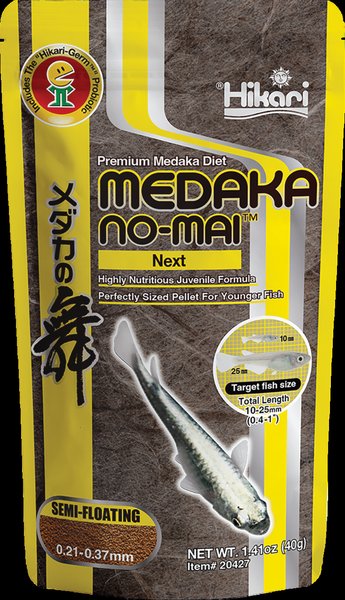
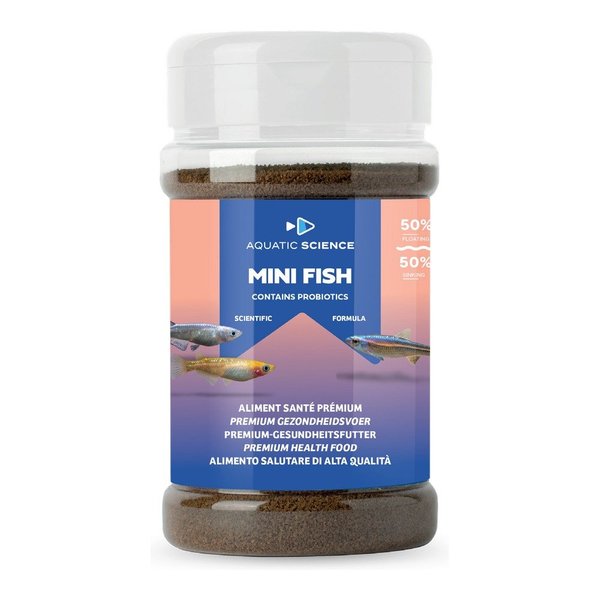
It is gradual, just like going into winter. When the water has been above 15 °C in the morning for several days in a row, give a pinch of a fine, easily digested food, such as Hikari Medaka Next or Aquatic Science’s Mini Fish, once every two days. At 18 °C, one meal a day. At 23 °C, full feeding, two meals a day if the fish finish within two minutes. This is also the time to remove the dead leaves, to make a first moderate water change, a quarter at most, with dechlorinated water at the same temperature, and to take off the cover. The season-by-season detail is in the guide through the seasons.
Expect a few losses in spring rather than in winter. A weakened fish often dies as it resumes, when its metabolism starts up again. As long as this stays marginal, it is not a sign that the winter went badly.
The figures to remember
| Reduced activity | below 15 °C |
|---|---|
| Feeding stops | below 10 °C, measured in the water in the morning |
| Hibernation | 5 to 10 °C; motionless around 0 °C |
| Minimum volume outside (mild climate) | 30 litres with a deeper area |
| Water changes | none; top-ups only, dechlorinated and at the same temperature |
| Cover | a board over one third to one half of the container, never closed |
| Frost | surface ice is fine; never the whole volume |
| Feeding resumes | gradually from 15 °C, full at 23 °C |
| This year’s fry | brought in if they are too small |
Frequently asked questions
Do medaka need a heater to overwinter?
No, not robust-variety adults in a container of 30 litres or more, outside areas where frost lasts more than a week. A heater is for fry and delicate varieties, and it then creates an indoor breeding season, not an overwintering.
Do they need an air pump in winter?
Generally not. Cold water holds more oxygen and the fish use very little. A strong air stone stirs the water, mixes the layers and stops the bottom staying slightly warmer than the surface. A simple air hole in the ice is enough.
Can Daruma and Longfin medaka winter outside?
The Daruma type is prone to digestive blockage and is kept between 25 and 28 °C. Bring it in. Longfin and Hirenaga are hardier, but their long fins expose them to injuries and fungal infections in cold water. We advise bringing them in too.
What should I do with eggs laid in October?
Incubate them indoors at 22 to 25 °C and raise the fry indoors all winter. Or do not collect them. Outside, they will not have time to hatch and grow. See the breeding guide.
My container holds 16 litres. Can my medaka winter outside?
In a mild Atlantic or Mediterranean climate, with adults, shelter from the wind and a cover, it is possible but with no margin. Elsewhere, no. The safest choice is to move that container into a garage or an unheated conservatory.
Sources
- Tokyo Aqua Garden, “メダカの越冬” (overwintering medaka): https://t-aquagarden.com/column/medaka_hibernation
- Tokyo Aqua Garden, “メダカの季節ごとの飼い方” (keeping medaka through the seasons): https://t-aquagarden.com/column/medaka_season
- Tokyo Aqua Garden, “足し水” (topping up): https://t-aquagarden.com/column/medaka_water_injection
- Medaka care guide, afloredeau.com (À Flore d’Eau, Gabriel Gayrin): the 10 °C threshold, 30 litres and a deeper area for a mild Breton winter.
- medaka.fr fact base (改良メダカWEB図鑑, Kamihata) for incubation temperature and the Daruma thresholds.