
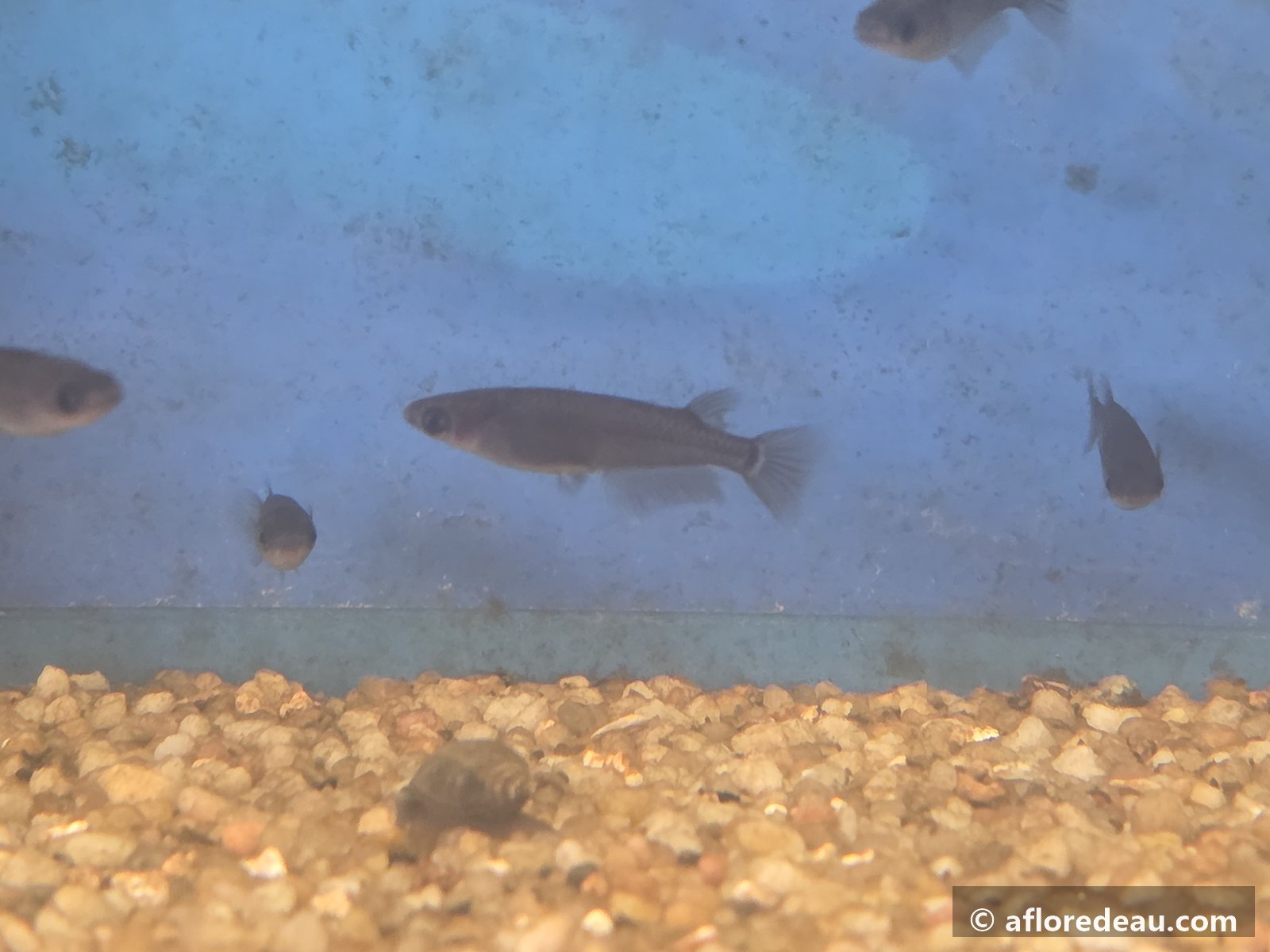
A medaka does very well in an aquarium, provided you give it at least 10 L for a small group, calm water, 8 to 14 hours of light depending on whether you want spawning or not, and a stable temperature between 20 and 25 °C. Indoors is the right choice for watching the fish from the side, for raising fry late in the season and for keeping fragile varieties such as the Daruma. The first month is when everything is decided.
Who indoors is right for
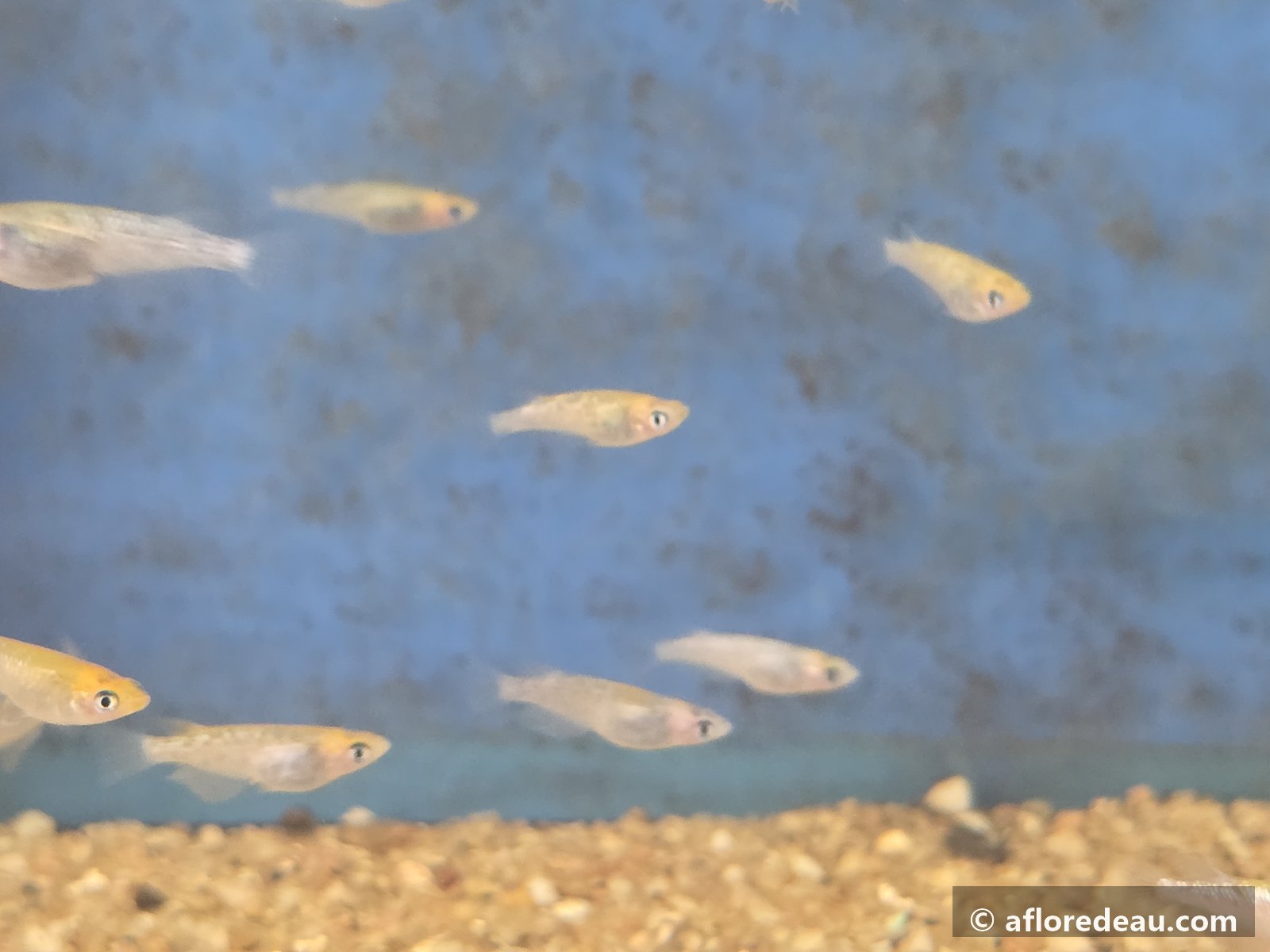
The medaka is first and foremost an outdoor fish, and the guide to keeping medaka outdoors remains the reference for colour and breeding. But the aquarium has three advantages that Japanese breeders acknowledge. Breeding becomes possible in winter, with water kept at 23 °C or more and enough light. Eggs and fry are safe from predators. And you see the fish from the side, which lets you spot an illness, a swollen belly or a damaged fin early.
In practice, the aquarium suits four situations. The flat with no balcony. Showing off varieties that are best viewed in profile: the inner light of a Miyuki (幹之) or of a Youkihi with transparent scales can only be seen well from the side. Raising late-season fry, which would not have time to grow outside. And keeping fragile varieties: the Daruma type (ダルマ) is kept between 25 and 28 °C and fears the cold, which triggers digestive blockages; a Miyuki Daruma has no business outdoors in Europe from October to April.
Conversely, anyone who wants intense colours and abundant spawning without effort will be disappointed by the aquarium. Artificial light does not replace the sun for colour-up.
Volume: 10 L at the very least, one litre per fish
Kamihata gives 10 L as the absolute minimum, and the general rule is 1 L per fish. In practice, a 20 to 30 L aquarium for six to ten adults is a good start: enough water to absorb mistakes, small enough to sit on a piece of furniture. A 60 cm tank, about 55 L, holds 50 to 60 at the very most, and far fewer if you want water that is easy to look after.
Shape matters more than volume. The medaka swims at the surface and in shallow water. A wide, low tank is better than a tall column. A lid or a net is useful: medaka jump, especially at night and when disturbed.
Sponge filter or no filter
There are two schools of thought, both valid. Without a filter, the tank works as a biotope: substrate, plants, few fish, regular water changes. This is the model of the Japanese tub on a windowsill. It demands discipline over feeding and water changes.
With a sponge filter, life is simpler. The sponge is the support for nitrifying bacteria that Japanese breeders cite for medaka tanks. It offers a large surface to the bacteria, it does not create a strong current, and it does not suck in fry, which a cartridge filter does. It runs on a small air pump set to the minimum. The medaka hates current: if the fish struggle against the flow or hide in a corner, the pump is too strong. The Medaka Filter Kit is designed on this principle.
Looking after the sponge is simple: squeeze it out in a bucket of water from the tank, never under the tap, whose chlorine kills the bacteria. Once a month is enough.
To start the tank, or to restart the sponge after cleaning, bottled bacteria set up the flora faster: Aquatic Science’s Bacto Flow, a liquid, for starting up, and Bactogen, the reference in the koi world, for maintenance. See our introduction to the Aquatic Science range.

Lighting: duration first, power second
The length of lighting is what controls spawning. It takes 13 to 14 hours of light a day to trigger it; 8 to 10 hours are enough if you do not want breeding. A socket timer, set once, avoids forgetting. Japanese breeders note that a sufficient lighting period gives sturdier, better coloured fish, even indoors.
Power comes second. Kamihata’s order of magnitude is about 10 W per 10 L with conventional lighting. The choice of lamp, the duration depending on the goal and how to give a tank seasons are covered in the guide to indoor lighting. For LED, the models cited by Japanese breeders for a medaka tank give about 500 lumens, with a cool 10,000 K light that brings out external lights and metallic fish. An LED desk lamp set over the tank works very well as a stopgap. Daylight from a window is a supplement, not a basis: it is too short in winter and it heats the tank in summer.
On a dark background, colours stand out, except for greens and metallics, which are shown off better on a white background. A black background stuck on the back and a dark substrate change the look of a Youkihi within a few weeks.
Temperature: the room’s, or a heater
In a room heated to 19 or 20 °C, the water sits around 18 to 20 °C. That is enough for everyday life, not for spawning. If you want to breed in winter, heat the water to 23 °C or more with a thermostatic heater. The comfortable range is 20 to 25 °C, and you should not exceed 30 °C.
Stability matters more than the value. A 20 L tank next to a radiator that switches off at night undergoes swings that the fish tolerates badly. Place the tank away from radiators, south-facing windows and draughts. A low-power heater, well set, costs less than the losses it avoids.
For the Daruma, aim for 25 to 28 °C. To incubate eggs and obtain Daruma, incubation above 28 °C expresses the gene; at 25 °C, incubation takes 10 days, at 20 °C, 13 days.
Water changes
Tap water often contains chlorine, which harms fish. Let it stand for 2 to 3 days indoors in an open container, or 24 hours outside, or use a conditioner. Bring it to the temperature of the tank before pouring it in.
The frequency depends on the tank. Without a filter, Kamihata advises a third to a half twice a month. With a filter and plants, a quarter to a third each week in the active season. Gabriel applies 10 to 20% a week. What counts is regularity: a small change every week is better than a big one every six weeks. Siphon the bottom at the same time.
The pH must stay between 6.5 and 8.5; we advise 7 to 8. Tap water is often within this range, but check yours with a test. Avoid soils and decorations that acidify it strongly.
The first month: the traps
Most failures in an aquarium happen in the first four weeks. The bacteria that convert ammonia take about 4 weeks to establish, and during the first 3 the water accumulates toxic compounds. Five mistakes come up every time.
- Putting all the fish in on the first day. Start with two or three, whose droppings feed the bacteria. Complete the group after a month.
- Not changing the water at start-up. In the first month, change a third of the water every 2 to 3 days, with dechlorinated water at the same temperature.
- Overfeeding. A medaka eats what it swallows in two to three minutes, once or twice a day. The rest rots. A day without food each week does no harm.
- Cleaning thoroughly. Rinsing the substrate, washing the sponge under the tap and changing all the water sets the cycle back to zero.
- Adding a treatment at the slightest doubt. Most problems in the first month come from the water, not from a parasite. Change the water before buying a medicine.
The tank is stabilised when the water stays clear from one week to the next, the fish eat with appetite and none stays at the surface in the morning. The complete step-by-step is in the set-up guide.
Plants and decoration
Plants are essential even in an aquarium: they consume nitrates and serve as spawning support and shelter for fry. Kamihata’s ratio is 10 cm of plant for 1.5 L. Indoors, plants that are not demanding on light are suitable: Anubias nana on a root, Java moss, Marimo, Elodea. A floating spawning mop completes the set-up for collecting eggs easily. See the breeding guide.
The figures to remember
| Volume | 10 L at the very least; 1 L per fish; 20 to 30 L to start well |
|---|---|
| Lighting | 13 to 14 h for spawning, 8 to 10 h otherwise; ≈ 10 W per 10 L; ≈ 500 lm in LED |
| Temperature | 20 to 25 °C; 23 °C or more to spawn in winter; 25 to 28 °C for the Daruma; never more than 30 °C |
| Tap water | stand 2 to 3 days indoors, or conditioner |
| Water changes | a third to a half twice a month without a filter; 10 to 20% a week for us |
| Start-up | cycle in ≈ 4 weeks; a third every 2 to 3 days in the first month |
| pH | 6.5 to 8.5; ideal 7 to 8 |
| Feeding | eaten in 2 to 3 minutes, 1 to 2 times a day |
Frequently asked questions
Can you keep medaka in a jar?
No. Below 10 L, the water degrades too fast and the temperature varies too much. A 5 L jar is an incubation or quarantine container, not a place to live.
Do I need a heater?
Not for adults of a robust variety in a heated room. Yes for spawning in winter, for the Daruma, and for raising fry quickly. You then need a thermostatic model, set between 23 and 25 °C.
What can medaka share a tank with?
Freshwater shrimp and snails, which clean the bottom. Not larger or more active fish that steal their food, nor warm-water species that need 26 °C all year round.
My medaka stay at the surface and breathe fast: what should I do?
It is a lack of oxygen or loaded water, almost always in the first month. Change a third of the water straight away, cut back on feeding, check the temperature, and add gentle aeration.
How long does a medaka live in an aquarium?
2 to 3 years, up to 4 in calm, stable conditions. A well-kept indoor tank, with no winter, tends towards the top of the range, but fish that spawn all year round also wear out faster.
Sources
- Tokyo Aqua Garden, “メダカの室内飼育・繁殖” (indoor keeping and breeding of medaka): https://t-aquagarden.com/column/medaka_indoor_breeding
- Tokyo Aqua Garden, “メダカとバクテリア” (medaka and bacteria): https://t-aquagarden.com/column/medaka_bacteria
- Tokyo Aqua Garden, “メダカの季節ごとの飼い方” (keeping medaka through the seasons): https://t-aquagarden.com/column/medaka_season
- medaka.fr fact base (Kamihata, WEB図鑑): 10 L minimum, 1 L per fish, lighting, water changes, pH, incubation, Daruma, lifespan.
- Medaka care guide, afloredeau.com (À Flore d’Eau, Gabriel Gayrin): 10 to 20% a week, pH 7 to 8.