

The Miyuki Daruma is a short, stocky medaka with the Miyuki’s blue-white external light band along its back. It swims with a waddle, like a rolling Daruma doll. It is the most delicate variety in our stock: its body shape makes its gut fragile, it does not winter outdoors, and breeding it takes method. A fish for the experienced breeder, or for the hobbyist who accepts a heated tank.
Identity card
| Name | Miyuki Daruma · 幹之ダルマ · Miyuki Daruma |
|---|---|
| Trade name | High-quality Daruma Miyuki (“high quality” is a seller’s label, not a JMA grade) |
| JMA classification | blue · normal scales · normal eyes · external light · no pattern · normal fins · Daruma type |
| Origin | WEB図鑑 sheet no. 0102, dated 2008; a cross of a Miyuki with the Daruma body form; creator not documented |
| Adult size | Shorter than a normal medaka: half to two thirds of its length according to Japanese breeders, so roughly 2 to 2.5 cm; the exact length depends on the degree of shortening |
| Temperature | Keep at 25 to 28 °C; incubate above 28 °C to obtain Daruma; do not go below 20 °C |
| Difficulty | Experienced: digestive blockages, no overwintering outdoors, low-yield breeding |
| Recommended background | Dark: it brings out the external light |
Recognising a Miyuki Daruma
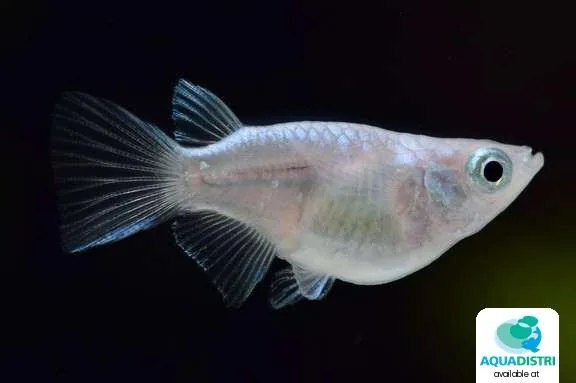
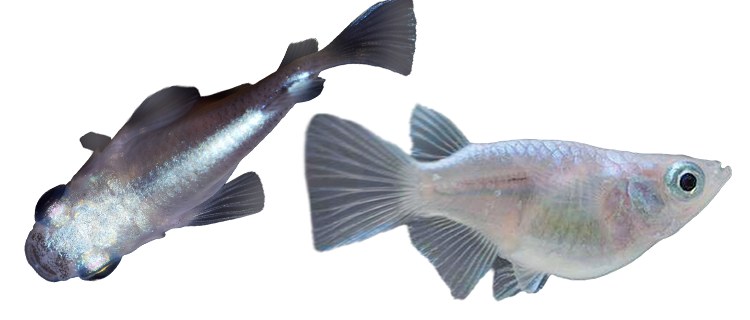
The name reads in two parts. Miyuki (幹之) refers to the external light, the reflective blue-white band that runs along the back, which appeared around 2008-2009. Daruma (ダルマ) is one of the three body types in the JMA classification, with the normal type and the Hikari type. See the page on JMA nomenclature.
The Daruma type comes from a shortening of the vertebrae. The fish keeps its height but loses length; it becomes round, almost spherical in the most marked individuals. Between the full Daruma and the normal type is the semi-Daruma, an intermediate, which counts for a great deal in breeding. The swimming is jerky, the fish waddles rather than darts. The name comes from Japanese Daruma dolls, round and weighted, which right themselves when pushed.
On this body, the Miyuki’s external light is read from above. On a fine individual, it starts at the tail fin and rises to the head, what the Japanese call the iron mask. On an ordinary individual, it stops in the middle of the back. The “high quality” label from our supplier is not an official grade: it describes a batch sorted for the exact characters of the variety, of good size and with a nicely plump body.
Miyuki fry are born dark, without the light; it rises with age. At 2 or 3 cm, a young Miyuki Daruma already shows its short body, but its light is not complete.
Keeping the Miyuki Daruma
The Daruma departs from the general care guide on three points.
Temperature first. The short body compresses the digestive tract, and a Daruma digests badly in cool water. Keep it at 25 to 28 °C all year round, so a heater indoors. Below 20 °C, the risk of blockage increases; JASMA describes fish that turn over and float, a disorder the Japanese call turning-over disease, often linked to digestion blocked by cold. Raising the temperature sometimes helps the fish to clear it.
Feeding next. Small rations, what is eaten in two to three minutes, preferably twice a day rather than one big feed. No feeding if the temperature has dropped. See the page on feeding.
Overwintering last. A full Daruma does not winter outdoors, according to JASMA. In Brittany as elsewhere in Europe, it comes into a heated aquarium as soon as the tank water drops towards 20 °C, in September or October. The rest of the year, it can live in an outdoor tub if the water stays in the 25-28 °C range, which limits outdoor spells to the summer months and to warm regions.
Breeding the Miyuki Daruma
The Daruma gene is present in all medaka. It is expressed when eggs incubate above 28 °C, between 28 and 32 °C: at this temperature, the spine forms shortened. Japanese breeders heat their incubation tanks to 30 or 31 °C. Even so, not all the young are Daruma, and below 28 °C the proportion collapses.
The cross matters as much as the temperature. Two full Daruma together give few eggs and many sterile young. The recommended method is to cross a Daruma with a semi-Daruma: the clutch is more abundant and the offspring include Daruma, semi-Daruma and a few normal types. The semi-Daruma from the clutch are kept as future breeders. The breeding method remains the same for spawning and egg collection; only the incubation temperature changes.
Warm incubation speeds up hatching. Tokyo Aqua Garden raises Daruma eggs and fry at 28 °C or more; we stop at 28-30 °C, 30 °C being the ceiling adopted on this site. The 250 degree-day rule gives an order of magnitude, hatching at around 8 or 9 days at this temperature, though no source has verified it at this heat. The fry feed from the third day, 4 to 5 times a day, in warm water and with no water change in the first weeks.
Tokyo Aqua Garden states that the shortened body of Daruma lowers the fertilisation rate: you find more clear eggs than with a normal medaka. It is often said that the males struggle to clasp the female; this is the most plausible explanation, though the source does not describe it. We have not yet had our Daruma spawn at Lesneven.
Our Miyuki Daruma in photos and video
Miyuki Daruma 2-3 cm, September 2026 batch: short body and external light already visible from above. Photos and video taken at Lesneven.


Related varieties
- Blue external light: the same Miyuki in normal type, robust and able to winter outside.
- Miyuki Longfin: external light and long fins, normal type.
- Yellow Hikari: the other JMA morphology, with symmetrical fins.
- Platinum: white with strong external light, normal type.
Frequently asked questions
My Daruma is floating upside down. What should I do?
Check the temperature and raise it towards 26-28 °C. Suspend feeding for a day or two. Most often it is digestion blocked by cold.
Can it live outdoors?
In summer, yes, if the water stays between 25 and 28 °C. In winter, no: it needs a heated aquarium.
If I cross two Daruma, will I get 100% Daruma?
No. The proportion depends on the incubation temperature and varies greatly even between two Daruma parents. And the Daruma × Daruma cross gives few viable eggs.
How long does it live?
2 to 3 years according to JASMA, like a normal medaka, provided the temperature is maintained.
Sources
- JASMA, “ダルマメダカ飼育完全ガイド”, jasma.sc/medakasiiku/473/
- 改良メダカWEB図鑑, “幹之(みゆき)ダルマメダカ No.0102”, medakazukan.net/0102_miyukidaharma/
- TAG and WEB図鑑, facts on the Daruma (gene, 28-32 °C, Daruma × semi-Daruma, 25-28 °C, blockage), cited via the medaka.fr editorial base
- TAG and WEB図鑑, facts on the Miyuki (2008-2009, light rising with age, iron mask), cited via the medaka.fr editorial base