

The Miyuki Longfin (幹之ロングフィン) combines two traits: the external light of the Miyuki, that bright blue-white band running along the back, and dorsal and anal fins with elongated rays. The light runs up the stretched fins, giving a fish that sparkles from above as well as in profile. It needs a little time and warmth to express its full potential.
Identity card
| Name | Miyuki Longfin · 幹之ロングフィン · Miyuki Rongufin |
|---|---|
| Trade name | Oryzias latipes Miyuki longfin; “Miyuki Super Long Line” at some wholesalers for the version with normal fins |
| JMA classification | blue (青) · normal scales · normal eyes · external light (体外光) · no pattern · Longfin · normal type |
| Origin | Miyuki: 2007, discovered by Kan Takashi (菅高志), WEB図鑑 entry no. 0100. The Longfin trait is one of the 45 JMA traits (“fins” group). Date of the Miyuki × Longfin combination not documented |
| Adult size | 3 to 4 cm, fins not included |
| Temperature | 5 to 30 °C tolerated; breeding 20-25 °C; fins grow mainly above 20 °C |
| Difficulty | intermediate: simple to keep, but the light and fins need sunlight, warmth and selection |
| Recommended background | dark: the external light stands out against black, seen from above |
Recognising a Miyuki Longfin
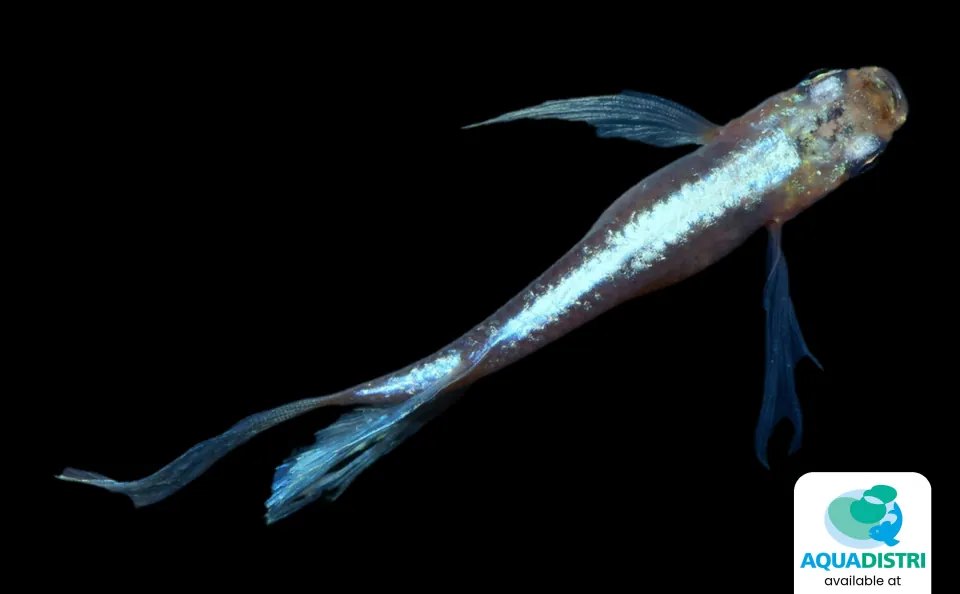
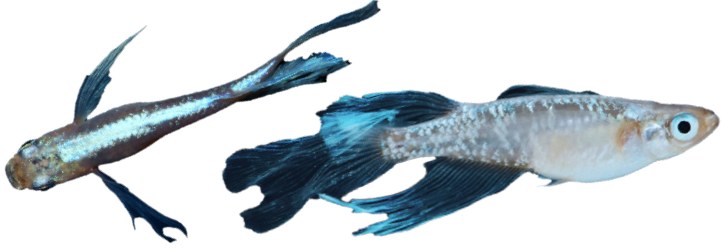
Two things to look at. First the external light: a reflective blue-white band, produced by iridophores lined up along the back. Since 2015, the WEB図鑑 has classed it in five grades: weak light, over a quarter of the body; strong light, up to half; super light, up to the pectoral fins; super strong light, up to the eyes; extreme light, up to the mouth. Breeders call the fish lit from snout to tail the “iron mask” (鉄仮面) or “full body”. It is the top of the scale.
Then the fins. According to the WEB図鑑, the Longfin lengthens the rays of the dorsal and anal fins, with no membrane between the stretched rays. This sets it apart from the Hirenaga, whose fins all lengthen, the tail included. On a Miyuki, the stretched part often carries the light: the rays shine like the back.
A fine specimen combines light that runs far up towards the head, without interruption, with well-stretched, symmetrical fins. Beware of young fish: Miyuki fry are born dark, the light appears and then progresses with age. A 2 cm fish has neither its final light nor its fins.
Keeping the Miyuki Longfin
The basics are those of the tank setup guide: at least 1 litre per fish, settled water, floating plants. Tokyo Aqua Garden notes that the Miyuki’s lifespan, 1 to 3 years, is slightly shorter than that of forms close to the wild fish.
Three levers raise the light. Sun: the WEB図鑑 recommends outdoor keeping for the Miyuki. Background: dark, to see the band. Food: Tokyo Aqua Garden mentions foods containing guanine, the substance of iridophores; see our feeding guide.
The fins have their own requirements. According to the Japanese site Hime-medaka, warmth favours their growth, by speeding up cell division and the deposit of guanine at the tips. It notes that in Japan the water stays above 20 °C only from mid-June to the end of September, and that young fish born in June do best. In Brittany the warm season is shorter still: a young Miyuki Longfin born late will grow its fins the following summer, or indoors in heated water. At Lesneven, outdoors and unheated, the fins reach their final length at around three to four months.
Overwintering: possible outdoors, like the others, according to our page on overwintering medaka. The long fins do not hamper the fish at rest.
Breeding the Miyuki Longfin
Spawning follows the general method. WEB図鑑 entry no. 0260, that of the blue Miyuki Hirenaga created in 2016 by Nakazato Yoshinori from the Matsui Hirenaga and the Miyuki, gives no fixation rate for this combination, and we do not yet have enough generations at Lesneven to offer one. What is observed in practice: the external light is passed on well but its grade varies, and some of the young do not have long fins. The same entry notes a useful point for sorting: the light of the fins concentrates in the elongated parts, which has led Miyuki breeders to judge their fish from the side as well, not only from above.
Sorting takes place in two stages. At about 2 cm, keep the young whose light climbs highest towards the head. Later, once the summer has passed, keep those whose dorsal and anal fins have stretched. The breeders of the next generation are those that combine both. Sexing does not change: dorsal and anal fins are larger in the male, but on a Longfin you must look at the shape of the anal fin, a parallelogram in the male, rather than its size.
Similar varieties
- Blue external light: the basic Miyuki, normal fins.
- Miyuki Daruma: same light, short and stocky body.
- Platinum: external light on a white or very pale blue body.
- Saboten: green, lamé, external light and long fins of Hirenaga lineage.
- Blue medaka: the blue without external light.
Frequently asked questions
My young Miyuki are grey with no light. Is that normal?
Yes. Miyuki fry are born dark. The light appears as they grow and climbs towards the head over several months, especially in the sun.
The fins are not growing. Why?
Most often for lack of warmth. The rays lengthen mainly above 20 °C. A youngster born at the end of summer will wait for the following summer.
Longfin or Hirenaga: what is the difference?
The Longfin stretches the rays of the dorsal and anal fins. The Hirenaga lengthens all the fins, tail included. The Saboten is of Hirenaga lineage.
Does the Miyuki Longfin winter outdoors?
Yes, under the same conditions as other medaka: at least 30 L and a deep zone, with no water changes during the cold.
Sources
- 改良メダカWEB図鑑, entry no. 0100 “幹之(みゆき)メダカ”: https://medakazukan.net/0100_miyukihikari/
- 改良メダカWEB図鑑, “ロングフィン ~メダカのヒレ変化の特徴~ メダカの特徴36/44”: medakazukan.net (Longfin trait)
- 東京アクアガーデン, “幹之メダカとは!特徴・寿命・飼い方の基本や改良品種”: https://t-aquagarden.com/column/miyuki_medaka
- 東京アクアガーデン, “幹之(みゆき)メダカ | メダカ図鑑”: https://t-aquagarden.com/column/zukan_medaka_miyuki
- Hime-medaka, “ロングフィンの伸ばし方” (fin growth and temperature): https://www.hime-medaka.com/situnaikate/longg.html