

The Saboten, “cactus” in Japanese, is a dark green medaka whose back is covered with shiny scales, with a green external-light band and elongated fins. It came out in 2021 from Medaka-ya Savanna, in Saitama Prefecture. It is also sold commercially as “Miyuki Vert Cactus”. It is a recent variety, best left to those who have already kept a lamé medaka.
Identity card
| Name | Saboten · サボテン · Saboten (“cactus”) |
|---|---|
| Trade name | Miyuki Vert Cactus, Cactus medaka |
| JMA classification | green in appearance, with no JMA colour category of its own and no WEB図鑑 entry found; depending on the reading, blue group or yellow-blue combination · normal scales · normal eyes · lamé + external light · no pattern · Hirenaga (Matsui line) · normal type |
| Origin | July 2021, Medaka-ya Savanna, Saitama; cross between white Ōka × Midorikō Matsui Hirenaga (緑光松井ヒレ長) |
| Adult size | 3 to 4 cm |
| Temperature | 5 to 30 °C tolerated; breeding from 18-20 °C |
| Difficulty | Intermediate to experienced: three traits to maintain together, not all of which express in every youngster |
| Recommended background | White for the brilliance of the lamé and green, according to SNR Medaka; some Japanese breeders prefer black to deepen the green |
Recognising a Saboten
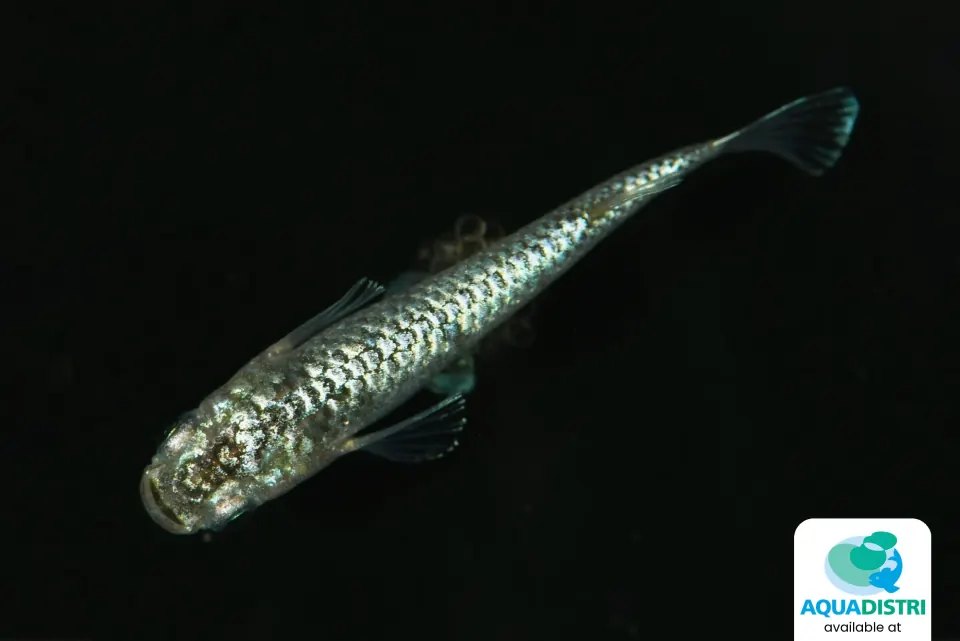
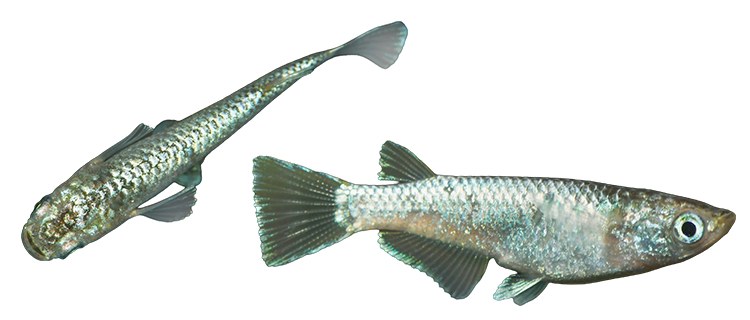
The Saboten reads as the sum of three iridophore and fin traits. The green comes from the Midorikō line (緑光, “green light”), a Miyuki whose external light leans green instead of blue-white. The dense lamé comes from the white Ōka, a lamé medaka. The elongated fins come from the Matsui Hirenaga, the long-finned line. Savanna crossed these two parents, then selected the greenest and most heavily covered fish over several generations.
The name Saboten describes the colour: a deep cactus green, neither the blue of the Miyuki nor yellow. Seen from above in the sun, the back is a mosaic of reflective green scales, with a continuous external-light band from mid-back to the tail. The fins, longer than in a normal medaka, ripple as it swims.
A fine specimen, according to JASMA, combines an intense green, an uninterrupted external light and an even lamé. Fish whose light stops at mid-back or whose lamé is sparse are of ordinary quality. Green does not appear in the list of ten JMA colours: it results from a combination of pigments and iridophores, which explains why the official classification attaches these fish to another group.
The trade name “Miyuki Vert Cactus” is consistent: Miyuki (幹之) denotes the external light, which the Saboten has. It is not a Japanese name but it does not misrepresent the variety.
Keeping the Saboten
Care follows the general guide. Two points are specific to this variety.
The first is the background. For most medaka, a dark background strengthens the colour. For greens and lamés, a white background shows off the brilliance: SNR Medaka advises it for the Saboten. JASMA advises instead a black container to deepen the green. Both are defensible: white to admire the glitter in the sun, black for the density of the green. A breeder can keep the tank white and judge the colour on a black background at sorting time. At Lesneven, the batch is kept on a black background.
The second is the light. The lamé and the external light are seen from above, under lighting coming from the top. In an aquarium viewed from the side, the Saboten is an uninteresting grey-green fish. It is made for a basin or open tank, with direct sun for part of the day. The long fins require nothing special; just avoid tankmates that nip them.
Breeding the Saboten
The Saboten has a reputation for high fixation for such a composite variety. SNR Medaka and medakatalog note it, and it is partly for this reason that Savanna used it as a parent of the Neptune two years later. JASMA tempers this: the three traits, green, lamé and external light, do not all express in every youngster. A spawning gives complete fish, fish without external light, fish with little lamé.
The breeding method is the same as for a Miyuki. The fry are born dark; the lamé and external light appear with growth. So do not sort before 2 cm. Then keep the greenest young, then those whose external light climbs highest on the back, then the best lamé. The long fins can be appreciated later still, near adult size.
Our Saboten in photos and video
Saboten 2-3 cm, September 2026 batch: the green and the lamé can be seen from above, even at this size. Photos and video taken at our shop in Lesneven.


Similar varieties
- Neptune: descendant of the Saboten, blue to the snout, green-gold lamé.
- Miyuki Longfin: blue-white external light and long fins, no lamé or green.
- Blue external light: the basic Miyuki, blue, normal type.
- Sanshoku lamé: lamé on three colours, no external light.
Frequently asked questions
Why “cactus”?
For the colour. The deep green of the back recalls a cactus, hence the name Saboten chosen by Savanna.
My Saboten is not green, it is grey.
Seen from the side, or under side lighting, the green and the lamé do not show. Look at it from above, in the sun, on a white background.
What is the price in Japan?
According to JASMA, from a few thousand to a few tens of thousands of yen depending on quality. An order of magnitude, not a reference for Europe.
Is the Saboten a Miyuki?
It has the external light, inherited from the Midorikō line. But it adds the lamé, the green and the Hirenaga fins: it is a variety in its own right.
Sources
- JASMA, “サボテンメダカの特徴、飼育難易度、固定率などについて”, jasma.sc/medaka/saboten/
- medakatalog, “サボテンとは”, medakatalog.com/cactus/ (cited via the medaka.fr editorial base)
- SNR Medaka, Saboten entry, cited via the medaka.fr editorial base (2021, white Ōka × Midorikō Matsui Hirenaga, white background)
- JMA manual, 5th edition, list of the ten colours, cited via the medaka.fr editorial base