

The Sanshoku lamé is a three-colour medaka, vermilion, black and white, with a back scattered with shiny scales. Every fish carries a different pattern, like a miniature Sanke koi. It is sold in shops as “Lamé Sanke”, the koi word, but its Japanese name is Sanshoku (三色). It is a variety for the patient breeder: the fish is easy to keep, the sorting is demanding.
Identity card
| Name | Sanshoku lamé · 三色ラメ · Sanshoku Lamé (full form in the WEB図鑑: 三色ラメ幹之, Sanshoku Lamé Miyuki) |
|---|---|
| Trade name | Lamé Sanke, Tricolor lamé |
| JMA classification | white + vermilion · transparent scales · normal eyes · lamé · black spots (斑) · normal fins · normal type |
| Origin | Sanshoku lamé Miyuki created in 2016 by Seirakuan (静楽庵), WEB図鑑 entry no. 0169; the Sanshoku group spreads around 2017 |
| Adult size | 3 to 4 cm |
| Temperature | 5 to 30 °C tolerated; breeding from 18-20 °C, ideally 20-25 °C |
| Difficulty | Intermediate: simple to keep, difficult to select, few three-colour fish per spawning |
| Recommended background | Black: it deepens the vermilion and makes the white and lamé stand out |
Recognising a Sanshoku lamé
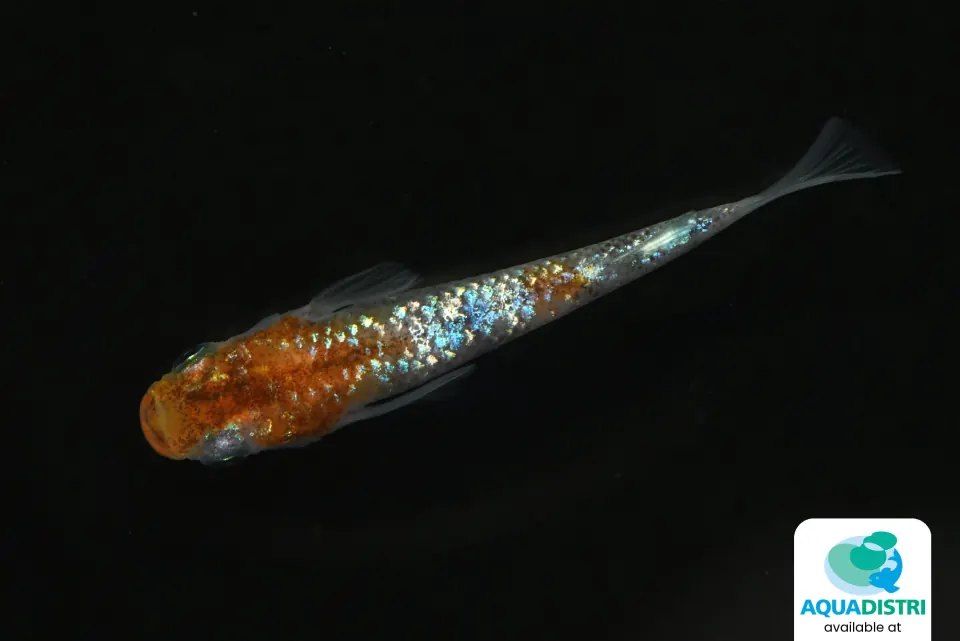
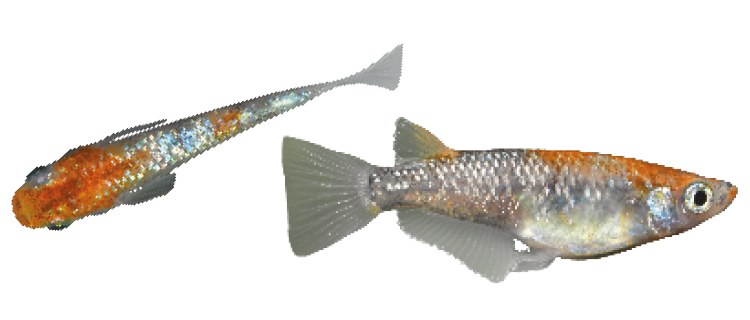
The name reads in four parts according to JMA nomenclature. Sanshoku, “three colours”, denotes a white base carrying vermilion patches and black spots. Lamé denotes the reflective scales spread over the back, due to iridophores. The full WEB図鑑 name adds Miyuki (幹之), because the original line descends from a Miyuki, but external light is not the trait sought here. To read the other names, see the page on JMA nomenclature.
The word Sanke comes from the koi world. It abbreviates Taishō Sanshoku, the white koi with red and black spots first exhibited in 1914. Koi enthusiasts read the same kanji “Sanke”, medaka breeders read them “Sanshoku”. The trade name “Lamé Sanke” is therefore a customary translation, not a mistake, but the Japanese entry says Sanshoku lamé.
A fine specimen shows the three colours clearly separated, with a vermilion head, black well placed on the body and clean white. The lamé must cover the back without gaps. According to JASMA, only 10 to 20% of the young express all three colours, and a show-quality fish comes out about once in a thousand. Fish with only two colours, white and vermilion without black, are Kōhaku lamé, sold at a lower price.
The fry are born pale. The black and vermilion settle over the months, and the final pattern can only be read at adult size. It is therefore normal for a batch of 2 to 3 cm fish to look incomplete still.
Keeping the Sanshoku lamé
The Sanshoku lamé has no requirements of its own. The rules in the care guide are enough: 1 litre per fish, pH 7 to 8, water changes of 10 to 20% a week, food eaten within two to three minutes.
The background makes the difference. On a black background, the vermilion deepens and the white contrasts; the lamé catches the sunlight. On a pale background, the black of the pattern fades and the fish loses its appeal. A dark outdoor tank, exposed to the morning sun, gives the best colours. A colour-enhancing food strengthens the vermilion; see the page on feeding.
Breeding the Sanshoku lamé
The females spawn a lot. This is the variety’s first quality according to JASMA, no doubt because Japanese breeders retained the most fecund layers. The difficulty lies elsewhere: the distribution of the three colours is not faithfully inherited. Each youngster draws a different pattern, and the majority have only two colours or badly placed black.
You therefore have to produce a lot to sort a little. Japanese breeders who maintain a quality strain raise several thousand fry per season. At a hobbyist’s scale, a hundred fry gives about ten three-colour fish and one or two fine breeders. The breeding method is the same as for other medaka: spawning mop, egg collection, incubation at 250 degree-days.
When sorting, select first for the vermilion head and the presence of black, then the density of the lamé. Keep more females than males in the breeding tank. Two-colour young are sold or kept in an ornamental tank; they make good fish without being breeders.
Our Sanshoku lamé in photos and video
Sanshoku lamé 2-3 cm, September 2026 batch: the vermilion and black patches are still settling. Photos and video taken at our shop in Lesneven.


Similar varieties
- Kōhaku: white and vermilion without black, often with external light.
- White Black: white and black without vermilion.
- Orange Black: orange and black.
- Yellow lamé Aurora: another lamé medaka, on a yellow base with semi-transparent scales.
Frequently asked questions
Sanke or Sanshoku: which is right?
Both readings denote the same kanji. Sanke is koi usage, Sanshoku that of medaka. The JMA entry says Sanshoku.
Why don’t my young have three colours?
Because the pattern is not fixed. A minority of the young express all three colours, and the black appears late. You have to wait for adult size to judge.
What is the price in Japan?
According to JASMA, an ordinary fish is worth about 1,000 yen, and a top-level fish from 10,000 to over 100,000 yen. An order of magnitude, not a reference for Europe.
Is the lamé passed on?
Better than the pattern. The 2016 Sanshoku lamé Miyuki was the first line to fix lamé on a three-colour medaka, and it is the origin of the Kōhaku lamé and the Sanshoku with external light.
Sources
- 改良メダカWEB図鑑, “三色ラメ幹之 No.0169”, medakazukan.net/0169_sansyokuramemiyuki/
- JASMA, “三色ラメメダカの特徴、飼育難易度、固定率、繁殖について”, jasma.sc/medaka/sanshokurame/
- Kodama Koi Farm, “Gosanke: Three Families of Nishikigoi”, medium.com/@kodamakoifarm (Taishō Sanshoku, 1914)
- TAG, medaka breeding guide, cited via the medaka.fr editorial base (Sanshoku around 2017, black background)