
White Black is a trade name for a white medaka marked with black. It is not a Japanese variety listed under that name, but a seller’s label: in JMA vocabulary, it is a white medaka with a pattern of black spots. The contrast is strong when seen from above, keeping it is easy, and every fish has its own pattern.
Identity card
| Name | White Black (trade name, no attested Japanese name) |
|---|---|
| Trade name | Oryzias latipes white black |
| JMA classification | white (白) · scales to be determined · normal eyes · iridophores to be determined · pattern of black spots (斑) · normal fins · normal type. |
| Origin | Trade name, origin not documented. Most medaka sold in Europe under English names come from farms in South-East Asia |
| Adult size | 3 to 4 cm |
| Temperature | 5 to 30 °C tolerated; breeds from 18-20 °C, ideally 20-25 °C |
| Difficulty | beginner for keeping; intermediate for obtaining well-marked young, no known fixation rate |
| Recommended background | dark, to deepen the black; the white stays readable on either background |
Recognising a White Black
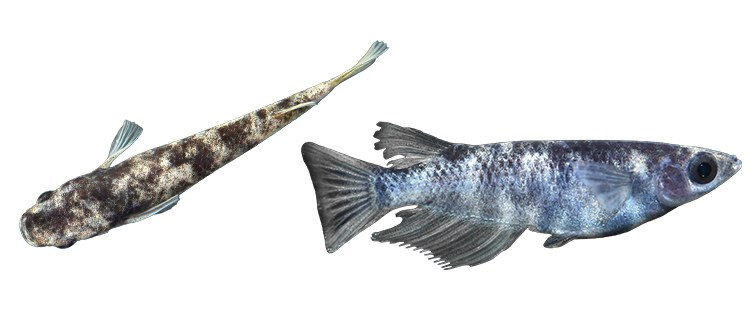
The body is white, like that of a standard white medaka. On top of it are black spots or patches, placed without any rule: on the head, the back, the base of the fins. The contrast is most readable from above, in a dark tank. From the side, in an aquarium, the white looks more cream and the black more grey.
The resemblance to the Panda is misleading. The Panda is white with black eyes and a dark belly; its black comes from the absence of iridophores, not from a pattern. The White Black, by contrast, carries black on the scales of the body. It can also be mistaken for a Sanshoku (三色) with no red, or for a Kōhaku seen in poor light. When in doubt, look at the colour of the spots in sunlight: solid black for the White Black, vermilion for the Kōhaku.
A fine specimen has a clean white, with no yellow tint, and a dense black with sharp edges. Grey or blurred spots are the sign of an ordinary fish, or of one raised on a light background.
Keeping the White Black
Care is the same as in the tank set-up guide: at least 1 litre per fish, aged water, floating plants, moderate water changes. The White Black overwinters outdoors as described on our page on overwintering medaka outdoors.
The background is the only adjustment that matters. The black of medaka reacts to the colour of the tank: on a light background it fades, on a dark one it deepens. Only the Orochi line keeps its black on a light background, and nothing suggests that the White Black descends from it. To see the pattern, a black tank or a dark tub is essential. The white, for its part, does not change.
Feeding does not change the pattern. Colour-up foods supply carotenoids that strengthen red and orange, according to Tokyo Aqua Garden; a white medaka has no pigment to strengthen and these foods are of no use to it. Ordinary good-quality food is enough; see our feeding guide.
Breeding the White Black
Spawning, egg collection and incubation follow the breeding page. No fixation rate is published for this name. As with all patterned varieties, the offspring of a well-marked pair include plain whites, faintly marked fish and a share of fine two-tone ones.
Sorting is done at 2 cm, once the black has taken its place. Keep the young with sharp spots and discard the plain and the veiled ones. The best become the following year’s breeders. Crossing a White Black with a white medaka dilutes the black; crossing it with a plain black drowns the white. The simplest route is White Black with White Black, generation after generation.
Related varieties
- White medaka — white alone, without spots.
- Panda — white with black eyes, but the black comes from the eyes and belly, not from a pattern.
- Orange Black — the same logic of black spots, on an orange body.
- Sanshoku lamé — white, black and vermilion, with lamé.
- Black Dragon — plain black, another trade name.
Frequently asked questions
Are White Black and Panda the same thing?
No. The Panda has black eyes and a black belly because it lacks iridophores. The White Black carries black spots on the body. Both are white, but the black does not have the same origin.
Will the black spots spread with age?
The pattern is set early. What changes is its density: darker on a black background, paler on a light one.
Does the White Black exist in Japan?
Not under that name. Japan knows white medaka with black spots in several lines, but “White Black” is a label used by European or Asian sellers.
Can I keep it with Kōhaku?
Yes as far as living together goes, all medaka get along. But they will interbreed, and the young will be a mix with no name.
Sources
- 改良メダカWEB図鑑, “パンダ ~メダカの目の変化の特徴~” (to tell the Panda’s black from a pattern): medakazukan.net (panda trait)
- Aquarium Glaser, “Oryzias latipes – Medaka breeding forms” (strains with English trade names): aquariumglaser.de
- 東京アクアガーデン, general medaka keeping guide: https://t-aquagarden.com/guide/medaka_howto