
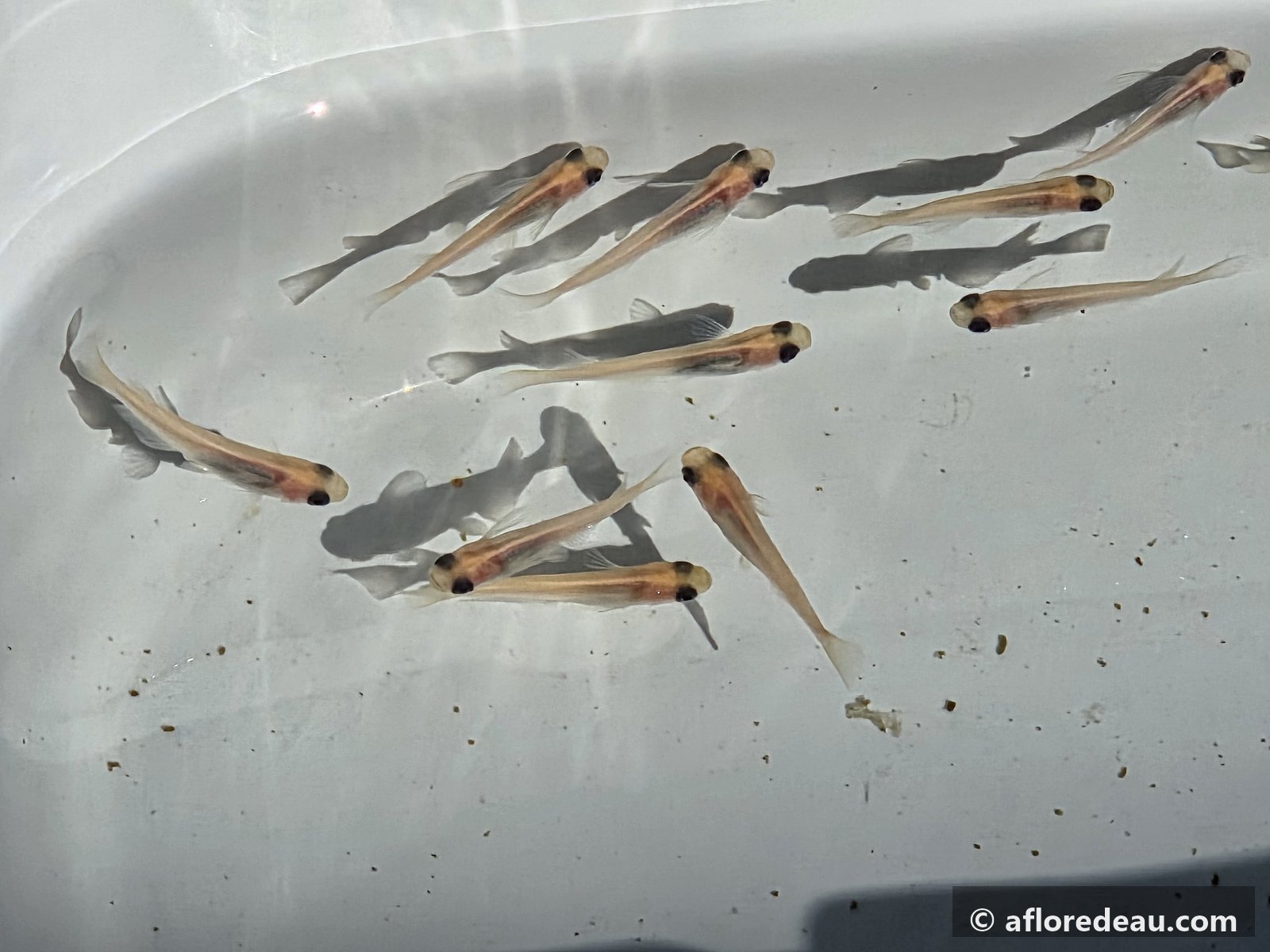
The Panda (パンダ) is a medaka with black-ringed eyes on a translucent body, hence its name. It is not a colour but an eye trait, which combines with almost every body colour. Easy to keep, it is best viewed from the side, in an aquarium, where its eyes show best.
Identity card
| Name | Panda · パンダ · Panda. Trait no. 14 of the 45 JMA traits (“eyes” group) |
|---|---|
| Trade name | Oryzias latipes Panda; “Panda White”, “Panda Grey” at European wholesalers depending on body colour |
| JMA classification | body colour varies with the line · transparent scales · panda eye · no particular iridophores · no pattern · normal fins · normal type |
| Origin | Japan, date and creator not documented. Most likely appeared in transparent-scaled lines, as the most advanced form of that trait |
| Adult size | 3 to 4 cm |
| Temperature | 5 to 30 °C tolerated; breeding from 18-20 °C, ideal 20-25 °C |
| Difficulty | beginner for keeping; intermediate for breeding, as the trait does not show in every youngster |
| Recommended background | dark for the top view; in an aquarium, a plain background and side lighting are enough |
Recognising a Panda
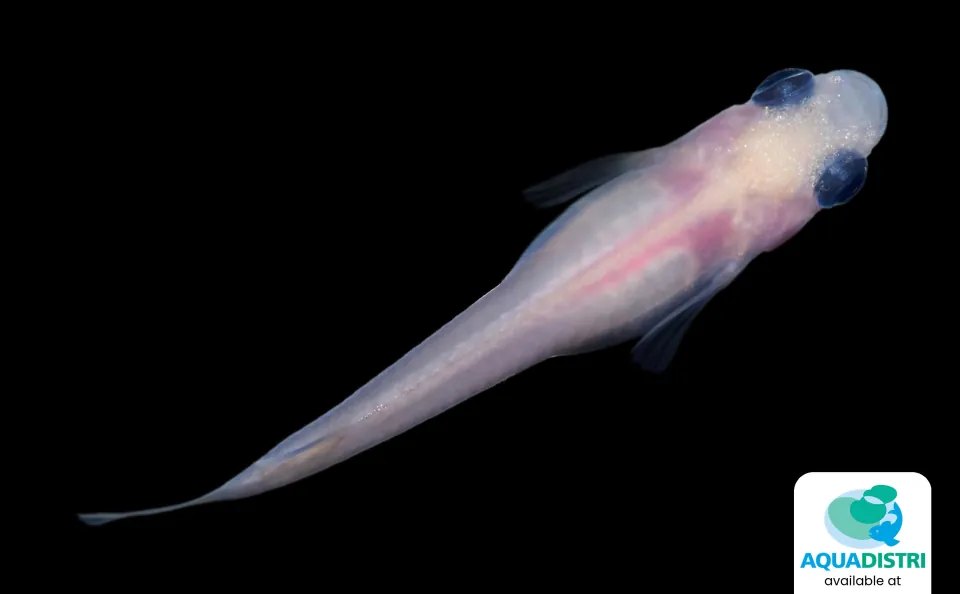
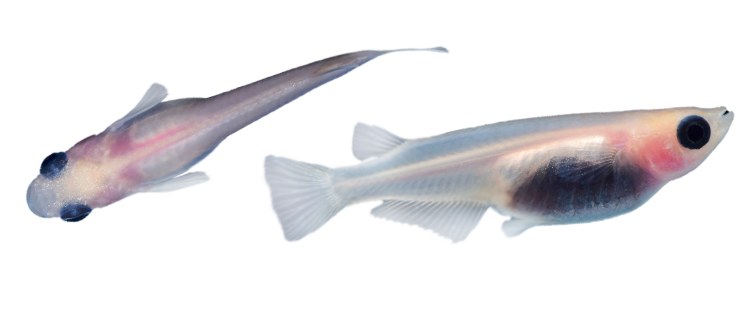
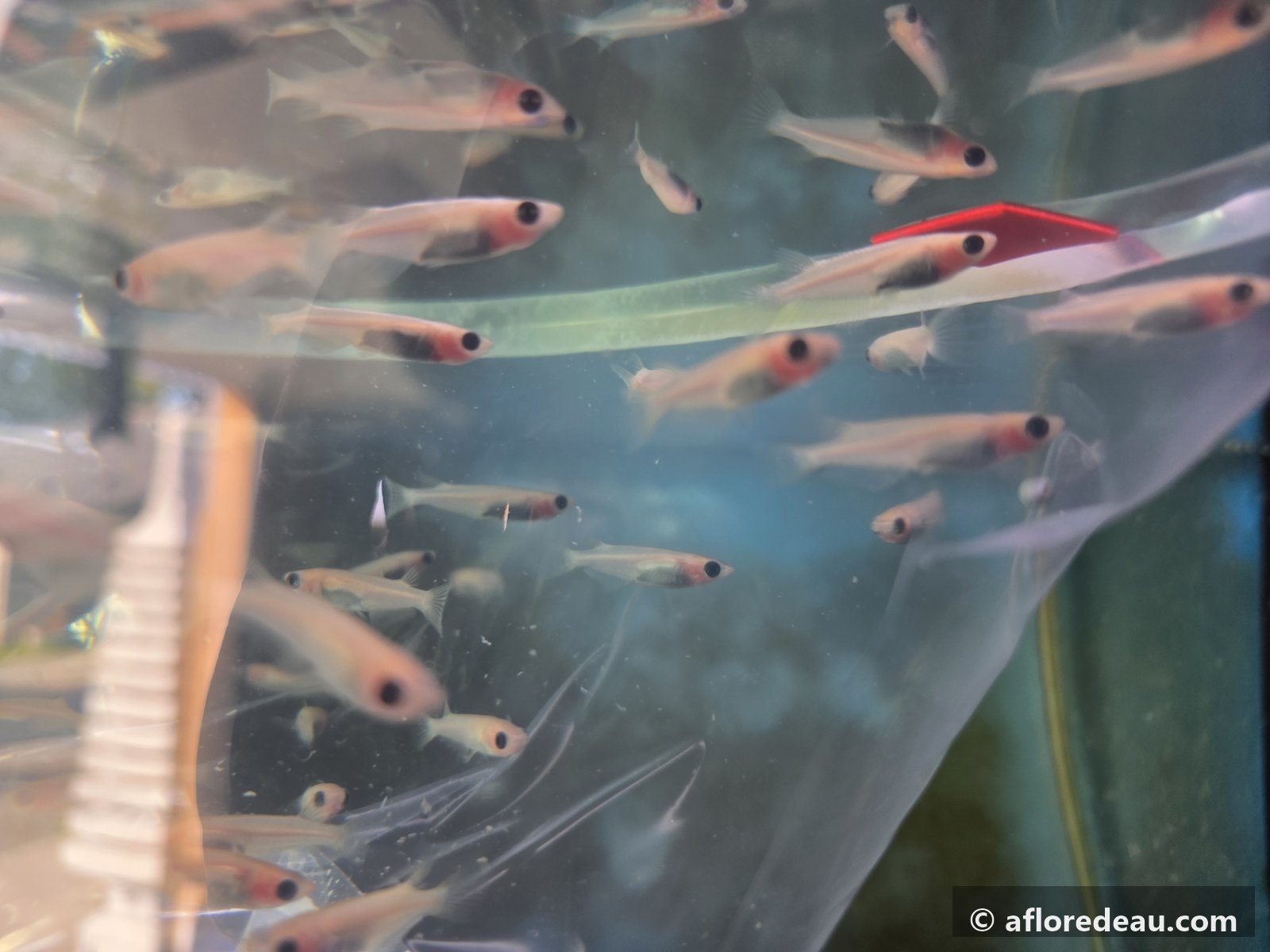
In an ordinary medaka, the iris is ringed by a bright, silver or gold band produced by iridophores. In the Panda, these iridophores are missing around the eye and on the belly. The eye then appears entirely black, large and round, which recalls the animal. The belly, deprived of its reflective layer, shows the dark abdominal membrane and sometimes the organs. The gill covers are translucent and red, the mark of transparent scales.
The WEB図鑑 notes that the degree of loss varies from one individual to another. Some show a clear black eye from every angle; others only seen from above. Japanese breeders distinguish the “true panda”, with a frankly black eye, from the first-generation panda, which is less marked. A fine specimen has both eyes uniformly black, with no residual ring, and a clearly transparent belly.
It can be confused with an albino: the albino has a red eye, the Panda a black one. It can also be confused with a simple transparent-scaled medaka, whose cheeks are red but whose iris keeps its bright ring. Body colour tells you nothing: there are white, blue, golden, yellow and brown Pandas, as well as the Youkihi panda (no. 0617) and the Kōhaku panda (no. 0745).
Keeping the Panda
Care is that of any medaka: at least 1 litre per fish, settled water, plants, moderate water changes. Everything is in the tank setup guide. The Panda winters outdoors like the others, according to our overwintering page.
The particularity lies in how you look at it. Seen from above, in an outdoor container, the panda trait is hard to read: you see a back and a head, not the eyes. Tokyo Aqua Garden recommends the aquarium and the side view, which shows the black eye and the translucent belly. If the fish lives in a pond, a display tank or a shallow basin lets you observe it in profile.
As for feeding, nothing special; the feeding guide applies as it stands. A colour-enhancing food changes nothing about the eye, only the body colour of coloured lines.
Breeding the Panda
Spawning and incubation follow the general method. What changes is the share of young that inherit the trait. Aquarium Glaser describes its Panda White strain as genetically pure, with recessive transmission. The Japanese site Aquaturtlium gives orders of magnitude for crosses: about 90% fixation for a Panda crossed with a Youkihi, about 70% for a Panda crossed with a Miyuki.
In practice, a pair of true Pandas gives a majority of Pandas, plus a few individuals with a partly ringed eye. Sorting takes place at about 2 cm, when the eye has reached its final size: keep the young with a fully black eye, set aside those that keep a bright ring. As the trait is recessive, a Panda crossed with an ordinary medaka gives a first generation with no pandas, or almost none; the trait reappears in the next generation.
Our Pandas in photos and video
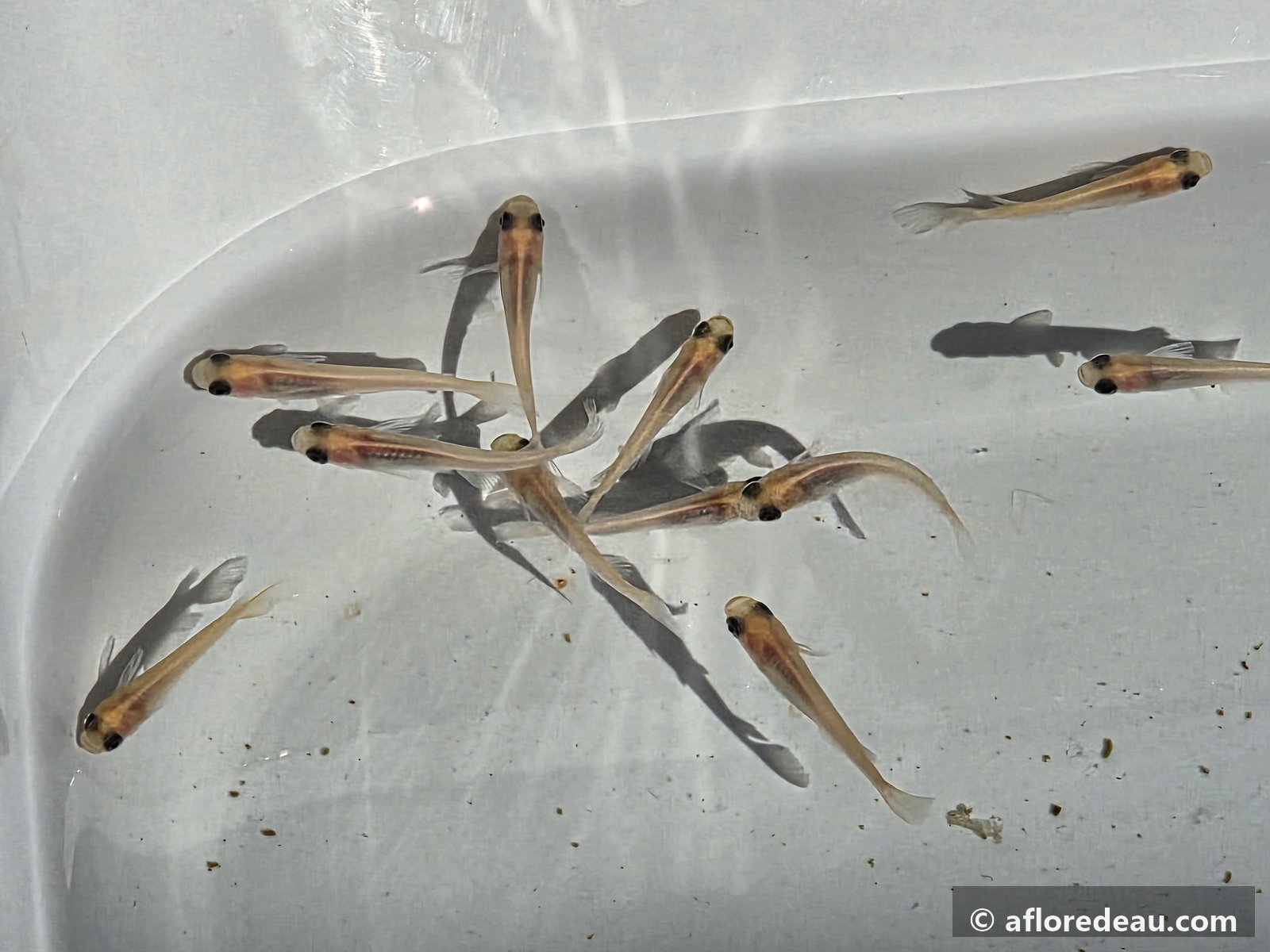
Panda 2.7-3 cm, September 2026 batch in a holding tank: from above, the black-ringed eyes are spotted at once. Photos and video taken at our shop in Lesneven.

Similar varieties
- White medaka: the white body without the panda trait, eye with a bright ring.
- Youkihi: the Youkihi panda combination pairs vermilion with the black eye.
- Kōhaku: also exists in a panda version (no. 0745).
- White Black: white with black spots, often mistaken for a white Panda because of the black.
- Aurora yellow lamé: semi-transparent scales, intermediate between normal and transparent.
Frequently asked questions
Does the Panda see less well?
Nothing suggests so. What is missing is the reflective layer around the eye, not the eye itself. The fish feeds and breeds normally.
Why is the belly transparent?
Because the same iridophores are missing on the abdomen. Without that silver layer, you see the dark abdominal membrane, and sometimes the organs.
Panda and albino: what is the difference?
The albino has no melanin: red eye, very pale body. The Panda has melanin but no ocular iridophores: black eye.
How much does a Panda cost in Japan?
Aquaturtlium quotes about 200 ¥ each for a basic Panda. This is only an order of magnitude; European prices are unrelated.
Sources
- 改良メダカWEB図鑑, “パンダ ~メダカの目の変化の特徴~ メダカの特徴14/44”: medakazukan.net (panda trait)
- 改良メダカWEB図鑑, entries no. 0617 “楊貴妃パンダ” and no. 0745 “紅白パンダ”: 0617, 0745
- 東京アクアガーデン, “パンダメダカ | メダカ図鑑”: https://t-aquagarden.com/column/zukan_medaka_panda
- Aquaturtlium, “パンダメダカの特徴・作出方法から飼育・繁殖方法まで解説”: https://aquaturtlium.com/panda-medaka/
- Aquarium Glaser, “Oryzias latipes – Medaka breeding forms” (Panda White, Panda Grey): aquariumglaser.de