

The Youkihi (楊貴妃) is the vermilion medaka, the variety that set off the wave of improved medaka in Japan. You recognise it by its entirely orange-red body, uniform and without pattern. Its fixation is almost total and keeping it requires nothing special: it is the coloured variety to start with.
Identity card
| Name | Youkihi · 楊貴妃 · Yōkihi. Official JMA name: vermilion medaka (朱赤メダカ), WEB図鑑 entry no. 0001 |
|---|---|
| Trade name | Oryzias latipes youkihi; “Yokihi Orange” at some European wholesalers |
| JMA classification | vermilion (朱赤) · normal scales · normal eyes · no particular iridophores · no pattern · normal fins · normal type |
| Origin | 2004, Ōba Sachio (大場幸雄), Medaka no Yakata, Hiroshima. Derived from a vermilion female that appeared in a tank of amber fish |
| Adult size | 3 to 4 cm |
| Temperature | 5 to 30 °C tolerated; breeding from 18-20 °C, ideal 20-25 °C |
| Difficulty | beginner: fixation rate stated at 99% or more, no delicate sorting |
| Recommended background | dark: the vermilion fades on a pale background |
Recognising a Youkihi
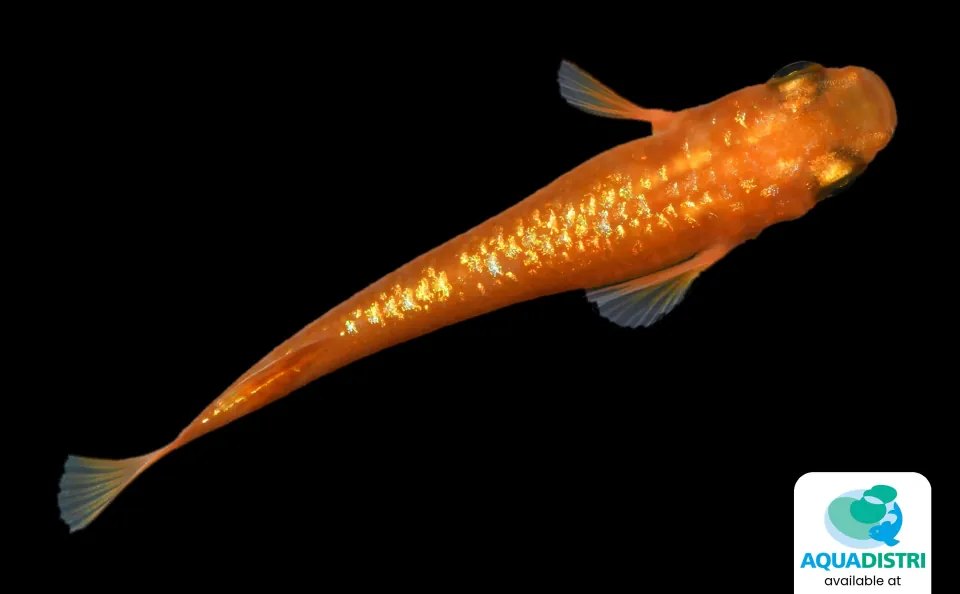
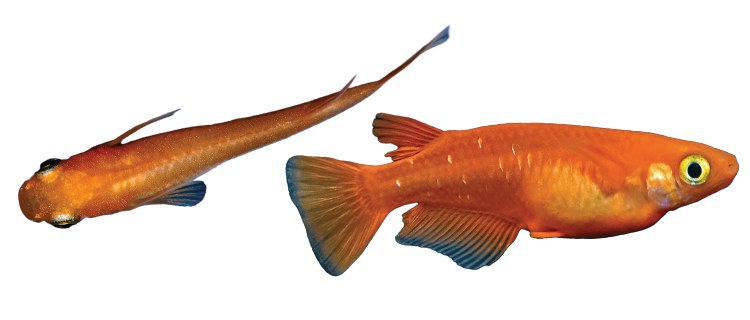
An adult Youkihi is vermilion from head to tail. The colour covers the body and spills over onto the fins. There are no spots, no metallic reflection, no white areas. Seen from above, in a dark tank, it looks almost red. Seen from the side in an aquarium, it leans more towards orange.
The most frequent confusion is with the Himedaka, the classic yellow medaka. The Himedaka is yellow-orange and paler; the Youkihi is clearly vermilion. Young fish complicate the reading: Youkihi fry are born pale and the colour intensifies as they grow. A 2 cm fish does not yet have its final shade.
A fine specimen shows a deep, even colour, with no washed-out patch on the belly or back. In Japan, the name comes from Yang Guifei, one of the famous beauties of ancient China. The WEB図鑑 gave it number 0001: it is the reference variety. More than fifty variants descend from it, from the Youkihi panda to the Youkihi lamé Daruma.
Keeping the Youkihi
The Youkihi is kept like any medaka. Everything is in the tank setup guide: at least 1 litre per fish, settled water, floating plants, no strong current.
Only one particularity matters: the colour depends on the environment. Three levers act together. A dark tank, or a black background, brings out the red. Direct sun outdoors strengthens the shade within a few weeks, as Aquarium Glaser observes with its “Yokihi Orange” strains. Finally, feeding: so-called colour-enhancing foods, rich in carotenoids, maintain the vermilion; see our feeding guide. A Youkihi raised under weak light, in a pale tank, looks like a Himedaka.
The Youkihi winters outdoors in a tank of at least 30 L, with a deep zone. The instructions are on the page about overwintering medaka. Beware in high summer: a dark tank heats up quickly, so shade half the surface.
Breeding the Youkihi
This is one of the variety’s great assets: the WEB図鑑 gives a fixation rate of 99% or more. A pair of Youkihi gives Youkihi. The method is that of the breeding page: spawning mop, egg collection, separate incubation over 250 degree-days, or about ten days at 25 °C.
Sorting remains useful for keeping a quality line. The WEB図鑑’s advice is simple: choose the most intensely coloured fish as breeders. Set aside pale adults, those that keep pale areas and those with a deformed body. As the fry are born pale, wait until 2 to 3 cm before judging the colour.
Crossing a Youkihi with another variety gives heterogeneous offspring, and the uniform vermilion is lost. If the aim is to preserve the variety, breed Youkihi with Youkihi.
Similar varieties
- Yellow medaka (Himedaka): same pigment family, paler yellow-orange shade, the oldest variety.
- Orange medaka: clear orange, less red than the Youkihi.
- Dark orange medaka: deep orange leaning towards vermilion, visually very close.
- Kōhaku: the Youkihi’s vermilion laid in patches on a white body.
- Panda: the Youkihi panda combination is no. 0617 in the WEB図鑑.
Frequently asked questions
My Youkihi is pale orange. Is that normal?
Yes if the fish is young or lives in a pale tank. Switch to a dark background, give more natural light and a colour-enhancing food; the shade strengthens within a few weeks.
Is the Youkihi more fragile than a yellow medaka?
No. It has the same temperature tolerance, 5 to 30 °C, and winters outdoors under the same conditions.
Are Youkihi and Himedaka the same thing?
No. The Himedaka is the old yellow-orange variety. The Youkihi is a 2004 selection, clearly redder, with its own WEB図鑑 entry.
How much does a Youkihi cost in Japan?
In 2021 the WEB図鑑 quoted prices of 1,000 to 2,000 ¥ each depending on the line. This is only an order of magnitude, unrelated to European prices.
Sources
- 改良メダカWEB図鑑, entry no. 0001 “楊貴妃”: https://medakazukan.net/0001_yokihi/
- 改良メダカWEB図鑑, “楊貴妃 誕生物語” (the creation story): https://medakazukan.net/youkihitanjou/
- 改良メダカWEB図鑑, entry no. 0617 “楊貴妃パンダ”: https://medakazukan.net/0617_youkihipanda/
- Aquarium Glaser, “Oryzias latipes – Medaka breeding forms” (Yokihi Orange strain): aquariumglaser.de
- AQUALASSIC, “ヒメダカ 改良メダカ解説” (pigments and colour enhancing): https://www.aqualassic.com/himedaka/
- 東京アクアガーデン, general medaka care guide: https://t-aquagarden.com/guide/medaka_howto