

The yellow medaka, or Himedaka (緋メダカ), is the oldest variety of improved medaka. Its yellow-orange body comes from a mutation that removed its black-pigment cells. Bred in Japan since the Edo period, it is the most widespread, cheapest and simplest medaka: the one you start with when you want to learn.
Identity card
| Name | Yellow medaka · 緋メダカ / ヒメダカ · Himedaka |
|---|---|
| Trade name | Oryzias latipes Yellow; “yellow medaka”, “golden medaka” at some sellers |
| JMA classification | yellow (黄) · normal scales · normal eyes · no particular iridophores · no pattern · normal fins · normal type |
| Origin | Japan, Edo period or earlier according to the WEB図鑑, which cites neither text nor year; selection of a spontaneous mutation of the wild medaka. Creator unknown. |
| Adult size | 3 to 4 cm |
| Temperature | 5 to 30 °C tolerated; breeding from 18-20 °C, ideal 20-25 °C |
| Difficulty | beginner: an old, stable variety, the most tolerant of all |
| Recommended background | dark: Aquaturtlium recommends a black tank to keep the shade, which fades on a pale background |
Recognising a Himedaka
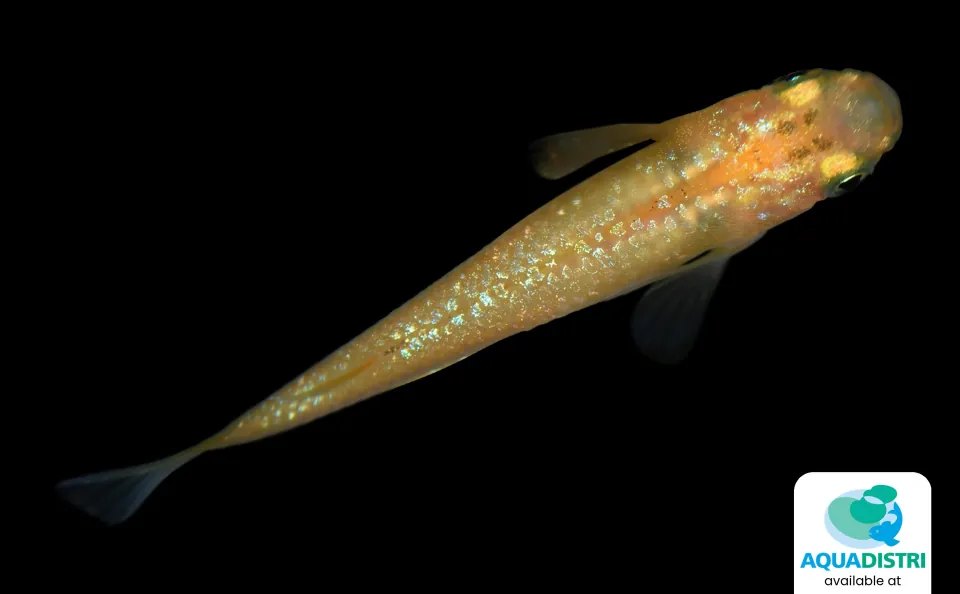
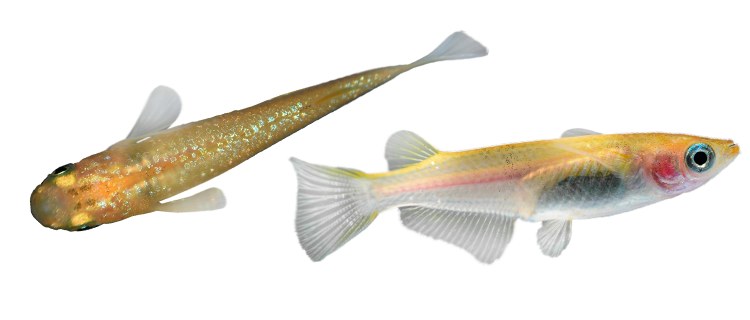
The Himedaka is yellow-orange over the whole body, in a soft shade, neither red nor golden. The fins are translucent, barely tinted. The eyes are black: this is what distinguishes it from an albino, which has a red eye. Seen from above in a dark tank, a group of Himedaka makes a pale orange patch that moves; seen from the side, it looks more yellow.
The genetics are known. A wild medaka has four types of pigment cells: black, yellow, white and reflective. The Himedaka has lost the black cells, the melanophores. The yellow ones remain, hence its colour. The mutation is recessive: two Himedaka give Himedaka, a Himedaka crossed with a wild fish gives brown young that carry the gene.
The most common confusion is with the Youkihi, selected in 2004 from the same pigment family. AQUALASSIC sums up the difference: the Himedaka is yellow, the Youkihi bright orange, and the Kōtei, derived from the Youkihi, dark red. A pale young Youkihi looks like a Himedaka; an adult Himedaka never becomes vermilion. A fine Himedaka has an even colour and a straight body, no more: the variety has no show criterion.
Keeping the Himedaka
It is the reference medaka for learning. Everything in the tank setup guide applies without exception: at least 1 litre per fish, water settled 24 h outdoors, floating plants, no filter needed outdoors. It tolerates 5 to 30 °C and winters outdoors in a 30 L tank with a deep zone, according to our page on overwintering medaka.
Two details improve the colour. A dark tank first: Aquaturtlium notes that a black container limits fading. Then a colour-enhancing food, rich in carotenoids or spirulina, which AQUALASSIC cites for the whole yellow-orange family; see our feeding guide. Without it, the Himedaka stays pale yellow, which is not a flaw.
One rule to observe in Europe as in Japan: never release a Himedaka into the wild. Wikipedia points out that releasing Himedaka threatens wild Japanese populations through hybridisation. Here, Oryzias latipes has no place in a river, yellow or not.
Breeding the Himedaka
Breeding is the easiest of all the varieties, and it is on the Himedaka that you learn the general method: 13 to 14 h of daylight, 20 to 25 °C, spawning mop, egg collection, separate incubation over 250 degree-days, or ten days at 25 °C. Aquaturtlium gives the same thresholds: more than 12 h of light and at least 18 °C.
As the mutation is recessive and the variety old, fixation is total: two Himedaka give Himedaka. There is nothing to sort for colour. You sort only for shape, setting aside young with a curved back or deformed fins, and keep more females than males in the spawning tank. A Himedaka spawning is also the best exercise for learning to raise fry: green water, powder food from the third day, 4 to 5 meals, sorting by size.
Similar varieties
- Youkihi: same pigment family, selected towards vermilion in 2004.
- Orange medaka: more orange than the Himedaka, less red than the Youkihi.
- Dark orange medaka: deep orange.
- Yellow Hikari: yellow with the Hikari type: dorsal equal to the anal, diamond tail.
- White medaka: the other old variety, which appeared after the Himedaka.
Frequently asked questions
Why is the Himedaka so inexpensive?
Because it is old, fixed and mass-produced. In Japan, it is also used as a feeder fish and a laboratory fish; Aquaturtlium quotes about 30 ¥ each. Only an order of magnitude.
Himedaka or Youkihi for a beginner?
Both are easy. The Himedaka is the most tolerant and the cheapest; the Youkihi is redder. The choice comes down to the colour you want to see.
My Himedaka has black eyes. Is it an albino?
No. The albino has red eyes. The Himedaka has lost its black skin cells but keeps black eyes.
Does the Himedaka have a WEB図鑑 entry?
Not a numbered entry of its own. The WEB図鑑 classes varieties by body colour; it places the Himedaka in the yellow group (黄) and presents it as the original variety of that group, on its page about the yellow colour.
Sources
- AQUALASSIC, “ヒメダカ 改良メダカ解説”: https://www.aqualassic.com/himedaka/
- Aquaturtlium, “ヒメダカ(緋メダカ)の特徴・作出方法から飼育・繁殖方法まで解説”: https://aquaturtlium.com/yellow-medaka/
- Wikipedia (ja), “ヒメダカ” (genetics, use, risk of release): https://ja.wikipedia.org/wiki/ヒメダカ
- 改良メダカWEB図鑑, entry no. 0001 “楊貴妃” (for comparison): https://medakazukan.net/0001_yokihi/
- 東京アクアガーデン, general medaka care guide: https://t-aquagarden.com/guide/medaka_howto