

The yellow Hikari is a yellow medaka of the Hikari type: its dorsal fin mirrors its anal fin, its tail forms a diamond, and its back reflects light. It is the oldest colour of the improved medaka, the yellow of the Himedaka, carried by a silhouette that does not exist in nature. A fish for the curious beginner, who learns to read body shape before colours.
Identity card
| Name | Yellow Hikari · 黄ヒカリ · Ki Hikari |
|---|---|
| Trade name | Yellow Hikari medaka; sometimes “Hotaru medaka” (firefly) |
| JMA classification | yellow · normal scales · normal eyes · no classified iridophore, the back’s reflection belongs to the type · no pattern · diamond-shaped tail · Hikari type |
| Origin | Hikari type arising from a mutation spotted by Professor Tomita Hideo, Nagoya University; the year is not published, nor the creator of the yellow form. According to the WEB図鑑, two Hikari parents give 99% Hikari young |
| Adult size | 3 to 4 cm |
| Temperature | 5 to 30 °C tolerated; breeding from 18-20 °C |
| Difficulty | Beginner: a type that is stable in breeding, robust; watch for spinal deformities |
| Recommended background | Dark: it deepens the yellow and brings out the back’s reflection |
Recognising a yellow Hikari
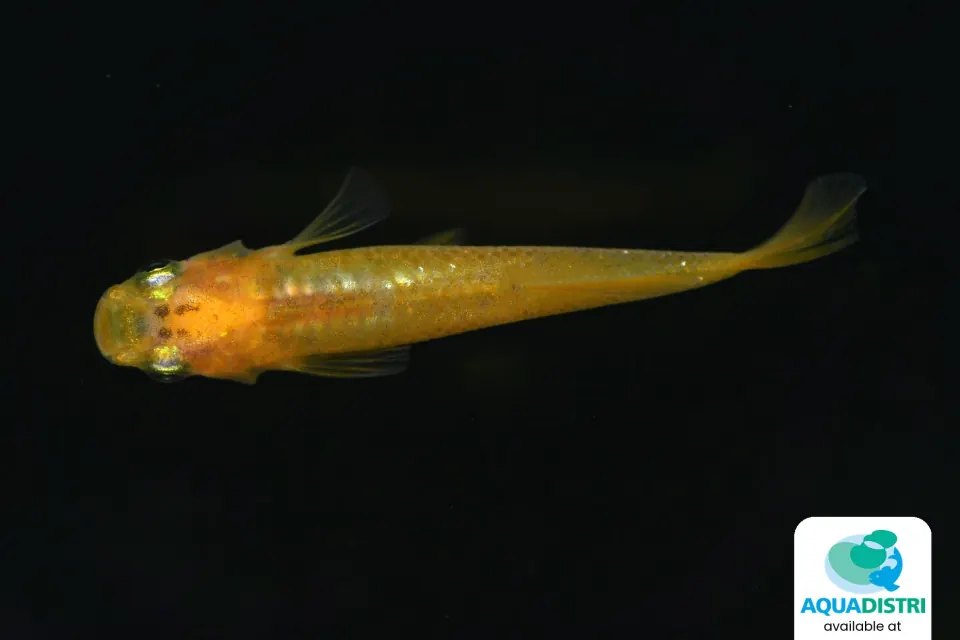
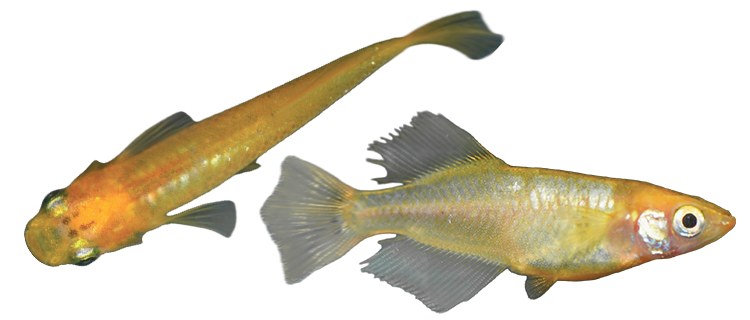
The name reads in two parts. Yellow (黄) is the body colour, that of the Himedaka, the oldest variety of improved medaka. Hikari (ヒカリ) is a body shape, one of the three body types of the JMA classification along with the normal type and the Daruma type. See the page on JMA nomenclature.
The Hikari type is a symmetry. In a normal medaka, the dorsal fin is small and set far back, the anal fin is long. In a Hikari, the dorsal has the same shape and size as the anal, and faces it on the other side of the spine. The tail, rounded or truncated in the normal type, takes a diamond shape, pointing backwards. Seen from the side, the fish looks folded on an axis: the top copies the bottom.
The name Hikari, “light”, comes from another effect of the same mutation. The iridophores that line the belly of medaka, that silvery membrane protecting the organs, are also found on the back. Seen from above, the back shines with a silvery reflection, especially in front of the dorsal fin. This reflection gave the type its name. Today, the word Hikari refers first to the shape of the fins; the reflection has become secondary next to the brighter external light of the Miyuki. According to medakayabase, the mutation was spotted by Professor Tomita Hideo of Nagoya University, and carries the gene name Da.
A fine yellow Hikari has a perfectly symmetrical dorsal and anal, a well-drawn diamond tail and a straight spine. The yellow should be uniform, with no pale patches. Individuals with a curved spine are common in this type, it is its known weakness; they live normally but are not used as breeders.
Keeping the yellow Hikari
No requirements of its own: the care guide covers everything. One litre per fish, pH 7 to 8, 10 to 20% of the water renewed each week. The yellow stands out on a dark background, and a colour-enhancing food supports it; see the feeding page.
The Hikari is worth watching from both sides. In profile, in an aquarium, you appreciate the symmetry of the fins and the diamond of the tail. From above, in a basin, you see the silvery reflection of the back. It is one of the few varieties that is as good in an aquarium as in an outdoor container. It winters outdoors in the usual conditions, in a container of at least 30 litres with a deep zone; see the page on overwintering.
Breeding the yellow Hikari
The Hikari type is one of the most stable in improved medaka. According to the WEB図鑑, a Hikari × Hikari cross gives 99% Hikari-type young. The yellow is passed on well too. A pair of yellow Hikari therefore gives almost entirely true offspring, which makes it a good first selection project.
The reverse does not work: you cannot make a Hikari from normal-type medaka. The mutation is rare and medakayabase advises against trying. To introduce the type into another colour, cross a Hikari with the desired colour and re-sort over several generations.
Sorting focuses on the spine. Vertebral deformities are more frequent in Hikari than in normal types. Set aside any youngster whose back undulates seen from above, and keep those whose dorsal and anal are most symmetrical. The breeding method does not change: spawning mop, collection, 250 degree-days of incubation.
A practical point: the usual sexing relies on the male’s dorsal and anal fins, larger and serrated. In a Hikari, the dorsal copies the anal in both sexes, which blurs the cue. The answer fits in one line: read the shape, not the size. The male has the dorsal and anal in a parallelogram, with a clear notch at the rear base of the dorsal and a serrated edge; the female has them in a trapezoid, rounded at the end, with no notch. We detail the method, cue by cue, in how to sex a Hikari medaka.
Our yellow Hikari in photos and video
Yellow Hikari 2-3 cm, September 2026 batch: the reflective back of the Hikari type is visible from above. Photos and video taken at our shop in Lesneven.


Similar varieties
- Yellow (Himedaka): same colour, normal type.
- Orange: deeper colour, normal type.
- Miyuki Daruma: the other JMA body shape, short body.
- Blue external light: a shiny back of a different origin, the Miyuki’s external light.
Frequently asked questions
Are Hikari and Miyuki the same thing?
No. Hikari is a body shape, with a dorsal symmetrical to the anal and a diamond tail. Miyuki is a band of external light on the back, on a normal-type body. A Miyuki of Hikari type exists; it combines both.
My Hikari has a twisted back. What can I do?
Nothing cures it. It is a common deformity in this type. The fish lives normally; you simply do not breed it.
Where does the name “firefly” come from?
From the silvery reflection of the back, visible from above: the WEB図鑑 recalls that the Hikari type was for a time called Hotaru medaka, the firefly medaka.
Is the Hikari type fragile?
No more than any other, apart from vertebral deformities. It eats, spawns and overwinters like a normal medaka.
Sources
- 改良メダカWEB図鑑, “ヒカリ体型 ~メダカの体型の特徴~”, medakazukan.net, trait 41/44
- Medakaya Base, “メダカのヒカリ体型を解説!”, medakayabase.com/blog/hikaribody/
- JMA manual, 5th edition, morphology group, cited via the medaka.fr editorial base
- TAG and Kamihata, sexing and breeding, cited via the medaka.fr editorial base