
In a normal-type medaka, you sex by looking at two fins: the dorsal, notched in the male, and the anal, a parallelogram in the male and a trapezoid in the female. In a Hikari, the dorsal is a copy of the anal, which is baffling at first glance. In fact, the method does not change: the two fins each carry the same marks, and the notch at the base of the dorsal remains the most reliable cue. Here is how to read a Hikari, cue by cue, and then how to sort a batch without mistakes.
Reminder: what you look at on a normal medaka
The basic method is described in sexing medaka and choosing breeders. In short, in the male the dorsal has a notch at its rear base, its edges are serrated, and the anal is long, with a straight lower edge, shaped like a parallelogram. In the female the dorsal is rounded, with no notch, and the anal narrows towards the tail, in a trapezoid. The male’s body is slimmer, the female’s rounder at the belly, especially in the spawning season. The male uses these fins to clasp the female during spawning, which is why they are larger.
What changes in a Hikari
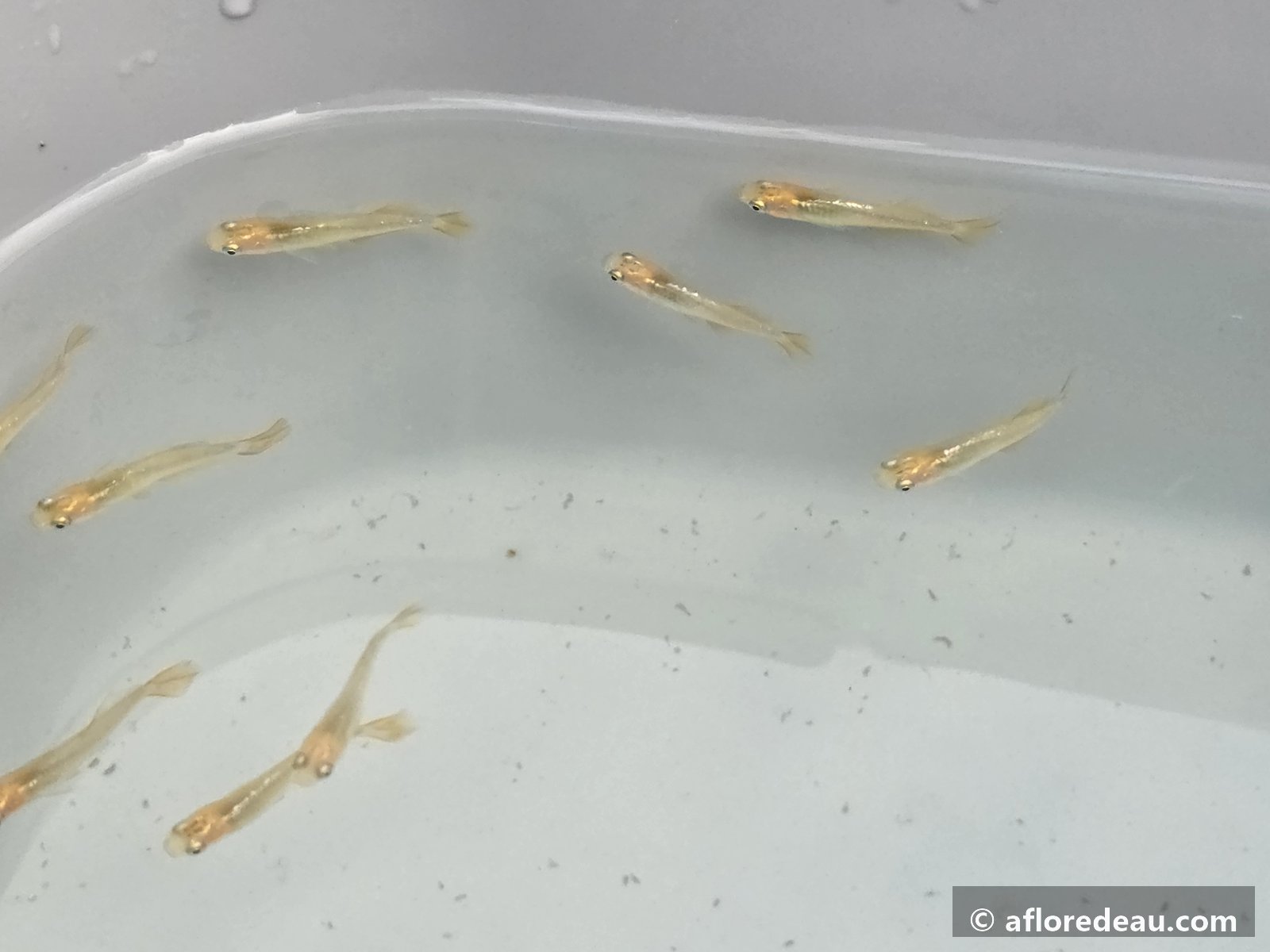
The Hikari type is a mutation that makes the fish symmetrical from top to bottom: the tail becomes a diamond, and the dorsal takes the shape and size of the anal, as if the anal had been copied onto the back. The silvery reflection of the belly also runs up onto the back, hence the name. These are the fish described on our yellow Hikari page.
Consequence for sexing: the usual contrast between a small dorsal and a large anal disappears. A beginner who sees a large dorsal concludes “male” and is wrong one time in two, because the female Hikari also has a large dorsal. You have to read the shape, not the size.
The cues, one after the other
1. The notch at the base of the dorsal
This is the main cue, the one Japanese breeders put first for this type. In the male Hikari, the dorsal has a clear notch at its rear base, where the fin meets the caudal peduncle, exactly as on a normal male. In the female, the base is continuous, with no indentation. You see it from the side, with the fish still in a small transparent container or a sorting box with flat walls.
2. Parallelogram or trapezoid
In the male, the dorsal and anal are both parallelograms: the free edge is roughly parallel to the body, and the fin keeps its height to the rear. In the female, both are trapezoids: the fin is taller at the front and tapers towards the tail, with a rounded tip. As the two fins echo each other, you get the same information twice, which helps when one is damaged.
3. The serrated edge
In the male, the end of the anal fin, and often of the dorsal, is serrated, with the rays slightly protruding beyond the membrane. In the female, the edge is smooth and rounded. This is a confirming cue, less clear on a young or thin fish.
4. Body and behaviour
The male is slimmer and more nervous; he follows the females and positions himself beneath them in the morning, in season. The female has a fuller belly, and sometimes carries her cluster of eggs in the early morning, which settles the question. Seen from above, some Japanese breeders add the shape of the snout, flatter in the male, rounder in the female; it is a hint, not proof.
At what age, and how to sort a batch
As with the normal type, the fins take their final shape at about 2.5 to 3 cm, that is two to three months after hatching for well-fed young born in spring. Before that, everyone has short, rounded fins, and you get it wrong. A thin fish is also hard to read: feed the batch well for two weeks before sorting.
The simplest way to sort, described by GEX: net several fish at once with a large net, let them settle in a shallow white container, and remove the males one by one with a small fry net. The white container makes the silhouette of the fins stand out. Medaka jump during this handling, so cover whatever you are not watching.
For breeding, keep one male for two females, or two males for four to five females, in a tank of 20 to 30 litres, as for any medaka. A Hikari breeds true: the type is fixed, and two Hikari parents give Hikari young.
The cases that complicate things further
- Long-finned Hikari (Hirenaga). When the fins lengthen, in a veil or swallow shape, the geometric form is lost. The advice of Japanese breeders is to sex the young at about 1.5 cm, before the fins grow, then mark or separate them. On an adult, fall back on the serrated edge in the male against the rounded one in the female. Our Saboten, a Hirenaga, is in this case.
- Hikari Daruma. The short body reduces the fins in proportion, but the cues stay the same: notch, parallelogram, serrated edge. You simply look more closely.
- Twisted back. The Hikari type has a share of individuals with a curved spine. A dorsal deformed by the curvature can no longer be read; judge by the anal alone, and do not make the fish a breeder.
Key points to remember
| Male Hikari | Female Hikari | |
|---|---|---|
| Base of the dorsal | clear notch at the rear | continuous, no notch |
| Shape of dorsal and anal | parallelogram, same height to the rear | trapezoid, taller at the front, rounded tip |
| Fin edge | serrated | smooth |
| Body | slim, nervous | full belly, eggs in the morning in season |
| Reliable age | 2.5 to 3 cm, two to three months; about 1.5 cm for long fins | |
Frequently asked questions
My Hikari has a large dorsal, so is it a male?
No. In a Hikari, the female also has a large dorsal, a copy of her anal. Look at the shape and the notch, not the size.
Should I look from above or from the side?
From the side, in a container with flat walls. The cues are in the profile of the fins. From above, you only see the reflection of the back and, possibly, the snout.
I cannot see the notch.
Either the fish is too young, or it is thin, or the fin is folded. Wait until it exceeds 2.5 cm, feed it well, and observe it still, in daylight, on a white background.
Can a Hikari breed with a normal medaka?
Yes, they are the same species. The young will be of normal type, with a slightly wider dorsal than usual: the complete Hikari body requires two copies of the gene, and a single copy shows only as a widened dorsal (see heredity in medaka); to keep the Hikari, cross Hikari with Hikari.
Sources
- Aqua Life blog, メダカQ&A No.001, メダカのオスとメスの見分け方は?品種別の見分け方も紹介: basic method, ヒカリ体型 (dorsal = anal, same reading), ダルマ, ヒレ長 (sex at about 1.5 cm, serrated or rounded edge in the adult), blog.mpj-aqualife.com/archives/14288.
- Oyama Medaka Center, メダカの体型とオス、メスの見分け方: male Hikari with dorsal and anal in a parallelogram with 切れ込み, female in 台形, oyama-medaka-center.com/osuormesu.html.
- GEX, メダカのオス・メスの見分け方と、簡単な選別方法: serrated dorsal and parallelogram anal in the male, sexing at about three months, sorting with two nets, gex-fp.co.jp.
- Tokyo Aqua Garden, メダカのオス・メスを見分ける方法: dorsal notch, long quadrangular anal fin, body, t-aquagarden.com/column/medaka_discern.