
A male medaka is recognised by its parallelogram-shaped anal fin with a serrated edge and its larger dorsal fin; the female has rounded fins and a rounder belly. Sexing is reliable on adult fish, from about 2.5 to 3 cm. To choose breeding stock, look first at the line of the back, the symmetry and the tail fin, before the colour, and judge a pair by what it passes on, that is, its fixation rate.
Telling male from female, fin by fin
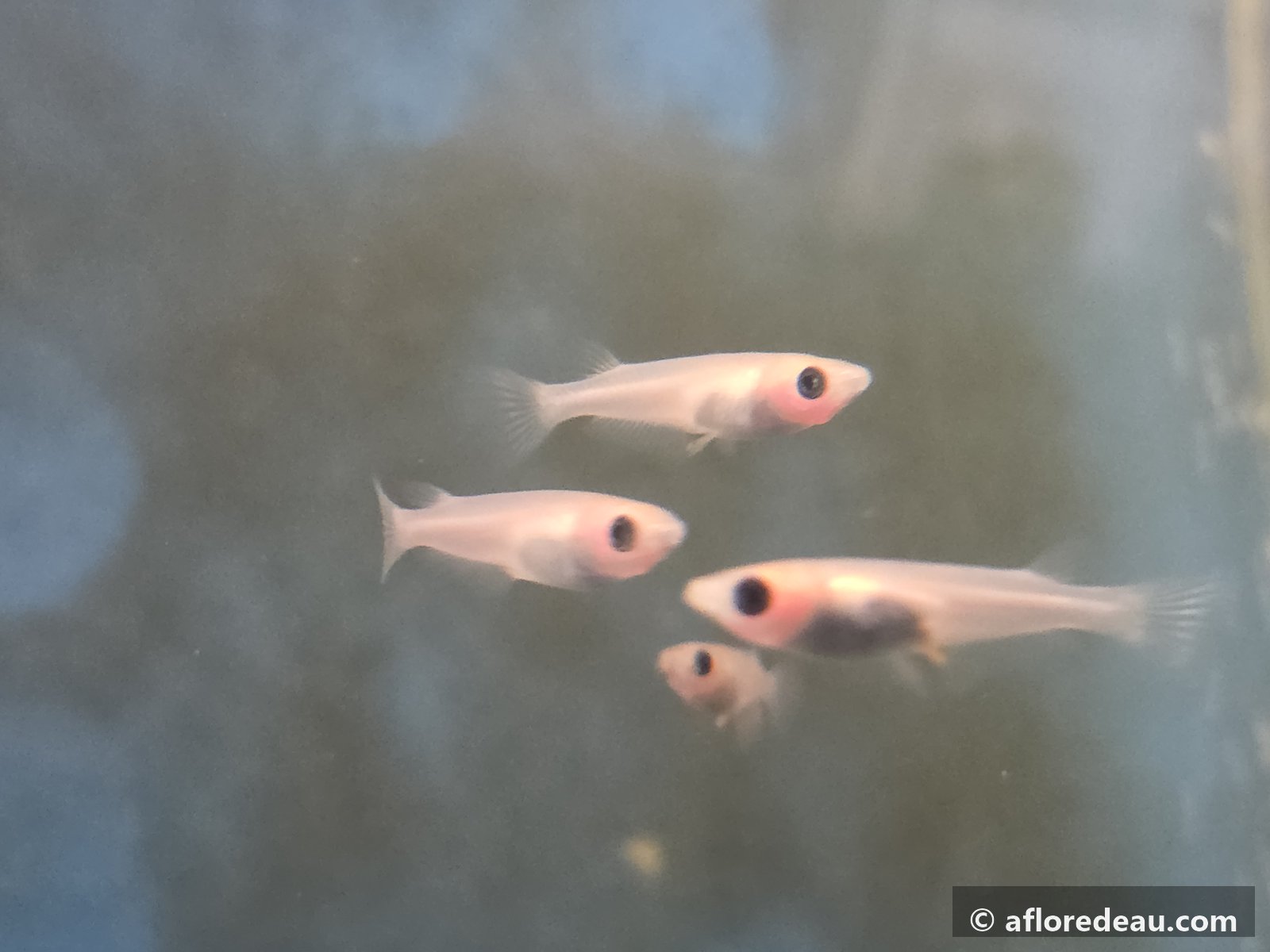
In Oryzias latipes, the two sexes are the same size and often the same colour. The difference is in the fins. Look at the fish from the side, in a small transparent container or against the glass.
The anal fin is the most reliable criterion. In the male, it is large, elongated in a parallelogram, and its free edge is serrated, almost fringed. In the female, it is shorter, narrower towards the rear, and its edge is smooth. The dorsal fin confirms it: the male’s is larger, and in many varieties it has a small notch at the rear, whereas the female’s is short and rounded. Samurai (サムライ) males take this trait further, with a split dorsal fin. The tail fin tells you little, except in Longfin forms where the male carries longer rays.
The body helps next. The female has a rounder belly, especially in the spawning season, and a belly line that slopes down towards the anal fin. In the morning, she often carries a cluster of eggs under the belly: any doubt is then settled. The male is more slender, and in season he chases the females and circles around them, spreading his fins.
At what age to sex
The fins take their final shape with maturity. Below 2 cm, all young fish have short, rounded fins, and you will get it wrong. Sexing becomes reliable at about 2.5 to 3 cm, that is around two to three months for young born in spring, well fed and kept at 25 °C, according to Aqua Life; in cooler water, allow longer. That is why fish of 2.7 to 3 cm can be sexed on request, whereas young fish of 1.5 to 2 cm cannot be sexed with any guarantee.
In Hikari (ヒカリ) types, the dorsal and anal fins are symmetrical and both large: the serrated edge of the male’s anal fin remains the marker. In Daruma (ダルマ), the short body distorts the reading a little, and the female’s round belly is even more pronounced. In Longfin, the elongated fins of both sexes mean you look at the shape, not the length.
How many breeders per tank
A breeding tank holds more females than males. One male fertilises several females, and two males for one female wear her out. The basis is a trio, one male and two females, or a family of two males and four or five females in a tank of 20 to 30 litres. Respect the density of one litre per fish at the minimum. For selection work, prefer a small number of chosen fish to a large tank where you no longer know who fertilised whom. How spawning unfolds is covered in breeding medaka: spawning, eggs and incubation.
The breeding stock, taneoya (種親), receive a generous diet, two to three small meals a day in season, with a rich food such as Hikari Medaka Breed. A female that spawns every day spends a lot, and a thin female lays few eggs.
What to look at in a “good” medaka
Japanese standards, those of the JMA (日本メダカ協会) and the selection sheets of the WEB図鑑, judge body shape first, then the colour and the traits of the variety. A very colourful fish on a twisted body is worth nothing for selection, because the fault is passed on. Look at the fish from above, as in a Japanese tub, then from the side.
For all types, first eliminate structural faults: a curved spine, seen from above or from the side, a body that is too thin, a deformed or hollowed head, missing fins, a badly formed mouth. These fish can live a long time and make good ornamental fish, but not breeding stock. In varieties with modified eyes, a hollow in the head is a common fault that people forget to check (medakazukan.net).
Normal type
The normal type (普通体型) is the silhouette of the wild form. What you look for is a straight or evenly curved back line, with no break, a body neither short nor spindly, and complete fins that are symmetrical from above. The WEB図鑑 warns against fish with a slightly shortened body: there is a continuous gradation between the normal type and the Daruma, and keeping slightly short breeders makes the strain drift towards semi-Daruma without intending it (medakazukan.net).
On colour, a simple criterion separates two healthy fish: colour present right up to the ventral ridge, the belly line, signals a denser body colour, and these fish give better coloured offspring (medakazukan.net). For varieties with external light such as the Miyuki (幹之), you want a band that rises as far as possible towards the head. For metallics, a dense and regular spread of shiny scales. For Sanshoku (三色), the pattern is unpredictable and you select on the balance of the three colours; see the metallic Sanshoku sheet.
Hikari type
The Hikari type (ヒカリ体型) is a symmetry of the top and bottom around the spine: the dorsal fin has the shape and size of the anal fin, the tail fin is diamond-shaped, and the back carries the reflection of the belly. Three selection points dominate. The dorsal fin must be as large as the anal fin, because it is the one that atrophies most easily. The tail fin must have its axis in the middle, with no narrowed upper lobe. And the tip of the tail fin, made up of two lobes, must stay whole, with no split (medakazukan.net).
The Hikari fixes very well: a Hikari pair gives almost only Hikari, about 99% according to the WEB図鑑, which makes it an accessible type for starting selection. The point to watch is the appearance of normal-type tail fins in some offspring, which disqualifies them in competitions (medakazukan.net).
Daruma type
The Daruma type (ダルマ体型) has shortened vertebrae and a body about half the length of a normal type. It is classed as intermediate level, because it is sensitive to variations in temperature and water quality, spawns less, and is prone to digestive blockage. Three selection criteria: a smoothly curved back line with no hump, whose peak falls ideally vertically above the anal fin; a moderate belly, because a female with a distended belly often retains her eggs and no longer spawns; and horizontal swimming, because Daruma have a fragile swim bladder and tip over, especially in the cold (medakazukan.net).
For breeding, cross a Daruma with a semi-Daruma rather than two Daruma, which give few eggs and many sterile ones. The trait is expressed during incubation: above 28 °C, between 28 and 32 °C, a share of the fry hatch as Daruma. Afterwards, keep the fish between 25 and 28 °C. The Miyuki Daruma sheet details this cross.
The fixation rate
A “good” medaka is not only a beautiful fish, it is a fish that passes things on. The fixation rate, koteiritsu (固定率), is the share of the offspring that reproduces the parents’ trait. The WEB図鑑 considers a variety fixed from 30%; a Hikari gives 99%, a Neptune about 70%, a Sanshoku far less. It depends on the variety, but also on the pair: two Kōhaku (紅白) from the same tank do not give the same proportion of good patterns. It is estimated by raising a whole spawning to 2 or 3 cm and counting what you get. The vocabulary is gathered in the glossary and the reading of a variety name in the JMA nomenclature.
Maintaining a strain over several generations
The method is that of Japanese breeders since the first Youkihi (楊貴妃): in each generation, you raise many young, sort them severely, and keep only a small fraction as breeders. Sorting, senbetsu (選別), is done in several passes. At about 2 cm, remove the deformed bodies. At about 3 cm, remove those that do not have the desired trait or have it poorly. At maturity, choose the pairs on shape, colour, and what you know of their parents. One generation a year outdoors, two in a heated aquarium.
Keep a notebook: origin of the pair, spawning date, number of young, what you kept. Without it, within two seasons you forget who descends from whom. Always keep a few reserve fish from one generation to the next, so as not to lose the strain through a tank accident.
When to renew the blood
A strain closed in on itself ends up accumulating faults: smaller bodies, curved spines, sterile eggs, weak fry. These are the signs that inbreeding is taking its toll. There is no numerical rule valid for all varieties. Japanese breeders hold that, starting from a single pair, three generations generally pass without damage, and that the risk lies less in the number of generations than in the number of breeders: keep several males and several females in each generation. The principle is to watch for these signs and, when they appear, to introduce one or two fish of the same variety from another breeder. Cross the newcomer with the best females of the strain, then re-sort the offspring against your own criteria. The trait may drop for one generation before rising again.
Conversely, renewing too often prevents anything from being fixed. A breeder aiming for a stable variety works a closed line for as long as the fish stay healthy, and opens it only when necessary.
The figures to remember
| Male | parallelogram anal fin with serrated edge, larger dorsal fin |
|---|---|
| Female | rounded fins, rounder belly, eggs under the belly in the morning |
| Reliable sexing | from about 2.5 to 3 cm |
| Ratio | more females than males |
| Density | 1 litre per fish at the minimum |
| Fixed variety | fixation rate of at least 30% (WEB図鑑) |
| Hikari × Hikari | about 99% Hikari |
| Daruma | Daruma × semi-Daruma, incubation at 28 to 32 °C, kept at 25 to 28 °C |
Frequently asked questions
Can you sex medaka of 1.5 cm?
Not reliably. The fins take their final shape only at maturity, at about 2.5 to 3 cm. Before that, you are only guessing.
Does a female spawn without a male?
Yes, she can carry eggs, but they are not fertilised: they stay white and go mouldy. You need at least one healthy male in the tank.
Should breeders be young or old?
Adults in their first or second season. A three-year-old female lays less. Young of the year born in spring can spawn from late summer in a heated aquarium.
Can a fish with a twisted back be used as a breeder?
No. The fault is partly passed on. It can live in an ornamental tank, but exclude it from breeding.
Can two different varieties be crossed?
Yes, they are all Oryzias latipes. That is how new varieties are born, but the first generation is often dull and the result takes several generations of sorting.
Sources
- 改良メダカWEB図鑑, “普通種の選別ポイント” (selection points for the normal type), https://medakazukan.net/tutsuusyupoint/
- 改良メダカWEB図鑑, “ヒカリ体型の選別ポイント” (selection points for the Hikari type), https://medakazukan.net/hikaripoint/
- 改良メダカWEB図鑑, “ダルマ体型の選別ポイント” (selection points for the Daruma type), https://medakazukan.net/dharmapoint/
- 改良メダカWEB図鑑, “図鑑の見方” (how to read the guide), https://medakazukan.net/mikata/
- 改良メダカWEB図鑑, FAQ, https://medakazukan.net/faq/
- Tokyo Aqua Garden, “産卵後の魚のケア” (care of fish after spawning), https://t-aquagarden.com/column/care_spawning_fish
- Kamihata and Tokyo Aqua Garden, medaka keeping guides (sexing)