
Medaka spawn almost every day once the water exceeds 18 to 20 °C and the day lasts 13 to 14 hours. The female attaches her eggs to a plant or a spawning mop, and they need to be removed, because the parents eat eggs and fry. Then allow 250 degree-days of incubation, that is 10 days at 25 °C, with daily checks that raise the hatching rate from 30-50 % to 70-90 %.
What triggers spawning
Three conditions must be met. The first is temperature: Oryzias latipes start breeding from 18-20 °C, and spawning is regular between 20 and 25 °C. Above 30 °C, the fish are stressed and spawning becomes erratic. The second is light: 13 to 14 hours of daylight are needed. Outside the breeding season, 8 to 10 hours are enough, and it is this shortening that puts the fish at rest. The third is food: a female that spawns every day spends a lot of energy and must eat twice a day in summer, in small portions eaten in two to three minutes.
In Europe, these conditions occur naturally from April-May to September depending on the climate. In a mild Atlantic climate such as Brittany, the water of an outdoor tub reaches 20 °C later than in a Mediterranean one, but the long days of June are the same everywhere. In a heated, lit aquarium, you can have them spawn all year round, provided you respect the light rhythm and give the females rest periods. The detailed calendar is in medaka through the seasons.
Setting up the breeding tub
First you need to know who is who. The male has a larger dorsal and anal fin, the anal fin shaped like a parallelogram with a serrated edge. The female has rounded fins and a rounder belly. The fin-by-fin detail is in sexing medaka and choosing breeders.
A breeding tub holds more females than males. One male fertilises several females, and too many males wear the females out with continual chasing. One male to two females is a common working basis. Respect the general density of at least one litre per fish, and provide hiding places with plants. A small dozen fish in a 20 to 30 litre tub is a good format for a family of breeders.
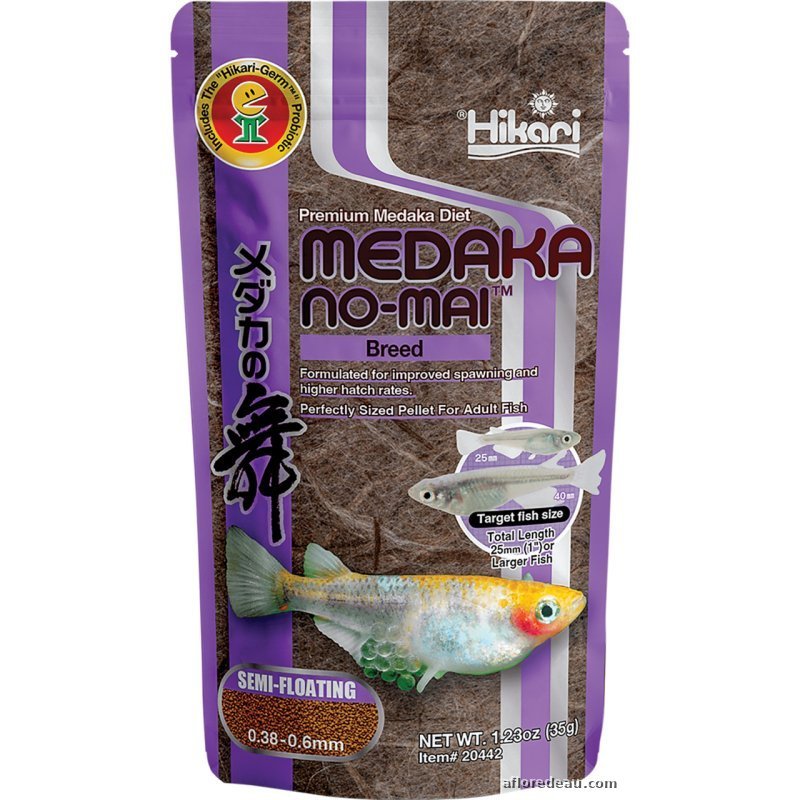
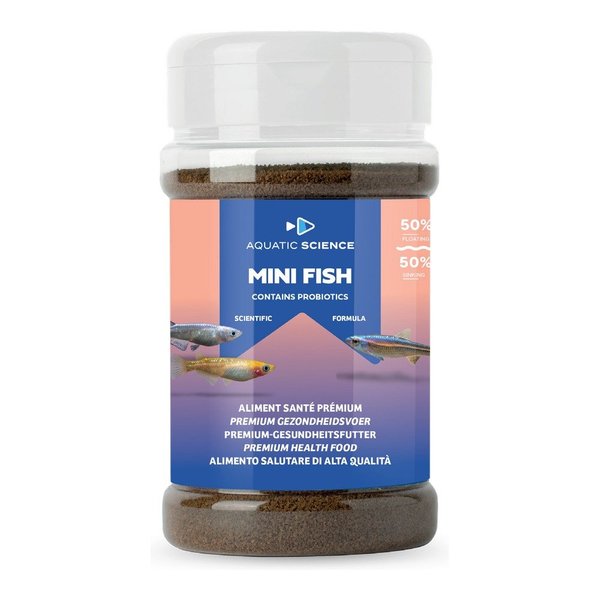
During the season, feed the breeders two to three times a day in small amounts rather than one big meal. A rich food designed for breeding is suitable, for example Hikari Medaka Breed, grain of 0.38 to 0.6 mm. Aquatic Science’s Mini Fish, at 43 % protein, is also given to breeders, in small pinches since part of it sinks. The rest of the feeding is covered in the complete feeding guide.
The spawning medium: plants or mop
In the morning, the female swims with a cluster of eggs stuck under her belly. During the day, she rubs them against a medium and the eggs stay attached by their filaments. Two media work. Plants with fine leaves, such as hornwort, Java moss or the roots of floating plants, frogbit for example, naturally receive the eggs. This is the solution for the planted biotope, but it makes collecting tedious.
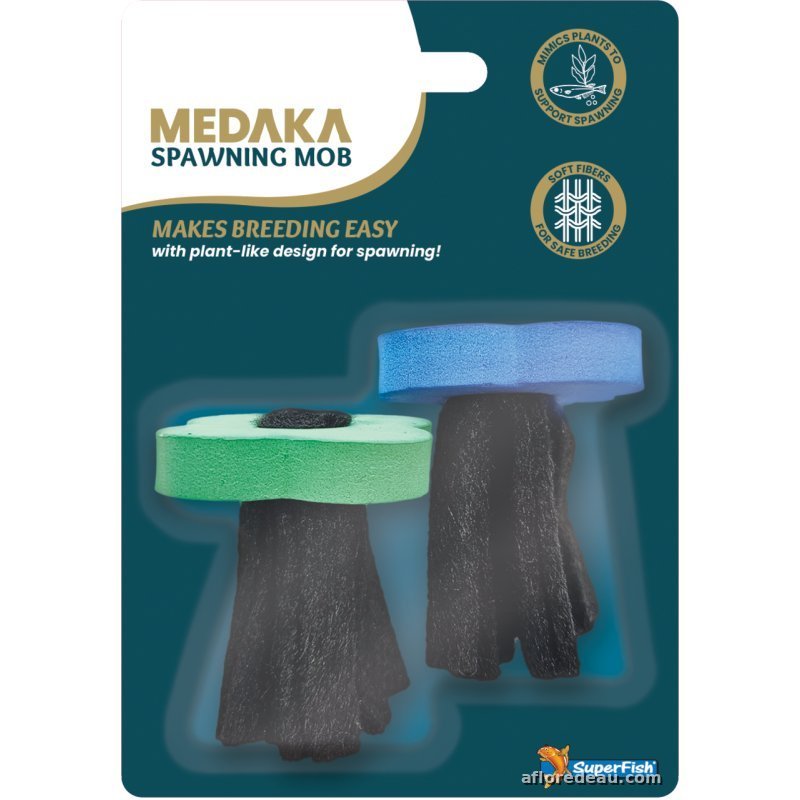
The spawning mop, or sanranshō (産卵床), is a pad of synthetic fibres mounted on a float. The females take to it quickly, and it can be lifted out of the tub in one movement to examine the eggs. It is the most practical medium for anyone who wants to collect. You need one per tub, two in a large tub so that the females do not get in each other’s way. The spawning mops are reusable from one season to the next after rinsing.
Collecting the eggs
Collection, sairan (採卵), consists of removing the eggs from the parents’ tub to incubate them separately. Without it, the adults eat most of the eggs and almost all of the fry. Inspect the medium every day or every other day, preferably in late morning, when the females have laid the day’s clutch.
Each clutch has 10 to 30 eggs, and a healthy female can give several hundred eggs over a season (tokyoaquagarden.com). The eggs are attached in a cluster by filaments. Detach them with your fingers by gently rolling them, which also separates the filaments. A fertilised egg is transparent to pale yellow, firm under light pressure. An unfertilised egg is white, opaque, and crushes under the finger (t-aquagarden.com). Keep the former and throw away the latter straight away.
The eggs go into a small container of water, with no substrate and no fish. A bowl, a clear box or a floating rearing basket placed in the main tub will do. The basket has the advantage of keeping the eggs at the temperature of the tub. Space the eggs out rather than leaving them in a heap, so that oxygen circulates around each one.
Incubating: the 250 degree-day rule
The incubation time depends on temperature, and the rule is simple: you need to accumulate about 250 degree-days. Multiply the average water temperature by the number of days. At 25 °C, you reach 250 in 10 days. At 22 °C, it takes 11 to 12 days. At 20 °C, 13 days. Below 20 °C, incubation drags on and mould gains ground: avoid long cool periods.
| Water temperature | Incubation time |
|---|---|
| 20 °C | about 13 days |
| 22 °C | 11 to 12 days |
| 25 °C | about 10 days |
These values are benchmarks, not fixed dates. An outdoor tub goes through cool nights and hot afternoons, and it is the average that counts. One point of caution: above 28 °C, the Daruma gene present in all medaka can be expressed and give shortened bodies; Tokyo Aqua Garden deliberately incubates Daruma at 28 °C and above, with a clear effect around 30 °C. For a normal-type strain, incubate between 20 and 26 °C.
Around day 8 to 12, two black dots appear in the egg: these are the eyes. At this stage, the embryo is well formed and you can sometimes already see it moving. This is the signal for the next step.
Mould, methylene blue and white eggs
Mould is the first enemy of incubation. It almost always starts from an unfertilised egg or a dead embryo, then spreads to neighbouring eggs by contact. A healthy egg, alone and in clean water, rarely goes mouldy. The whole method therefore consists of isolating the viable eggs and removing the others.
Three steps are enough. First, a daily water change of the incubation container. You can use tap water that has not been left to stand: the chlorine in French tap water is low and it limits mould without harming the egg, whose shell protects it (t-aquagarden.com). Next, methylene blue at low dose, 1 to 2 drops per litre, until the water is pale blue (t-aquagarden.com). The product slows fungi and stains dead eggs blue, making them easy to spot. Redose after each water change. Finally, remove white or blue eggs daily, with a pipette or tweezers, before they contaminate the rest.
Methylene blue is sold in pet shops and pharmacies. At the stated dose, it is not dangerous to the eggs. It stains everything it touches, including fingers and silicone seals.
When to stop the treatment, and hatching
As soon as the eyes are visible, move the eggs into water without methylene blue. The embryo is then advanced enough that mould is no longer the main threat, and the fry must hatch in water that contains no product. For these last days use water that has been left to stand or conditioned, like that of the rearing tub. If the eggs are in a floating basket, you simply stop dosing.
Hatching most often takes place in the morning, and rarely all at once. The eggs of one clutch can open over two or three days. If the eyes have been visible for a long time and nothing comes out, the cause is almost always water that is too cool: see why eggs do not hatch. The newborn, called harigo (針子), measures a few millimetres and lives two to three days on its yolk reserve. It must eat from the third day: what follows is in raising medaka fry.
How many fry to expect
With this daily follow-up, the hatching rate is between 70 and 90 %. Without collection or treatment, in the parents’ tub, it falls to 30-50 % and most of those hatched are eaten. A family of six or seven breeders thus produces far more fry than an ordinary tub can house. You need to plan the space, or deliberately limit collection to what you can raise. A hundred fry already need a 30 to 40 litre tub to grow without crowding.
Finally, the females tire. After a few weeks of daily spawning, you can rest them by reducing the lighting or separating them from the males, with a generous diet. This is what keeps breeders healthy over two or three seasons.
The figures to remember
| Spawning temperature | from 18-20 °C, regular from 20 to 25 °C |
|---|---|
| Day length | 13 to 14 hours to spawn; 8 to 10 hours for rest |
| Male/female ratio | more females than males |
| Eggs per clutch | 10 to 30, several hundred per season |
| Incubation | 250 degree-days: 13 d at 20 °C, 11-12 d at 22 °C, 10 d at 25 °C |
| Methylene blue | 1 to 2 drops per litre, pale blue water, until the eyes appear |
| Eyes appear | day 8 to 12 depending on temperature |
| Hatching rate | 70-90 % with follow-up, 30-50 % without |
| Yolk reserve | 2 to 3 days, first meal on day 3 |
Frequently asked questions
My medaka are not spawning: why?
First check the water temperature, which must exceed 18-20 °C, then the day length, at least 13 hours. Then check that you do have males and females, and that the fish are adult and well fed. An underfed female does not produce eggs.
Can you leave the eggs in the parents’ tub?
Yes, but you get few fry: 30 to 50 % hatching and most of the newborns are eaten. In a heavily planted biotope, a few fry survive each year. For a managed breeding programme, you collect.
Do you need a heater to incubate?
No, if the water is above 20 °C. An outdoor tub in June or July is enough in temperate Europe. Below 20 °C, incubation lengthens and mould gains ground: a small heater set to 24-25 °C is then useful.
The eggs are all turning white: what should I do?
Either they were not fertilised, often for lack of a male or a fit male, or mould has spread from one or two dead eggs. In the second case, remove the affected eggs every day, change the water daily and dose the methylene blue.
How long does a female spawn?
As long as the conditions are met, almost every day for several months. A female of two or three years spawns less. Rest periods prolong her life as a breeder.
Sources
- Tokyo Aqua Garden, “Medaka eggs”, https://tokyoaquagarden.com/medaka-eggs
- Tokyo Aqua Garden, “メダカの卵のカビ対策”, https://t-aquagarden.com/column/medaka_eggs_mold
- Tokyo Aqua Garden, “産卵後の魚のケア”, https://t-aquagarden.com/column/care_spawning_fish
- 改良メダカWEB図鑑, FAQ, https://medakazukan.net/faq/
- Kamihata, medaka-keeping guide (temperature, light, density)
- À Flore d’Eau keeping guide, afloredeau.com