
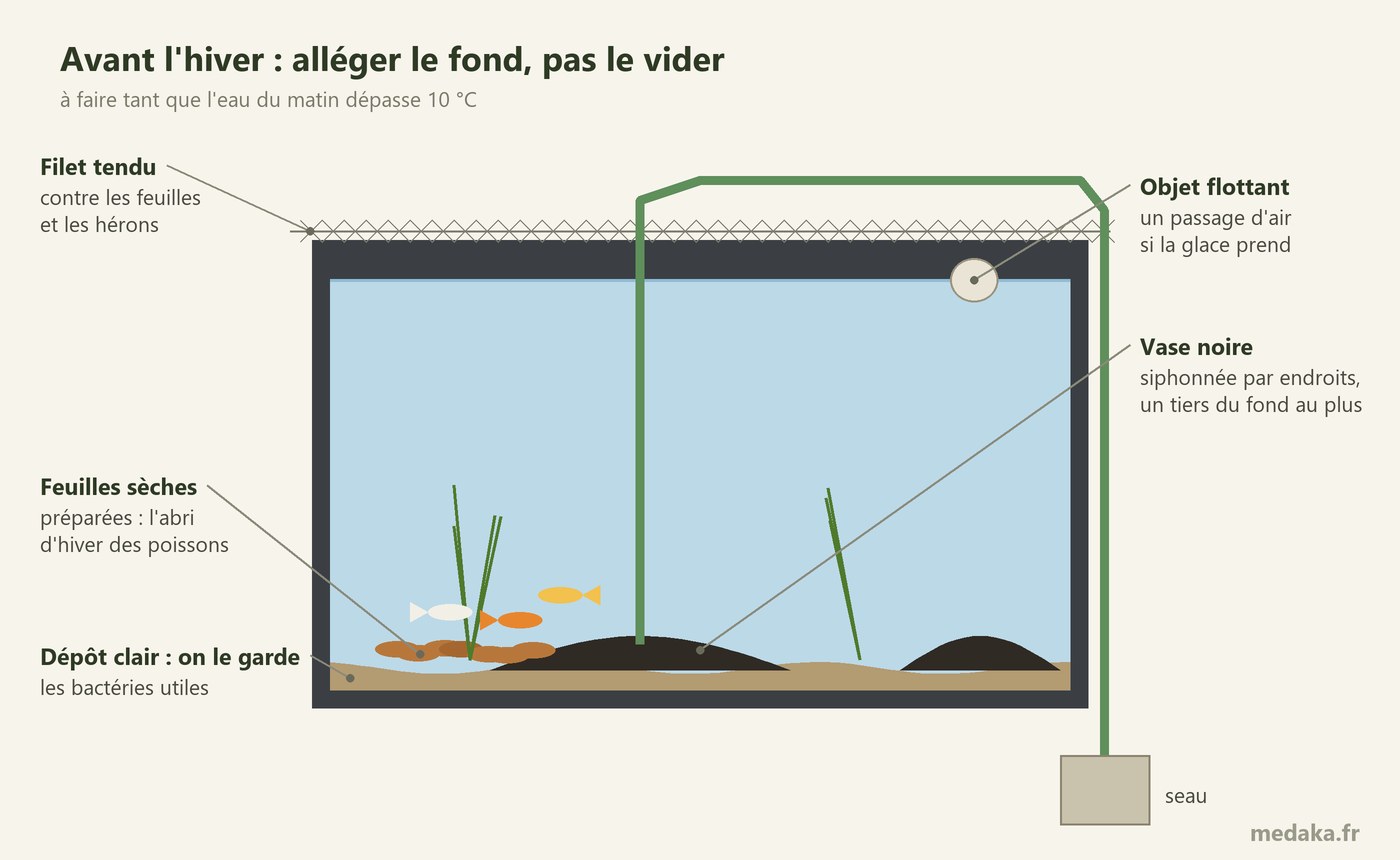
Should you clean the bottom of a medaka tub before winter? Japanese breeders tend to say no: leaves and a little sediment shelter the resting fish, and the big clean waits for spring. The Dutch breeders at medaka.nl say yes: under closed ice, a thick layer of sludge can starve the bottom of oxygen and produce toxic gases. Both are right, each for their own case. Good practice in Europe sits between the two: never strip the bottom bare, but remove the excess black sludge while the water is still mild, and leave the fish a clean shelter for the winter.
What builds up on the bottom between March and November
The Japanese call this black mud ヘドロ (hedoro). It is the sum of everything that has sunk since spring: leaves from neighbouring trees, stems of plants at the end of their cycle, droppings, food that slipped past the fish, snail shells and debris. While the water stays clear you hardly see any of it. Yet it thickens every week, and faster in autumn than in summer: the leaves arrive in bulk just as the cold slows the bacteria that break them down.
Volume changes everything. In a tub of 60 to 100 litres, each centimetre of sediment weighs far more than in a pond of several cubic metres, because there is little water to buffer it.
Why you do not empty the bottom
A medaka overwintering (越冬, ettō) stays in the deepest, calmest spot. In the wild it spends the winter under the leaf litter of ditches and rice paddies. A bottom with a little material and a few leaves gives it that shelter, and the bacteria living in this sediment and on the walls keep the water clean through the months when you no longer touch it. A tub scrubbed bare in November has neither, at the worst possible moment. That is why overwintering medaka in Europe lists cleaning the bottom in mid-winter among the mistakes, and why dry leaves have their place in an outdoor tub for winter, see oak leaves and fallen leaves.
Why you lighten it anyway
A little sediment shelters; a black layer several centimetres thick, full of rotting leaves, becomes a stock of matter that consumes oxygen all winter. While the surface is open, the water takes up oxygen from the air. When closed ice covers it for several days, exchange stops while decomposition carries on at the bottom. Medaka.nl states that oxygen can then fall almost to zero in the lower layer of a tub with no circulation, exactly where the fish sit.
Without oxygen, decomposition changes character and produces ammonia and hydrogen sulphide, the rotten-egg gas that is toxic to gills at very low doses. Under ice it stays dissolved in the water and you cannot smell it. If a rotten-egg smell appears at thaw, or when you clear the surface, the bottom has been short of oxygen for some time.
The risk depends on climate. In continental areas and in mountain or northern regions, where ice can close a tub for several days in a row, it is real. In the mild Atlantic and Mediterranean climates, where ice is rare and thin, it is low, but excess sludge still loads the water all through autumn.
When to do it
Water temperature decides, not the calendar. Act while the morning water is above 10 °C: below that, you no longer touch the water of a tub going into overwintering, as explained in water changes. This is also when the fish, still active, tolerate the disturbance, and when the bacteria are still working.
- Continental, northern and mountain climates: in October, often before the end of the month. See the French calendars (in French) for the north and Paris Basin and the east, which cover French regions only.
- Mild Atlantic climate (we are in Brittany): the water often stays above 10 °C later in autumn; take advantage of a mild day, thermometer in hand. See our Brittany calendar (in French).
- Mediterranean climate and the south-west: the window runs longer, and the issue is mostly autumn leaves. See the French calendars for the south-west and the Mediterranean (in French).
If the water is already below 10 °C, it is too late to siphon: simply skim off freshly fallen leaves that float or settle on top, and keep the rest for the spring clean.
The method: lighten it in patches
- Remove what floats first with a net: leaves, yellowed stems, debris.
- Siphon only the black sludge, where it collects, usually in the centre and the corners, with a flexible hose. A piece of fine mesh over the end of the hose stops you sucking up a fry. Work in patches, one third of the bottom at most, and touch neither the walls nor the light brown sediment covering the rest: that is where the useful bacteria live.
- Let the bucket settle for an hour: the clear water on top can go back into the tub, and the sediment goes on the compost.
- Top up the level with settled water within 2 °C of the tub, poured in slowly.
- Do not wash the filter if there is one: a quick rinse in a bucket of tub water is enough, to keep its bacteria. See cycling a medaka tank.
What the hose has not removed, a micro-organism activator can digest. On a bottom that is still heavily loaded, Aquatic Science Biobooster+ finishes the job after siphoning: we sell it and have used it for twenty years, and its effect shows within a few hours. Like anything biological, it works better while the water is still mild: it is a job for October or early November, not January.

What you leave, and what you add
Leave the light sediment and part of the bottom untouched. You can then give the fish a clean shelter: a few washed and dried oak or persimmon leaves, a pot laid on its side, a tuft of hornwort that folds down to the bottom for winter. These prepared leaves have nothing to do with a heap of fresh leaves rotting: they break down slowly and are removed in spring.
Two things stop the layer re-forming within a fortnight. A net stretched over the tub stops leaves from neighbouring trees, and also protects against herons, see medaka predators. And a reduced ration: uneaten food ends up on the bottom. Between 15 and 10 °C, feed little, every other day, only what is eaten in two or three minutes; below 10 °C, stop, see feeding medaka by temperature.
During the winter
Do not siphon any more and do not break the ice: the shock and the vibrations disturb fish that must spend as little energy as possible. To keep a gap for air, place a floating object before the frost, a ball or a half-filled bottle, as described in overwintering. At thaw, watch the fish: medaka hanging motionless just under the surface, gulping air, or lying on their side with no injury, point to water that has run short of oxygen. Then aerate the surface and follow the checklist in dead medaka: the causes.
The big clean of the bottom is done in spring, when the water is lastingly above 10 to 15 °C and the fish resume activity.
Frequently asked questions
How many times a year should the bottom be cleaned?
One real clean a year, in spring, and a lightening in autumn if the sludge is thick. In between, net out whatever falls in, especially after a week of wind.
My tub is under a tree and full of fresh leaves. What should I do in November?
Net them out as they come, even if the water is already cold: these are the leaves that rot and use up the oxygen. Then stretch a net over the tub. The dry, prepared leaves you add on purpose, in small quantity, are another matter.
Is an air stone enough to avoid the problem?
It keeps an open area through which gases escape and oxygen enters, which helps during the weeks of frost. It does not make a thick layer of sludge disappear: the two measures complement each other. Place it near the surface, not on the bottom, so as not to stir the cold water where the fish sit.
What if I did not have time before the cold?
Do not siphon a tub that is overwintering. Remove what floats, keep an opening in the ice and do the clean in spring. In a small, heavily loaded volume in the shade of a tree, moving the fish to a clean frost-free tub is still safer than working in mid-winter.
Sources
- Medaka.nl, “Slib verwijderen voor de winter”, medaka.nl: sludge and oxygen under closed ice, hydrogen sulphide, signs at thaw, siphoning in parts.
- medaka.fr rules on overwintering, water changes and dead leaves: no work on the water below 10 °C, dry leaves as shelter, big clean in spring (Japanese sources cited in those articles).