
The first predator of a medaka tub in Europe is neither the heron nor the cat. It is the dragonfly larva, which lives in the water and eats several fish a day. A fine-mesh net held 5 cm above the surface stops dragonflies laying eggs and also keeps out birds, cats, frogs and grass snakes. For fry, the danger comes from inside the tank, with the hydra. Mosquitoes, for their part, are not a problem: medaka eat their larvae.
The dragonfly larva, the first predator
The Japanese call it yago (ヤゴ) and rank it first among the enemies of the medaka, ahead of every furred and feathered animal. The reason is simple: the other predators attack from outside, while the dragonfly larva lives in the tank, hidden in the plants or the silt, and hunts day and night. It measures 2 to 6 cm depending on its stage, and a single larva can consume more than three medaka a day (t-aquagarden.com). In Europe, the large species, such as hawkers and emperors, give the most dangerous larvae. They catch adult fish.
How do they arrive? The female dragonfly lays in the water or on emergent plants, from spring to autumn. A well-planted outdoor tub is an ideal pond for her. Some species lay in flight by dipping the abdomen, others settle on a stem. A dragonfly that lands on a net stretched level with the water lays through the mesh: that is why the net must be raised, and we come back to this below.
To spot an established larva, look for exuviae, the empty skins left hanging on stems after a moult, and inspect the plants by shaking them in a basin. Remove larvae by hand, with a net or with tweezers, once a week in season (t-aquagarden.com). Regular pruning of the plants, which reduces hiding places, also helps. A larva you remove can be released into a nearby pond, where it has its place.
The raised net, the basic protection
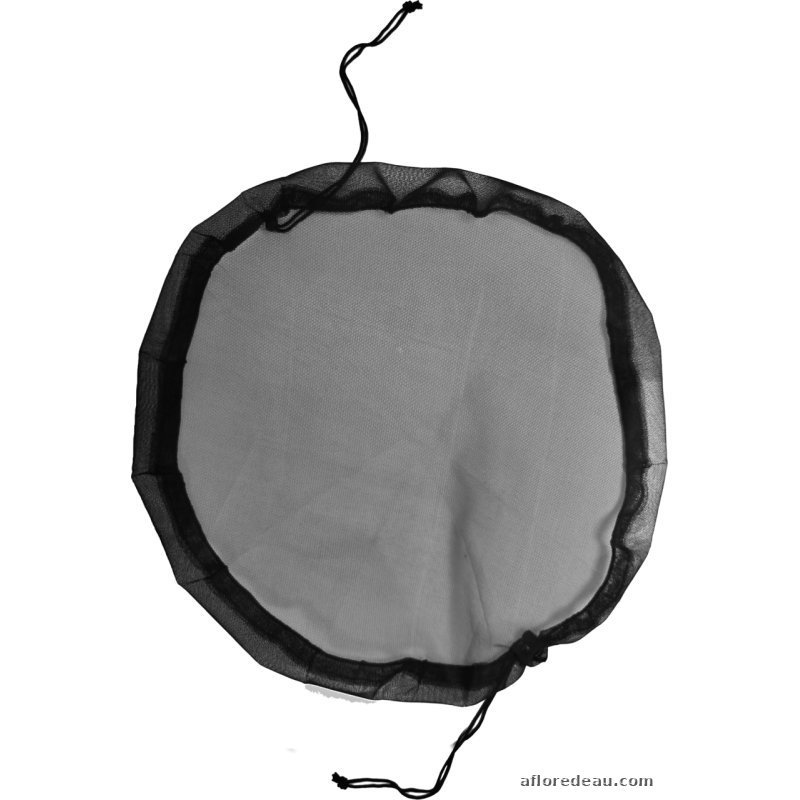
A fine net over the tub is the measure that solves the most problems at once, provided you follow two rules. The mesh must be fine, around 1 mm, like a garden insect screen, so that dragonflies cannot push the abdomen through. And the net must be held at least 5 cm above the surface, because a dragonfly that lands on a net touching the water lays through it (t-aquagarden.com). Stretch it over a frame, over hoops, or over a tub rim that stands proud.
The same net stops most other visitors: birds, which do not land on it, cats, which cannot fish through it, frogs and grass snakes, which find no way in. A purpose-made net such as the Cover Net is designed for this job on a medaka tub, but a garden-centre insect screen stretched over a wooden frame does the same thing. You simply need to weight it or fix it, because a cat will lift a net that is just laid on.
The net does not replace watching. A larva already present, a dragonfly egg laid before the net went on, or a net badly closed on one side is enough. Carry on with the weekly inspections.
Herons and kingfishers
The grey heron is the great fisher of European ponds. It visits gardens early in the morning, stands at the water’s edge and empties a medaka tub in a few passes. It does not need a large surface: a 60 cm tub is enough for it. The kingfisher is more discreet and fishes by diving from a perch. It takes surface medaka, one at a time, but it comes back. Crows and magpies, finally, also fish in shallow tubs.
Against birds, water depth and hiding places matter. A heron fishes standing in 20 to 30 cm of water, and it stands on a flat edge. A tub with high, smooth sides and a deeper area is less accessible. Floating plants give the fish a shelter to dive under. The net remains the only complete protection. Scarers, heron silhouettes or taut lines, work for a few days, then the bird gets used to them.
Cats
A garden cat sits at the edge of a tub and waits. It catches the medaka that come to the surface, especially at feeding time, when the fish are all at the top. It does not always eat its catch, but it kills it. A fixed wire-mesh lid, or a stretched and weighted net, stops it. A rim height that forces it to lean over also helps. Feeding the fish when the cat is not there, and away from the accessible edge, reduces the opportunities.
Frogs, newts and grass snakes
Frogs and newts find a welcoming habitat in a planted tub, and they eat what they can catch there. An adult green frog takes surface medaka, while a newt attacks fry and eggs. These animals are protected in France: they are not to be destroyed, and for most species you are also not allowed to capture them, move them or touch their spawn. Check the rules where you live. Close the tub before their season, the only action that is both effective and legal in France: see medaka and frogs, living together. The raised net stops them getting in. A tub with smooth, high sides also hinders their access.
The grass snake is harmless to humans, but it is a fisher. It swims well, enters ponds and swallows fish the size of a medaka without difficulty. It is protected too. It is seen mostly in gardens near a river, a pond or a wetland. A tub closed by a net or a wire mesh is out of its reach.
The enemies of fry: hydras and aquatic insects
The hydra is a small freshwater polyp a few millimetres long, attached to walls, plants or spawning mops. Its tentacles paralyse and capture the harigo (針子), the fry of the first days. It arrives with plants, wild daphnia or pond water. In a fry tank, remove it by cleaning the walls and rinsing the plants; adults are in no danger. Some breeders treat with salt or change tanks, which is simpler.
Other aquatic insects hunt in tubs. The larva of the diving beetle, a swimming beetle, exceeds 5 cm and attacks tadpoles, fry and small fish; according to naturalist sheets, it can take several dozen prey a day before it transforms. It is less common than the dragonfly larva in a tank, but an adult can fly in and lay eggs. Backswimmers, those water bugs that swim on their backs, sting fry. All of them arrive by flying, like dragonflies, and the same fine net stops them. The hydra, for its part, comes in with water and plants: rinse everything that goes into a fry tank.
Mosquitoes, an argument in favour of medaka
A tub of still water attracts mosquitoes, which lay in it. This is the classic objection from neighbours and local councils. The answer is that medaka eat mosquito larvae. It is even one of the reasons this fish is kept in the rice fields and ponds of its native country, and it has been introduced into several countries for this purpose. A tub stocked with medaka produces fewer mosquitoes than a forgotten bucket of rainwater. Larvae that appear are eaten as they come. A net with a 1 mm mesh put up for dragonflies also stops adult mosquitoes, in both directions.
The only case where a medaka tub produces mosquitoes is a tub too lightly stocked, or too crowded with plants for the fish to reach the whole surface. An egg-incubation tub with no fish, left outdoors, produces them too. Cover it.
What you can do from the start
Prevention begins with the choice of tub and its position. A tub with high, smooth sides hinders frogs, cats and the heron. A deeper area gives a refuge. Floating plants cover part of the surface. A position near the house, under a window, is visited less than an isolated corner of the garden. A new tub, filled with tap water left to stand and with rinsed plants, starts with no hydra and no larvae. All this is detailed in keeping medaka outdoors.
After that, put the raised net on as soon as the tub is filled, and inspect once a week from April to October. At our farm in Lesneven, the outdoor sales tubs are covered for the whole season. In winter, when the fish are on the bottom and the dragonflies are absent, you can replace the net with the ventilated cover plate described in overwintering medaka outdoors.
The key figures
| First predator | the dragonfly larva, 2 to 6 cm, more than 3 medaka a day |
|---|---|
| Net mesh | about 1 mm |
| Net height | at least 5 cm above the water |
| Inspection | once a week in season |
| Dragonfly season | spring to autumn |
| Fry predators | hydra, aquatic insect larvae, the adult medaka themselves |
| Protected species (France) | frogs, newts, grass snakes, herons, kingfishers: move or close off, do not destroy |
Frequently asked questions
My medaka are vanishing one by one without a trace. Who is the culprit?
With no trace and no dead fish, think first of a dragonfly larva in the tank, then of a kingfisher or a cat. Shake the plants in a basin and look for exuviae on the stems.
Is a net stretched over the tub enough against dragonflies?
Only if it is raised 5 cm and fine-meshed. A dragonfly that lands on a net touching the water lays through it.
Should you remove frogs from the tub?
No, do not capture them: they are protected in France, and for most species capture and relocation are prohibited. Only the green frog sometimes takes a medaka at the surface; cover the tub and lower the water level, and it will go and sit elsewhere. The species-by-species detail is in medaka and frogs.
Does a medaka tub attract mosquitoes?
It attracts them, but medaka eat the larvae. A well-stocked tub produces fewer than a container of water with no fish.
Do the adults eat their fry?
Yes, anything that fits in their mouth. That is why you collect the eggs and raise the fry separately, see raising medaka fry.
Sources
- Tokyo Aqua Garden, “メダカの天敵”, https://t-aquagarden.com/column/medaka_enemy
- Tokyo Aqua Garden, “ヤゴ対策”, https://t-aquagarden.com/column/dragonfly_measures
- 改良メダカWEB図鑑, FAQ, https://medakazukan.net/faq/
- À Flore d’Eau care guide, afloredeau.com