
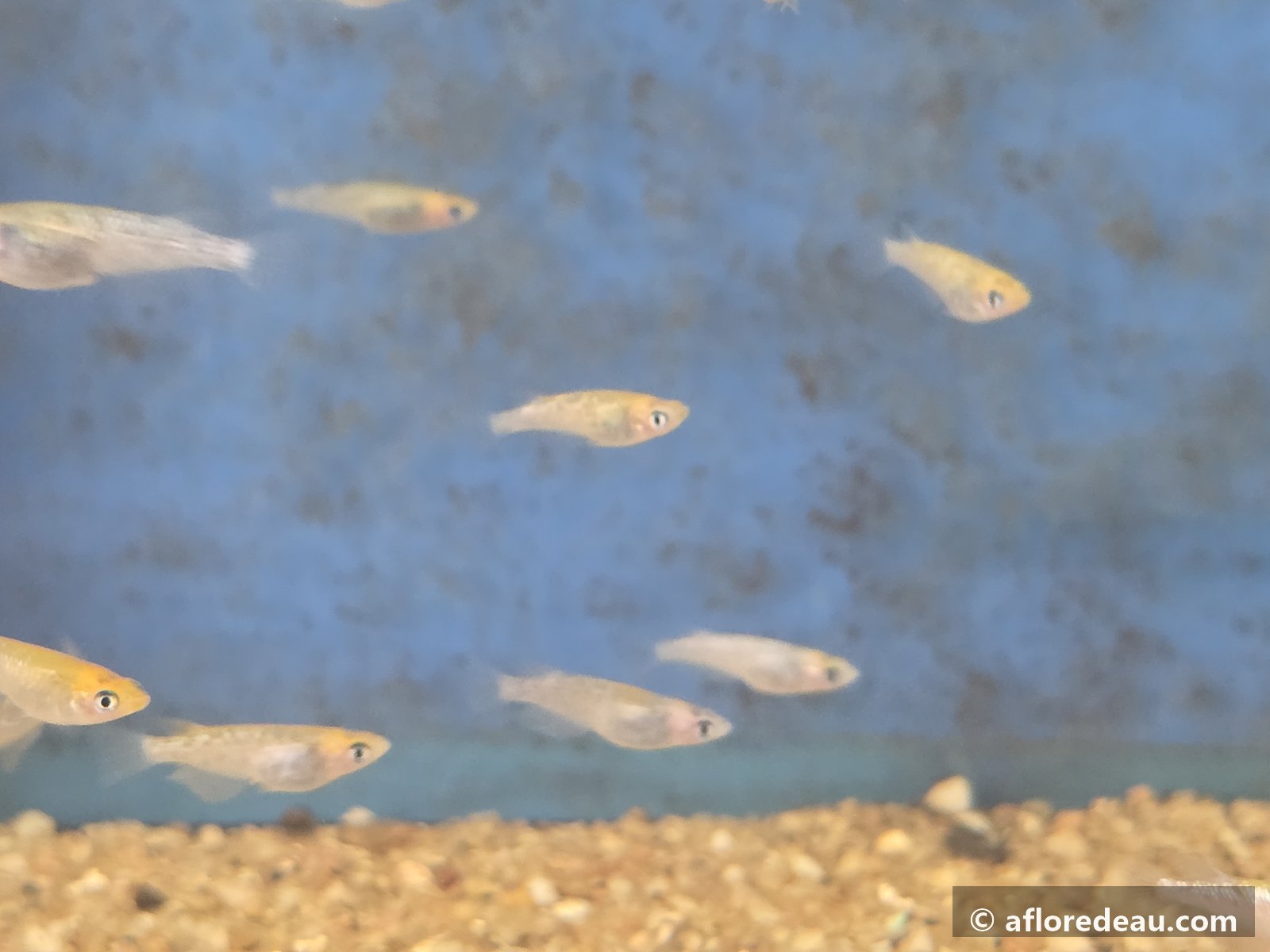
A medaka tub with 20 cm of water, in full July sun, gains 5 °C in two or three hours; a small black tub passes 40 °C within an hour. Left alone, Japanese breeders measure 34 to 36 °C in their summer tubs, and that is where the fish stop spawning, then fall ill. Shade is therefore the first summer task, before anything else, and it can be made in two ways that are not equal: a screen above the water, or floating plants on the water. Here is what each brings, to what extent, which plants suit European conditions, and what you must never do.
What heat does, in figures
The thresholds quoted by Japanese breeders agree with each other. Around 28 °C, medaka are active and spawn. Between 30 and 32 °C they keep moving but spawning drops. Between 33 and 35 °C, the first fish fall ill, and 33 °C is the limit the manufacturer GEX asks owners not to exceed. From 36 °C, the risk of death shoots up; around 40 °C it is almost certain, even if you sometimes still see fish swimming. It is not only the heat: oxygen dissolves less and less well as the water warms, 9 mg per litre at 20 °C, 7.5 at 30 °C, 7 at 35 °C, and at night, when plants and green water consume instead of producing, a hot, heavily stocked tub can suffocate all at once. Japanese breeders speak of whole tubs lost in a single July night.
The places where this happens in Europe are the ones with hot, continental or Mediterranean summers, from mid-June to the end of August; in France, the regional calendars (in French) set this out region by region. Even in a mild Atlantic climate such as ours in Brittany, a black tub on a south-facing balcony gets there one or two days a summer. A thermometer in the water, read in the middle of the afternoon, tells you where your tub stands: see reading the temperature of a tub.
Shade first: the screen above the water
In Japan, the reference protection is the sudare, a bamboo or reed screen placed above the tub, and the rules for fitting it make all the difference.
- Raised, not laid on: 30 to 50 cm above the tub, on stakes or wedges. A screen laid directly on the rim makes an oven: the hot air stays trapped. A closed lid is worse still.
- Partial: a third to a half of the surface, never all of it. Medaka need 13 hours of light to spawn, and plants need light to live. The ideal is morning sun and afternoon shade: a tub that receives western sun until 5 pm has the widest temperature swings.
- Ventilated: a screen lets the wind through, which cools the surface by evaporation. A shade net does the same job, at about 50 %, preferably white or light in colour, also fitted above the water. Nets that are too dense, at 70 % and more, cut too much light and weaken the fish over time.
How many degrees? No Japanese breeder has published a measurement with and without a screen; they report 2 to 4 °C less, and a tub under a double screen that stays around 32 °C in midsummer where it would exceed 36. The order of magnitude is confirmed elsewhere: cattle troughs shaded in the Australian summer had peak temperatures 6.4 °C lower than troughs in the sun, and evaporation reduced by a third; Chilean troughs under cloth were at 25 °C at 5 pm against 33 °C in the sun. On a pond one metre deep, 40 % shaded surface gains only 0.5 to 0.7 °C on average, but reduces the daily range and the number of days above the threshold by as much, with better fish survival. The smaller the volume, the more shade matters.
Three free measures go with the screen: move the tub to a ventilated place in light shade, which is worth 2 to 3 °C according to Japanese breeders; stand it on soil or on a slatted base rather than on concrete or asphalt, which radiate heat; and top up the water level every day, because a tub that is evaporating heats up faster and faster.
Floating plants: which ones, and how many
Floating plants shade the surface, shelter the fish and serve as spawning support when their roots hang in the water. They have two limits. They do not cool the water as a screen does, because they take the sun in its place and their leaves transpire: large floating plants use more water than an open surface, and only the small duckweeds save a little. And they must never cover the whole tub: under a continuous carpet of duckweed, dissolved oxygen has been measured 83 % lower than in open water at 30 °C, because the oxygen produced by the leaves escapes into the air and the surface no longer exchanges with the atmosphere. At night, the carpet consumes and the tub suffocates. Japanese breeders give different ranges, from a fifth to a half of the surface; most hover around a third, and all say the same thing: never the whole surface, and thin them out every week in summer.
In Japan, the summer floating plant is water hyacinth, for its long roots on which the females leave their eggs; breeding stations harvest eggs there from late April to September. It is banned in the European Union, as is water lettuce since August 2024, and so is giant salvinia: see small-pond plants. Here is what replaces it in Europe.
| Plant | Outdoors in winter | Shade and spawning | Good to know |
|---|---|---|---|
| Frogbit, Hydrocharis morsus-ranae | yes, by buds that sink to the bottom and rise again in spring | round leaves, fine hanging roots that can take the eggs; medium cover, runners | native, protected in several regions of France: never collect it from the wild, always buy it from a nursery |
| Floating fern, Salvinia natans | annual, reseeds by spores | small hairy leaves, covers quickly, short roots: little spawning | nationally protected in France, grown in nurseries; thin out every week |
| Ivy-leaved duckweed, Lemna trisulca | yes | lives mid-water, does not shade the surface but offers a tangle where eggs cling | native, does not run away like the lesser duckweed |
| Amazon frogbit, Limnobium laevigatum | no, it dies in the cold | the floating plant Japanese breeders use for spawning, long roots, fast cover | a summer plant to compost in autumn and never to throw into a ditch or pond: it has been found naturalised in France since 2022 and the European Union is studying it for its list |
| Dwarf water lily, Nymphaea ‘Pygmaea Helvola’ and others | yes, very hardy | stable floating leaves, fixed shade over a quarter of the surface; no hanging roots | in a basket under 10 to 20 cm of water, full sun; the calmest of the shades, for a tub of 60 litres and more |
| Water soldier, Stratiotes aloides; water chestnut, Trapa natans | yes | rosettes, partial shade; the water chestnut needs depth | natives with regional protection in France, more for ponds than for tubs |
Two floating plants to avoid even though they are legal: the lesser duckweed, Lemna minor, which turns up on its own, covers everything in a few weeks and can no longer be eradicated; and azolla, Azolla filiculoides, a reddish fern that doubles its surface in three days, dies in frost leaving a rotting mat, and shelters no spawn. Japanese breeders treat both as invaders to be skimmed off.
The tub itself
- Volume and depth: at equal volume, a deep tub heats less than a shallow one, and a large volume moves less than a small one. A tub with 20 cm of water is a dangerous summer tub.
- Colour: black, then transparent, then white, in order of heating. The black tub that brings out the fish’s colours in spring is the one you shade the most in summer, or replace with a light-coloured tub.
- The double tub: a polystyrene tub, or a tub stood inside a larger one, smooths out the variations.
- Green water, light, is counted by the Japanese among the protections: it shelters the fish from direct light. Too dense, it does the opposite: it absorbs the sun at the surface, and it exhausts the oxygen at dawn. See green water.
- Aeration gains half a degree to a degree, no more, but it guarantees oxygen on hot nights, which matters more. A small fan blowing across the surface lowers the water by 3 to 4 °C through evaporation, at the price of a level to top up every day.
What not to do
- Never put ice, a frozen bottle or cold tap water in the tub: thermal shock kills more surely than 34 °C. Every Japanese breeder repeats this. If the water is at 34 °C, shade it, top up the level with water at the same temperature, and aerate.
- Never a closed lid, nor a screen laid straight on the rim.
- Never a surface entirely covered with floating plants, and never opaque green water in July.
- Never feed in the hot hours: morning and evening, and less than in spring, because hot water copes badly with leftovers.
When to put shade up, when to take it down
In continental and Mediterranean climates, from mid-June to the end of August; in temperate northern climates, in July and August; on the Atlantic coast, in Brittany, only on days of announced heatwave, and on black tubs. The criterion for removal, in September, is the Japanese breeders’: when the maximum water temperature, read on a memory thermometer, stays below 28 °C for several days in a row. Then take the screen down and thin out the floating plants, to give the fish and plants back the autumn light, which prepares them for winter.
The figures to remember
- 30 °C: spawning drops. 33 °C: ceiling. 36 °C: danger of death.
- Screen or net at 50 %, raised 30 to 50 cm, over a third to a half of the tub: 2 to 4 °C less according to breeders, up to 6 °C on the peaks according to a trial on troughs.
- Floating plants over a third of the surface, never more than half; under a complete carpet, 83 % less oxygen.
- Light-coloured rather than black tub, deep rather than shallow, stood on soil rather than concrete, level topped up every day.
- No ice, no lid, no midday meal.
Frequently asked questions
My tub is at 35 °C this afternoon: what should I do right now?
Shade it with whatever you have to hand, a sheet stretched over two chairs, top up the level with water at a similar temperature, and add an air stone. No ice. The next day, fit a screen or move it to afternoon shade.
Are floating plants enough without a screen?
In northern and Atlantic climates, often; in hot continental and Mediterranean climates, no: they do not lower the water as a screen does, and you cannot put in more than half without suffocating the tub at night.
Can I keep Amazon frogbit outdoors in winter?
No, it dies in the cold; bring it in or compost it, and start again in spring. And never throw it into a pond or ditch: it has already settled in French rivers.
Sources
- メダカ屋えん, “メダカの夏の高水温対策” (measures against high summer temperatures), 2026, medakayaen-ec.com: table of thresholds 28, 30-32, 33-35, 36 and 40 °C, deep tub, colour, lid, no ice.
- GEX, “メダカの屋外飼育の月別ポイント”, gex-fp.co.jp: do not exceed 33 °C, tubs lost in a night through suffocation, thin out the leaves in August.
- Tokyo Aqua Garden, “ビオトープの高水温対策” (against heat in a biotope), t-aquagarden.com: 34-36 °C without protection; “メダカに屋根が必要な理由” (why a roof is needed), t-aquagarden.com: raised, ventilated screen, white net; “メダカと浮草” (medaka and floating plants), t-aquagarden.com.
- 日淡といっしょ, “真夏にメダカが産卵しなくなる原因と対策”, nittanwith.com; “夏の池の水温上昇・蒸発対策完全ガイド”, nittanwith.com: +5 °C in two or three hours in 20 cm, net at 50-70 %, 2 to 4 °C, oxygen solubility; ほぼメダカ, “すだれは高さが大事”, hobomedaka.com: screen at 30-50 cm, 32 °C under a double screen; なおたろファーム, “浮草と酸欠”, aqua-naotaro.com: at most a third of the surface; 水草水槽.com, mizukusasuisou.com: night-time suffocation under full cover.
- Webster M. E., Day M. L., “The impacts of shade on evaporation rates and temperatures in stock watering troughs”, Australian Journal of Agricultural Research 44, 1993, publish.csiro.au: peaks 6.4 °C lower, evaporation 7.1 against 11.1 mm per day.
- Lee, Kuo, Chung, Yang, “Effect of Shading Ratio on Japanese Sea Bass and Asian Sea Bass Aquaculture”, Fishes 10, 2025, doi.org: 40 % shading on a one-metre pond.
- Parr L. B., Perkins R. G., Mason C. F., “Reduction in photosynthetic efficiency of Cladophora glomerata, induced by overlying canopies of Lemna spp.”, Water Research 36, 2002: oxygen 83 % lower under duckweed at 30 °C; Daigo K., Phaovattana V., “Evaporation and percolation control in small farm ponds in Thailand”, JARQ 33, 1999: duckweed, 9 to 17 % less evaporation.
- Implementing Regulation (EU) 2022/1203 adding Pistia stratiotes to the Union list, applicable from 2 August 2024, eur-lex.europa.eu; French order of 14 February 2018 on preventing the introduction and spread of invasive alien plant species, consolidated annexes, aida.ineris.fr; EPPO Reporting Service 2026/022, Limnobium laevigatum in France, gd.eppo.int; protection status of native species, TAXREF reference list of the Muséum national d’histoire naturelle.