
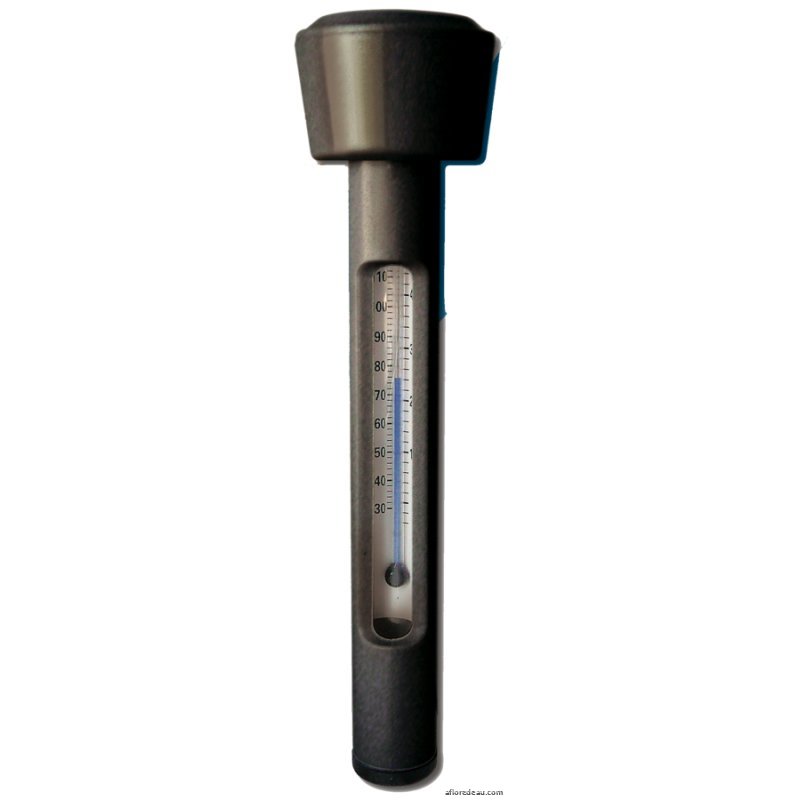
All our calendars and all our thresholds refer to the temperature of the water, never of the air, for a simple reason: the two have little to do with each other in a tub standing outdoors. The water in a 60-litre tub is still at 21 °C at dawn when the air has dropped to 14 °C, and the surface of a black tub in the sun gains 10 °C in an hour. A thermometer in the water is the cheapest and most useful tool in fishkeeping. You still need to know which one, where to put it, at what time to read it, and what the figures mean. Here is what Japanese breeders say, and what measurements made in small bodies of water add.
Why the air tells you nothing
Water warms and cools more slowly than air, and it keeps the heat of the sun it received during the day. Measurements made in small pools show that the water is on average 4 to 6 °C warmer than the nearby air, and that at dawn a 25 cm deep vat can exceed the air by 6 to 8 °C in summer. In the other direction, a three-litre tub follows the air almost step by step, while a sixty-litre tub moves little during the day. Between the two, everything depends on volume, colour, shade and wind. The hand is no help: it judges against the air and its own warmth. Japanese breeders sum it up in one rule: judge by the water, never by the air, and a single thermometer is enough, provided it is in the tub.
A day in a tub
A Dutch team recorded, for a year, every half hour and at five depths, the temperature of a vat 1.10 m across with 25 cm of water. The cycle is always the same.
- At dawn, the water is at its minimum, and the whole column is at the same temperature: the night’s mixing is complete.
- From sunrise, the surface warms faster than the bottom and the water stratifies. At midday, the top layer is clearly warmer than the bottom: 2 to 3 °C in April, 3 to 4 °C in August in this 25 cm vat; in a 40 cm jar, a Japanese breeder measured a 1.3 °C difference between his probe at the bottom and his floating thermometer.
- The maximum at the surface falls in the middle of the afternoon, between 2 and 4 pm, one to two hours after the air peak, later still if the tub receives western sun.
- In the evening, cooling starts from the surface and a mixed layer gradually descends, until all the water is homogeneous late in the night.
Three factors amplify the cycle. Volume: in three ponds of 16, 32 and 96 cm, at the same mean temperature, the range between minimum and maximum was 14 °C in the smallest and 7 °C in the largest. The colour of the water and of the tub: at 1 pm, the surface layer of turbid water was 2.8 °C warmer than that of clear water, and Japanese breeders measure green water 5 °C above fresh water in the same sun, a black tub of a few litres gaining 10 °C in an hour. Finally, shelter from the wind: a pool surrounded by tall grass had a gradient twice as strong as the open vat.
Which thermometer, and where to put it
- The alcohol float, a few euros, no battery: rated at ±2 °C by its maker. It measures the surface, so the warmest layer of the day, and remembers nothing.
- The digital probe, rated at ±1 °C over the useful range: the unit stays out of the water, the probe goes down wherever you want.
- The digital model with minimum and maximum memory is the real tool for an outdoor tub: a glance in the morning gives the night’s floor and the previous day’s ceiling, that is, what happened while you were not there. Japanese breeders recommend it to anyone who worries about midday heat or night-time cold.
- Liquid-crystal strips stuck on a wall read the glass, not the water, and are wrong by 1 to 3 °C in the sun. Avoid them outdoors.
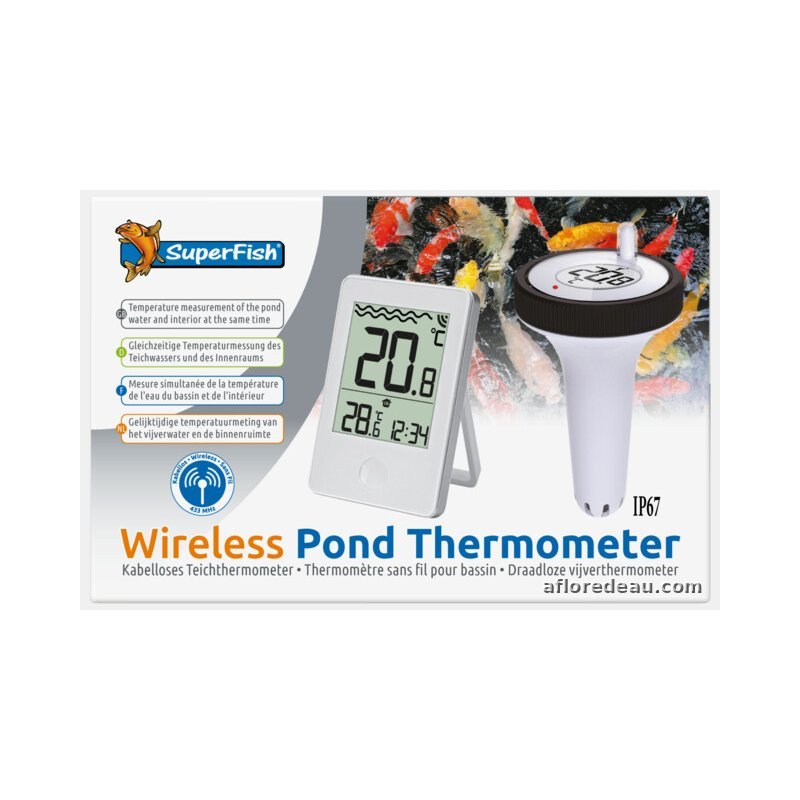
For outdoor tubs, we have chosen the SuperFish wireless pond thermometer: a waterproof floating probe that stays in the tub, and a digital display that receives the reading by radio, to be read from the house without going outside; it is the simplest way to look at the water at dawn and at 3 pm without thinking about it. For a tub you can see from where you are, the floating pond thermometer, an alcohol model, does the job for a few euros, and for indoor tanks, the hanging aquarium thermometers. The stick-on-glass model remains an aquarium instrument, not an outdoor-tub one.
Placement matters as much as the device: on the shaded side, at mid-height, away from a pump or heater, in an area where the water circulates moderately, so as to read the average of the tub and not its hottest point. Clean the algae that cover the probe, and replace a thermometer that is ageing: it drifts. Two devices of the same model do not give quite the same figure; with two or three thermometers in a tub, discard the one that is 2 °C away from the others. One detail that appears on no instruction leaflet: medaka climb onto floats, and some die there, out of the water. Prefer a float without a tray, or a probe.
When to read, and what to do with it
| Time | What the reading measures | What to do with it |
|---|---|---|
| Dawn | The day’s minimum, the whole column at the same temperature | This is the figure that decides feeding in spring and autumn: if the morning is below 10 °C, the afternoon meal will not be digested during the night, whatever the thermometer shows at 3 pm. In March-April, cold water in the morning gives badly fertilised clutches. |
| Mid-afternoon, 2 to 4 pm | The maximum, at the surface; the bottom is 1 to 4 °C below | This is the summer figure: 28 °C is the threshold at which you put up shade, 30 °C the one for attention, 33 °C the limit Japanese breeders do not cross. A deep tub keeps a cooler bottom where the fish go down. |
| Minimum and maximum reading, in the morning | The previous day’s range at a glance | Under 5 °C, comfortable. Around 10 °C, the limit quoted by every Japanese breeder. Beyond that for several days in a row, the fish wear themselves out: one breeder linked a 12 °C range over an autumn week to a fungal infection in his fish. |
| Evening | Water cooling down from the surface | No late meal; and a tub that gets sun until 5 pm is a roller coaster, so it is the one you move. |
A nuance that only Japanese manufacturers state: 15 °C rising in spring and 15 °C falling in October are not the same water for the fish. On the way down, after a hot summer, it is the disease season, and you keep observing even when the figure is reassuring. The explanation lies in acclimation, which is asymmetric: gaining tolerance to cold takes days or weeks, losing it takes a few days.
The differences that matter
- Between day and night: aim for under 5 °C, tolerate 10. Shade often brings the range down from 10 to 5 °C. Spring is the season of accidents: 20 °C in the afternoon, 10 °C in the early morning.
- At a water change: no more than 2 °C difference between new water and tub water, 1 °C in winter, 3 °C at most for fry. Nature changes slowly; a bucket changes in an instant.
- When transferring a fish: a 1 to 2 °C difference is fine, 5 °C is not; the bag floats for half an hour to an hour. See moving fish to the pond.
- At the bottom of the tub: the afternoon stratification is not a defect, it is a refuge. A deep tub keeps a bottom 2 to 4 °C cooler in summer, and the fish use it.
What science adds
The medaka tolerates 0 to 40 °C, but its upper limit depends on what it has lived through. Measured in the laboratory on fish raised for years at 20 °C, the critical temperature at which it loses its balance is 38.9 °C; on fish raised at 30 °C, 43.8 °C. And this limit moves fast: a two-week heatwave raises it by 1.5 °C, and two weeks later the effect has gone. A fish from a cool Atlantic climate that has never seen 25 °C does not have the margin of a fish from the Mediterranean in August.
On fluctuations themselves, one study raised medaka from hatching to maturity at mean temperatures of 27 and 30 °C, either constant or oscillating by 5 °C each day: the fish under fluctuation mature earlier and smaller, without spawning more. A 2024 synthesis of 143 studies of cold-blooded animals concludes that regular cycles change averages little, but increase stress markers and shorten life in aquatic species, and that it is the extremes, the heatwaves, that do the most damage. In other words, Japanese breeders are right to aim for a 5 °C range, and the priority remains to cut the afternoon peaks.
Going further: a logger
There are waterproof temperature loggers, floating or with a probe, for a few tens of euros, which record the water every ten minutes for months and can be read on a phone or computer. It is the only way to see the whole curve, the dawn trough, the morning rise, the 3 pm peak, and to compare two positions or two tub colours in the same garden. No measurement of this kind has been published for a medaka tub in Europe; if you fit one, we are interested in the curve.
The figures to remember
- Minimum at dawn, maximum at the surface between 2 and 4 pm, one to two hours after the air.
- Surface and bottom: 1 to 4 °C difference in the afternoon, none at dawn.
- Day-night range: under 5 °C comfortable, 10 °C the limit.
- Water change: no more than 2 °C difference, 3 for fry.
- Probe on the shaded side, at mid-height, away from equipment; min-max memory read in the morning.
- Thermometers: ±1 °C for a good digital one, ±2 °C for an alcohol float, 1 to 3 °C error for a stick-on strip.
Frequently asked questions
It is 25 °C outside at midday: can I feed my medaka in April?
Look at the morning water. If it was at 9 °C at dawn, no: the water will drop again at night and what is not eaten will stay on the bottom. If it was at 12 °C or more, a small ration early in the afternoon.
My float says 31 °C at 3 pm and my fish are at the bottom. Should I act?
The bottom is probably at 27-28 °C, which is why they are there. Shade the tub for the following days, and check that the maximum comes back below 30 °C. Do not add cold water all at once.
Do I need a thermometer for each tub?
One per different position is enough: two tubs side by side, of the same colour and volume, have the same curve. A black tub and a white tub do not.
Sources
- Jacobs A. F. G., Heusinkveld B. G., Kraai A., Paaijmans K. P., “Diurnal temperature fluctuations in an artificial small shallow water body”, International Journal of Biometeorology 52, 2008, pmc.ncbi.nlm.nih.gov: daytime stratification, night-time mixing, minimum at dawn and maximum in mid-afternoon, read from the figures; Jacobs, Paaijmans, Heusinkveld, “Diurnal temperature cycles in shallow water pools”, American Meteorological Society, 2006, ams.confex.com.
- Paaijmans K. P. et al., Hydrological Processes 22, 2008 (range of 14 °C in a 16 cm pond against 7 °C in a 96 cm pond); Malaria Journal 9, 2010, pmc.ncbi.nlm.nih.gov (water 4 to 6 °C warmer than air); International Journal of Biometeorology 52, 2008 (turbid water 2.8 °C warmer at the surface at 1 pm).
- Morla J. et al., “Multigenerational effects of temperature exposure on upper thermal limit… in medaka”, Journal of Thermal Biology 130, 2025, preprint biorxiv.org: CTmax 38.9 and 43.8 °C; Vallin J. et al., “Rapid and reversible plasticity of upper thermal limit… in medaka”, Journal of Thermal Biology, 2025: +1.5 °C after two weeks of heat, reversible.
- Dhillon R. S., Fox M. G., “Growth-independent effects of a fluctuating thermal regime on the life-history traits of the Japanese medaka”, Ecology of Freshwater Fish 16, 2007; Stocker C. et al., “The effect of temperature variability on biological responses of ectothermic animals”, Ecology Letters 27, 2024.
- Tokyo Aqua Garden, “メダカに最適な水温” (the ideal temperature), t-aquagarden.com: 10 °C range, 2 °C at a water change; “水温計ベスト5” (the five best thermometers), t-aquagarden.com: placement, fouling, drift.
- THE AQUA LAB, “メダカの適水温は何度?”, practical-aqualabo.com: judge by the water, probe on the shaded side at mid-height, decide from the minimum, 3 L against 60 L.
- Hime-medaka, “水温差は10℃未満”, hime-medaka.com; “容器の置き場所で変わる水温”, hime-medaka.com; “最低水温は何度?”, hime-medaka.com: range under 10 °C, 5 °C with shade, maximum after 3 pm, black tub +10 °C in an hour, asymmetric acclimation.
- GEX, “メダカの屋外飼育の月別ポイント”, gex-fp.co.jp: 15 °C rising and falling, 33 °C.
- メダカの飼い方.com, “針子や稚魚に最適な水温”, medaka.papa77.com: read early in the morning and during the day, ±3 °C for fry; medaka-secret-base, test of a probe thermometer, medaka-secret-base.com: 1.3 °C between bottom and surface, 12 °C range and fungal infection; 日淡といっしょ, “すだれはいつ外す?”, nittanwith.com: remove shade when the maximum holds below 28 °C; Medakaya-en, “水合わせのやり方”, medakayaen-ec.com: 1-2 °C is fine, 5 °C is not.
- Tetra and GEX manufacturer specifications for thermometer accuracy, compared on pono-town.com.