
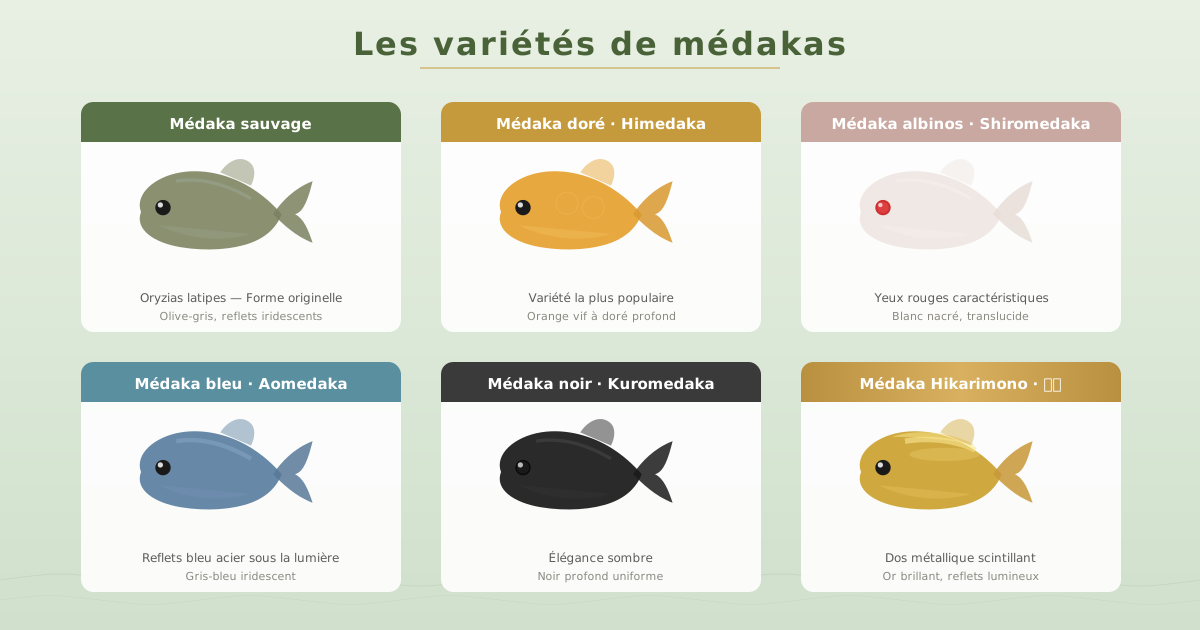
The medaka, Oryzias latipes, is a fish of 3 to 4 cm from which Japan has developed more than 900 varieties in a quarter of a century. All of them descend from the same brown wild form and are described with the same grammar. This guide presents the main families of improved medaka, points to our variety pages, and says which suit a first tank.
What an improved medaka is
In the wild, this Japanese rice-field fish is olive brown, with a slight sheen on the back. The improved medaka (改良メダカ, kairyō medaka) is a variety obtained by selection from this wild form. We say variety, never breed or species: a Youkihi and a Miyuki are the same fish, Oryzias latipes, and breed with each other.
The yellow Himedaka and the white medaka have been kept in Japan since the Edo period, but the explosion is recent. Around the year 2000, Japan had about twenty varieties. The online encyclopedia of Medaka no Yakata listed 552 in April 2019, more than 700 in 2022, and 909 in September 2026. Two fish explain this movement. The Youkihi (楊貴妃), a vermilion medaka created in 2004 in Hiroshima by Ōba Sachio, showed that a bold colour could be fixed; more than 50 variants descend from it. The Miyuki (幹之), which appeared in the late 2000s, brought the reflective band along the back that makes the modern medaka. As each breeder christens their creations with a house name, a classification became necessary.
Seven groups of traits for reading a name
The Japan Medaka Association (JMA) publishes a classification manual, the fifth edition of which dates from September 2025. It describes 45 traits in seven groups, always in the same order: body colour, scales, eyes, iridophores, patterns, fins and body shape. A name is assembled by stringing together the traits present: “Sanshoku lamé Miyuki Daruma” reads as three colours, sparse glittering scales, a luminous band on the back, short body. The full grammar is on our page reading the name of a medaka, and the terms are in the glossary. The overview that follows groups the varieties by family, as a shop would.
Solid colours
The starting point is brown (茶), the wild colour; the farmed Kuro medaka (黒メダカ) is its commercial form, brown-black, sold in Japan because the wild form is protected there. Yellow (黄) is the Himedaka, the oldest variety, which has lost its black pigment. The orange medaka and the dark orange are more saturated selections of it.
White (白) has lost black and yellow. Blue (青) has no blue pigment: it lacks yellow, which makes it look grey-blue, and it is on this base that the Miyuki was born. Black (黒) ranges from anthracite grey to deep black. The Orochi (オロチ) line, selected in 2016 in Nara Prefecture, is the only one that stays black on a light background. In Europe, these fish are often sold under the name Black Dragon. Vermilion (朱赤) is the orange-red of the Youkihi, the most reliable coloured variety in breeding. The pale gold is sometimes sold under the name Champagne, a seller’s label.
Bicolours and tricolours
Here, colour combines with the pattern group. The Kōhaku (紅白) is white and vermilion, patterned like a koi carp; the white-vermilion group has 45 entries in the WEB図鑑, including the external-light Kōhaku, no. 0183. The Sanshoku (三色) adds black. Released around 2017, its pattern is distributed at random: few young come out with all three colours well placed, which explains its price. It is often sold under the koi name, Sanke, but the Japanese for medaka says Sanshoku.
The European trade follows the same logic under English names: the White Orange, white with orange patches, a cousin of the Kōhaku; the White Black, white with black spots; the Orange Black, orange with black zones. These are sellers’ names, with no catalogued Japanese variety and no known fixation rate. What the family has in common: you do not breed a pattern true, you sort for it in every generation.
Lights
Iridophores are reflective cells, and the JMA manual distinguishes six ways in which they express themselves. The best known is the external light (体外光), the blue-white band on the back that is the defining trait of the Miyuki (幹之). It is read in grades, from weak to super, then iron mask (鉄仮面) when the band reaches the head, and whole body. Fry are born dark; the light rises with age and sun. The Miyuki exists on a blue base, the blue external light, and with elongated fins, the Miyuki Longfin. The Platinum is the commercial name of a white or pale blue Miyuki with dense light.
The lamé (ラメ) is different: sparse glittering scales, like sequins, and not a continuous band. One fish can carry both. Lamé shows chiefly on the semi-transparent scales of the Aurora (オーロラ) line, the base of most recent lamé varieties; the yellow lamé Aurora, yellow head and sequinned back, is the common example.
Shapes
The Hikari (ヒカリ) type is a symmetry mutation: the anal fin takes the shape of the dorsal, the tail becomes a diamond, the back carries a sheen. It is not a colour; the yellow Hikari is a Himedaka of Hikari type. The Daruma (ダルマ) type has shortened vertebrae and a round body. The gene exists in all medaka and is expressed when the eggs incubate above 28 °C. The Miyuki Daruma combines this short body with external light; it is the most delicate variety we know, prone to digestive blockages and unable to winter outdoors.
Fins form a group of their own, with eleven traits. The Longfin (ロングフィン) lengthens all the fins evenly; the Swallow (スワロー) stretches certain rays into irregular filaments; Hirenaga (ヒレ長) denotes the long fins of the Matsui line. These traits graft onto any colour: a Youkihi Longfin remains a Youkihi.
The novelties of the Savanna line
Medaka-ya Savanna, in Saitama Prefecture, has produced two of the most recent varieties available in Europe. The Saboten (サボテン, “cactus”), released in 2021, crosses white Ōka and Midorikō Matsui Hirenaga: cactus green, dense lamé, long fins, high fixation. It is one of the few varieties best viewed against a white background, because the light background brings out the green lamé. It is also sold as “Miyuki Green Cactus”.
The Neptune (ネプチューン) descends from it. Released on 26 July 2023 on Yahoo Auctions, bred from (Miyazakura × Himitsu Heiki) × Saboten, it is blue right to the snout, with a broad green-gold lamé on the back, and its fixation rate is given as about 70 %. The first trio was sold for ¥601,000, a Japanese order of magnitude unrelated to the price of a young fish in Europe two years later.
Choosing your first variety
The question is not “which is the prettiest” but “which forgives mistakes”. All medaka can be kept between 5 and 30 °C, at a minimum of 1 litre per fish. What changes from one variety to another is consistency in breeding, the fragility of the body shape and the amount of sorting.
- Beginner: Youkihi, yellow Himedaka, blue, white. Solid-coloured fish of normal type, which breed true and are visible from afar in a bowl. The Youkihi is the most colourful of the four; blue and white are the most discreet.
- Intermediate: Miyuki, Kōhaku, Panda. Keeping is simple, but you have to sort: the Miyuki’s light is not expressed to the same degree in every young fish, the Kōhaku’s pattern changes with each fish, and the Panda trait does not come out in all the offspring.
- Experienced: Sanshoku, Daruma. The first demands patience in sorting. The second demands a method: warm incubation, Daruma × semi-Daruma crossing rather than Daruma × Daruma, a heated tank in winter.
For set-up, see setting up a tank for medaka.
What the English trade names mean
A large part of the medaka sold in Europe comes from farms in South-East Asia, under English names. The German importer Aquarium Glaser, for instance, distributes strains named Panda White, Blue & Black Lamé, Red & White or Yokihi Orange. These names describe what you see, without giving the line or the breeder, and can almost always be translated into JMA vocabulary.
| Trade name | JMA reading |
|---|---|
| Red White | white + patchy vermilion: a Kōhaku |
| Tricolor, Sanke, Lamé Sanke | white + vermilion + black: a Sanshoku, lamé or not |
| Platinum | white or pale blue with dense external light: a Miyuki |
| Black Dragon | solid black, often of the Orochi or Black Diamond line, without certainty |
| Orange Black, White Black, White Orange | a base colour + a pattern of patches in a second colour |
| Yellow Head, Lamé yellow head | most often a yellow lamé Aurora |
| Champagne, Tomoki | sellers’ labels with no identified Japanese variety |
Our variety pages keep the name under which the fish is sold, but always give the JMA equivalent and flag when it is uncertain. The Tomoki, for example, is a name whose origin we could not trace, and its page says so.
The figures to remember
| Varieties catalogued in Japan | about 20 in 2000, 552 in April 2019, 909 in September 2026 |
|---|---|
| Traits in the JMA standard | 44, in 7 groups (5th edition, September 2025) |
| Threshold of a fixed variety | 30 % of conforming offspring |
| Birth of the Youkihi | 2004, Hiroshima, Ōba Sachio; more than 50 variants descend from it |
| Orochi | 2016, Nara Prefecture; ¥400 to 1,000 each in Japan |
| Saboten / Neptune | 2021 / 26 July 2023, Savanna, Saitama; Neptune fixed at about 70 % |
| Daruma expression | incubation above 28 °C |
Frequently asked questions
Can you mix several varieties in the same tank?
Yes for keeping: they are all Oryzias latipes, with the same needs. No if you want to breed a variety: crosses give mixed young. One tank per variety as soon as you collect eggs.
What is the difference between Miyuki and lamé?
The Miyuki carries a continuous reflective band along the line of the back, the external light. The lamé is made of glittering scales scattered over the body. A fish can have both, like the Sanshoku lamé Miyuki.
Is a recent variety more fragile?
Not necessarily. The Neptune, released in 2023, is given about 70 % fixation and keeps like an ordinary medaka. What makes a variety demanding is a modified body shape, like the Daruma, or a pattern to be sorted, like the Sanshoku.
Why has my black medaka turned pale?
Most black medaka adapt their shade to the background: in a light tank, they turn grey. Only the Orochi line stays black whatever the background. A dark background brings the colour back in the others; see the guide keeping medaka outdoors.
Sources
- Japan Medaka Association, 改良メダカ品種分類マニュアル, 5th edition, September 2025, jma-medaka.com/medaka-variety-classification-manual/
- Medaka no Yakata, 改良メダカWEB図鑑, search by traits, entries no. 0183 (external-light Kōhaku) and no. 0800 (Aurora Miyuki Sapphire), and the account 楊貴妃誕生物語, medakazukan.net
- Tokyo Aqua Garden, メダカの種類・品種・体型・鱗とは and articles on Orochi, Sanshoku, Daruma, t-aquagarden.com/column/
- SNR Medaka and medakatalog, Saboten (サボテンメダカ) entries
- nedo-freedom and inoue-medaka, articles on the Neptune (ネプチューン) by Medaka-ya Savanna, 2023
- Aquarium Glaser, import sheets Oryzias latipes (Friedrich Bitter strains), aquariumglaser.de