

The Kōhaku (紅白) is the two-tone white and vermilion medaka, patterned like a koi carp. Every fish carries a different pattern, which makes it a variety to select rather than to reproduce identically. In Europe, the same variety circulates under the English trade name “Red White”: they are the same fish, and this sheet covers both names. Our own stock also carries lamé scales on the flanks and back: its official name is Kōhaku lamé (紅白ラメ), a variety created in 2016 by the Seirakuan breeder.
Identity card
| Name | Kōhaku · 紅白 · Kōhaku. Official JMA name: white-vermilion medaka (白朱赤メダカ). Our batch: Kōhaku lamé · 紅白ラメ · white-vermilion lamé (白朱赤ラメ) |
|---|---|
| Trade name | Kohaku; Lamé Kohaku at our supplier Aquafarm; Red White or Red & White (English name used by wholesalers, same variety) |
| JMA classification | white + vermilion (白朱赤) · transparent or normal scales depending on the line, non-transparent on our lamé batch · normal eyes · lamé on our batch, often external light · spotted pattern (斑) · normal fins · normal type |
| Origin | Japan. Two families: the transparent-scaled Kōhaku, sheet no. 0177, created in 2012; the normal-scaled Kōhaku (Komachi, Unshū Kōhaku), sheet no. 0185, created in 2017 by Nojiri (野尻治男). The external-light Kōhaku is sheet no. 0183. The lamé Kōhaku, our batch, is sheet no. 0181: created in 2016 by Seirakuan (静楽庵) from Sanshoku lamé Miyuki whose black has disappeared, non-transparent scales, multicoloured lamé; according to the WEB図鑑, about one young fish in ten shows a clear red and white. The white-vermilion group has 45 sheets in the WEB図鑑 |
| Adult size | 3 to 4 cm |
| Temperature | 5 to 30 °C tolerated; breeding from 18-20 °C, ideal 20-25 °C |
| Difficulty | intermediate: easy to keep, but no established fixation rate, each generation has to be sorted |
| Recommended background | dark: the WEB図鑑 notes that a black tank sharpens the boundary between white and red |
Recognising a Kōhaku
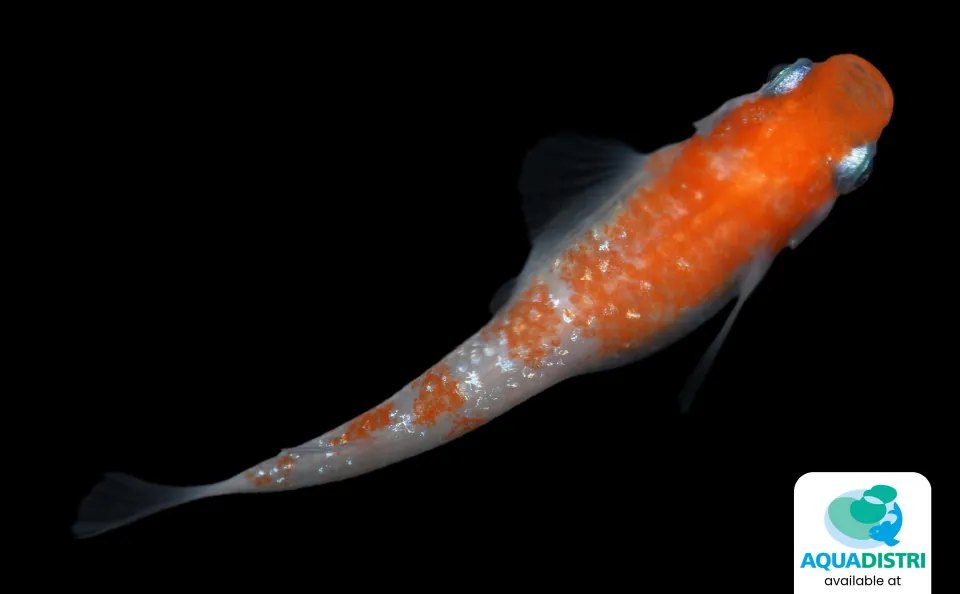
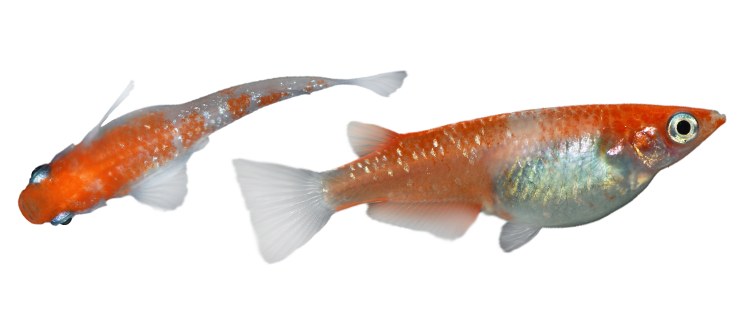
The body is white, with vermilion patches distributed without any rule. The WEB図鑑 distinguishes two distributions: the Sarasa (更紗) pattern, red and white mixed over the whole body, and the Tanchō (丹頂) pattern, where the red is confined to the head. On transparent-scaled lines, the cheeks are red and translucent. On external-light lines, a bright blue-white band runs along the back, between the patches.
What is called “Red White” in Europe corresponds to the strain described by Aquarium Glaser as highly variable: the selection aim there is a red-orange head, orange-tinted fins and a pale body. It is indeed a Kōhaku, sold under an English name. Nothing genetically distinguishes the two names.
A fine individual has clean patches with sharp edges and a deep red. Fish whose red is washed out or whose white turns yellow are less sought after. It can be confused with the White Orange, whose patches are orange rather than vermilion, and with the Sanshoku (三色), which adds black.
Keeping the Kōhaku
Nothing special on the maintenance side: 1 litre per fish at the very least, water left to stand, plants, and the rest of the set-up guide. The Kōhaku winters outdoors like the others, under the conditions on our overwintering page.
Two points matter for the result. The background first: dark, so that the white-red contrast stands out. Feeding next: a colour-enhancing food strengthens the vermilion of the patches without touching the white; our feeding guide details the contributions. The pattern itself does not change: it is fixed from a young age, only its intensity changes.
Breeding the Kōhaku
Breeding follows the general method. The difference is in the result: the WEB図鑑 gives no fixation rate for the Kōhaku, and Aquarium Glaser describes its Red & White strain as “very variable”. A pair of fine Kōhaku gives fry ranging from pure white to almost solid vermilion, with every distribution in between. This is normal, and it is what makes the variety interesting for those who like to sort.
Sorting criteria, once the young reach 2 cm: keep those with red and white, discard the solid-coloured ones; then, among the two-tone fish, prefer clean patches and dense red. For an external-light line, the WEB図鑑 classes the Kōhaku taigaikō among varieties for experienced breeders, less difficult than the Sanshoku taigaikō for lack of a third colour, but more so than the plain Kōhaku. Breeding the best together, generation after generation, improves the share of fine individuals without ever guaranteeing it.
Related varieties
- Youkihi — the vermilion of the Kōhaku, but over the whole body, with no white.
- White Orange — two-tone white and orange, paler patches.
- Sanshoku lamé — adds black to the white and vermilion, plus shiny scales.
- White medaka — white alone, no patches.
- Panda — the Kōhaku panda combination carries nos. 0616 and 0745 in the WEB図鑑.
Frequently asked questions
Are Kohaku and Red White really the same variety?
Yes. Kōhaku is the Japanese name, Red White the English name used by wholesalers. They are the same fish.
My Kōhaku fry are all white or all red. Why?
The pattern is not fixed. Part of every clutch gives solid-coloured individuals. Sort at 2 cm and keep only the two-tone fish for the next generation.
Do you need a black background?
This is the WEB図鑑’s advice: on a dark background, the boundary between white and red reads clearly. On a light background, the red fades and the pattern blurs.
Does the Kōhaku always have external light?
No. It exists on certain lines, listed separately in the WEB図鑑 under no. 0183. A Kōhaku described without this mention does not have it; when a batch does show it, it can be seen from above, as a pale band on the back.
Sources
- 改良メダカWEB図鑑, sheet no. 0177 “透明鱗紅白 更紗”: https://medakazukan.net/0177_toumeirinkouhakusarasa/
- 改良メダカWEB図鑑, sheet no. 0183 “紅白体外光”: https://medakazukan.net/0183_kouhakutaigaikou/
- 改良メダカWEB図鑑, sheet no. 0185 “小町(非透明鱗紅白)”: https://medakazukan.net/0185_komariti/
- 改良メダカWEB図鑑, sheet no. 0745 “紅白パンダ”: https://medakazukan.net/0745_kohakupanda/
- Aquarium Glaser, “Oryzias latipes – Medaka breeding forms” (Red & White strain): aquariumglaser.de
- 東京アクアガーデン, general medaka care guide: https://t-aquagarden.com/guide/medaka_howto