
The golden Longfin is a medaka of a golden colour, yellow with metallic highlights, with all its fins elongated. Seen from the side, the dorsal, anal and tail fins form a veil; seen from above, the back shines. It is an aquarium fish rather than a tub fish, hardy, and one of the most accessible long-finned varieties.
Identity card
| Name | Golden Longfin · 黄金ロングフィン · Ōgon rongu fin |
|---|---|
| Trade name | Medaka Jaune Longfin (French trade name); Longfin Gold at the supplier Aquafarm |
| JMA classification | golden (黄金) · normal scales · normal eyes · no marked iridophores · no pattern · Longfin (ロングフィン) · normal type |
| Origin | A combination of the golden colour, long established in Japanese breeding, and the Longfin trait; European batches come from farms in South-East Asia, and the exact line is not documented |
| Adult size | 3 to 4 cm of body, plus the fins |
| Temperature | 5 to 30 °C tolerated; breeds from 18-20 °C |
| Difficulty | Intermediate: hardy, but the long fins get damaged in an unsuitable tank |
| Recommended background | Dark, to bring out the gold; an aquarium seen from the side is its best setting |
Recognising a golden Longfin
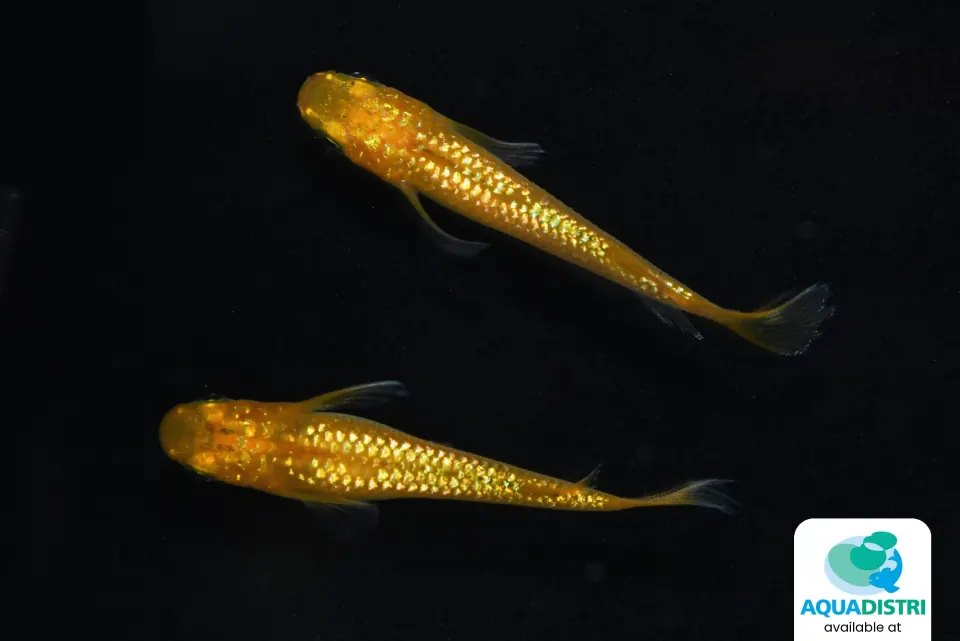
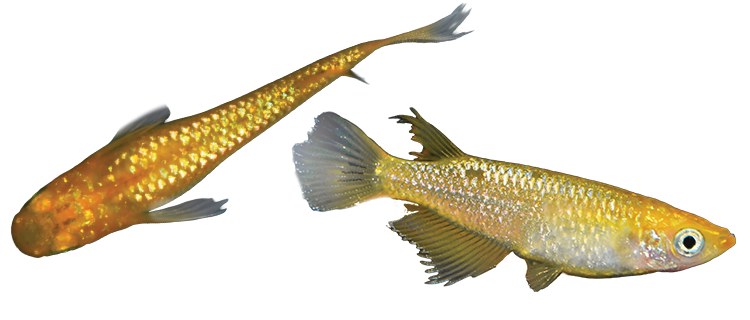
The colour is a warm yellow with metallic highlights, denser and brighter than the yellow of a Himedaka, without the red of a Youkihi. The fins are lengthened evenly, as a veil, and not in irregular filaments as in the Swallow. In a fine specimen, the lengthening is symmetrical, the edges of the fins are intact, and the dorsal and anal fins are about the same length. The Longfin differs from the Hirenaga of the Matsui line, which is more slender, and from the Hikari type, whose tail fin is diamond-shaped.
Young fish do not yet show their fins: at 2 or 3 cm, you can only make out some lengthening. The veil develops over the first year, faster in the warm.
Keeping the golden Longfin
Nothing special for water and food; see the set-up guide. What changes is the fins. They tear on sharp decoration, get damaged in a strong current, and serve as a target for lively fish: a calm tank, without a powerful filter, with soft-leaved plants, and no cohabitation with nippy species. In cold water, long fins are more prone to fungal infections; we advise bringing it indoors for the winter rather than leaving it outside, as set out in the overwintering guide.
This is a medaka to be watched from the side: a lit aquarium with a dark background shows off the veil and the gold, whereas a tub seen from above shows only the back. The lighting guide gives the settings.
Breeding the golden Longfin
The golden colour is passed on well. The Longfin trait is more capricious: a Longfin-on-Longfin spawning gives young with fins of varying length, and some of normal type. Keep as breeders the fish with the most regular and symmetrical veil, and discard those with torn or asymmetrical fins, which also pass that on. The breeding method is the same as for other medaka. Longfin males fertilise normally, unlike Daruma.
Our golden Longfin in photos and video
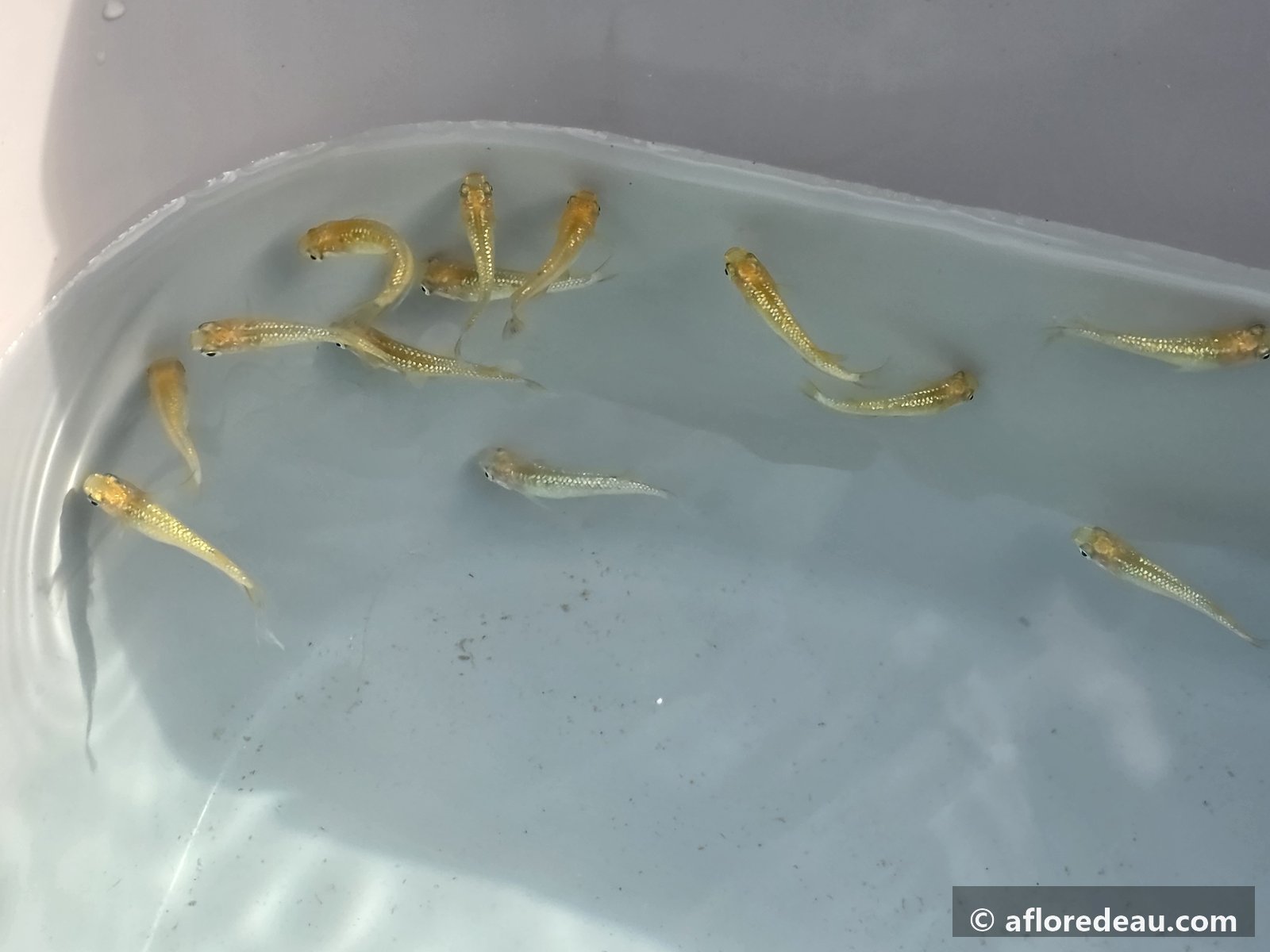
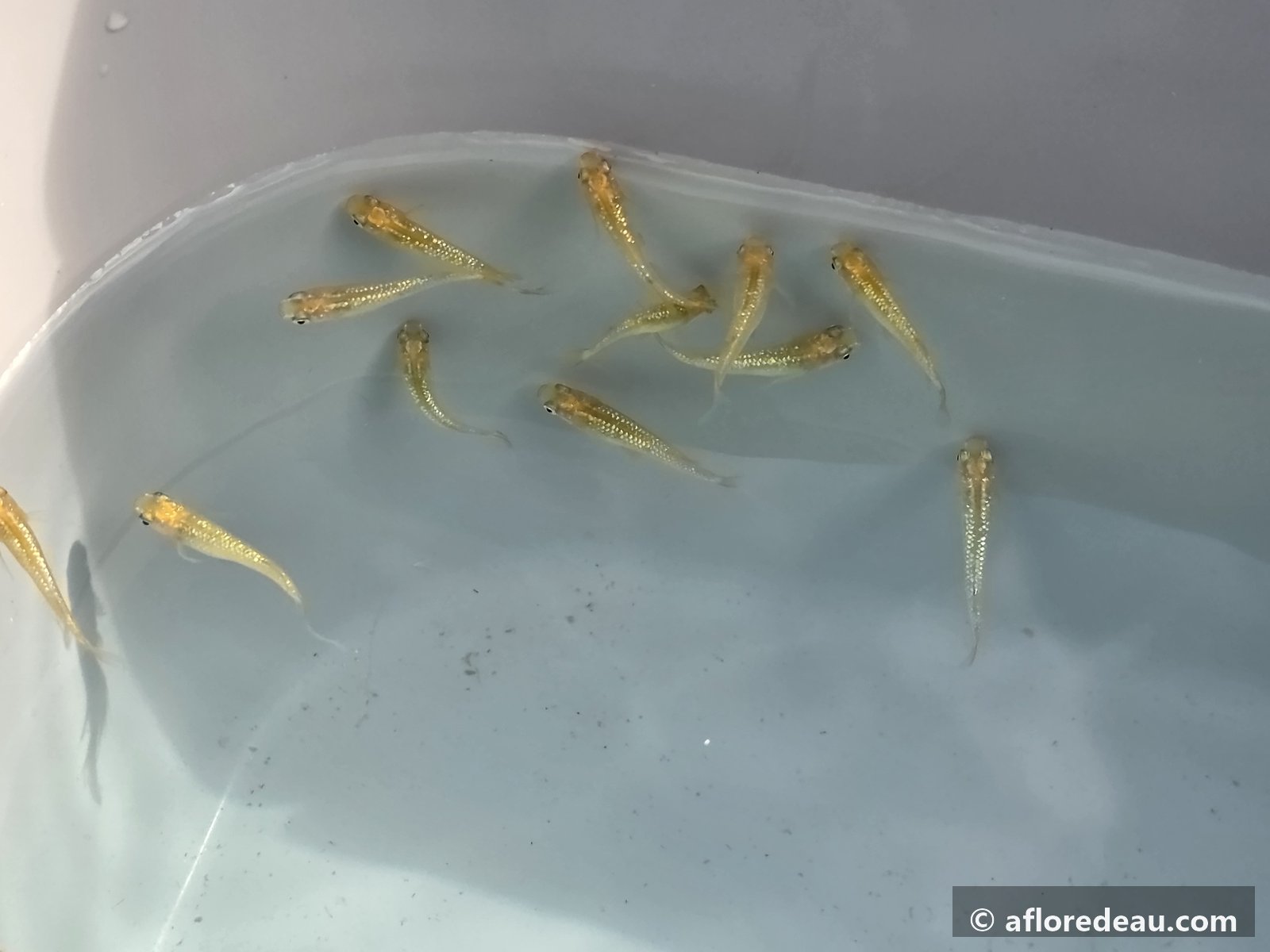
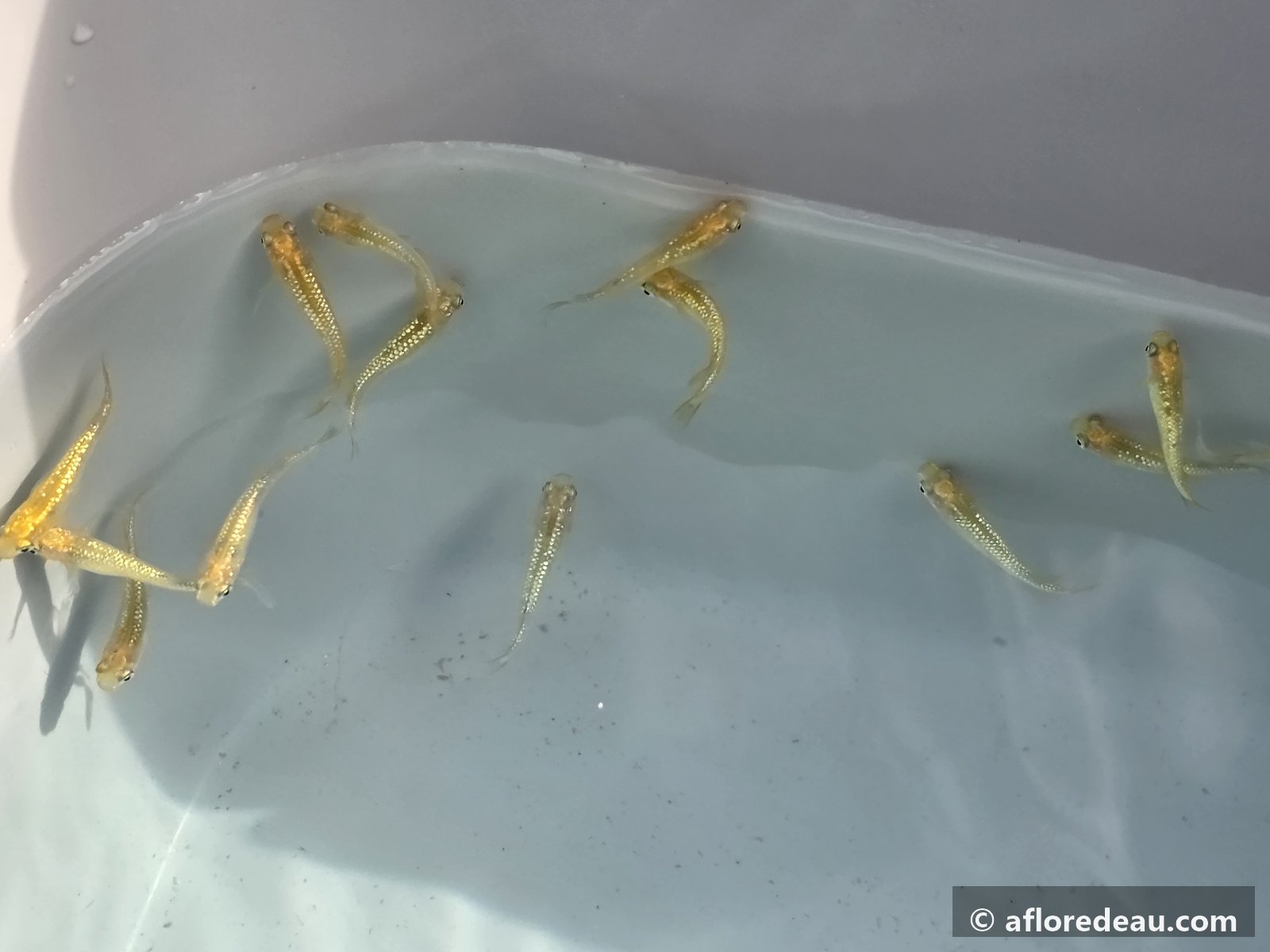
Golden Longfin at 2-3 cm: from above in a holding tank, then from the side in an aquarium, where the fin veil shows best. Photos and video taken at our premises in Lesneven.
Related varieties
- Miyuki Longfin: the same veil on a blue base with external light.
- Yellow, Himedaka: the basic yellow, normal type, without metallic highlights.
- Yellow Hikari: also golden, but Hikari type, with a diamond-shaped tail fin rather than a veil.
- Champagne: pale gold, normal type.
Frequently asked questions
Its fins have frayed edges. Is it ill?
Most often not: a piece of decoration, a current or a tank mate has damaged them. They grow back. A white, cottony edge, on the other hand, is a fungal infection, to be treated with a salt bath.
Longfin, Hirenaga, Swallow: what is the difference?
The Longfin lengthens all the fins into an even veil; the Hirenaga, of the Matsui line, lengthens them into slender points; the Swallow lengthens only certain rays, into filaments. The glossary details the fin types.
Can it live in a tub outdoors?
In summer, yes. But you will only see its back, and winter outdoors exposes it to fungal infections. It is an aquarium fish.
Sources
- Japan Medaka Association, classification manual, 5th edition, September 2025: Longfin, Hirenaga and Swallow traits, golden colour.
- Tokyo Aqua Garden, メダカの種類・品種・体型・鱗とは: fin nomenclature.
- Aquafarm, medaka variety catalogue, 2026.