
A medaka that is doing badly shows it before it is truly ill. It reacts more slowly to food, swims less, and stays in a part of the tank it did not use before. Spotting these changes at the morning feed, then checking the water, isolating the fish and watching it, is the only method that leaves time to act.
Why mealtime is the best moment to look
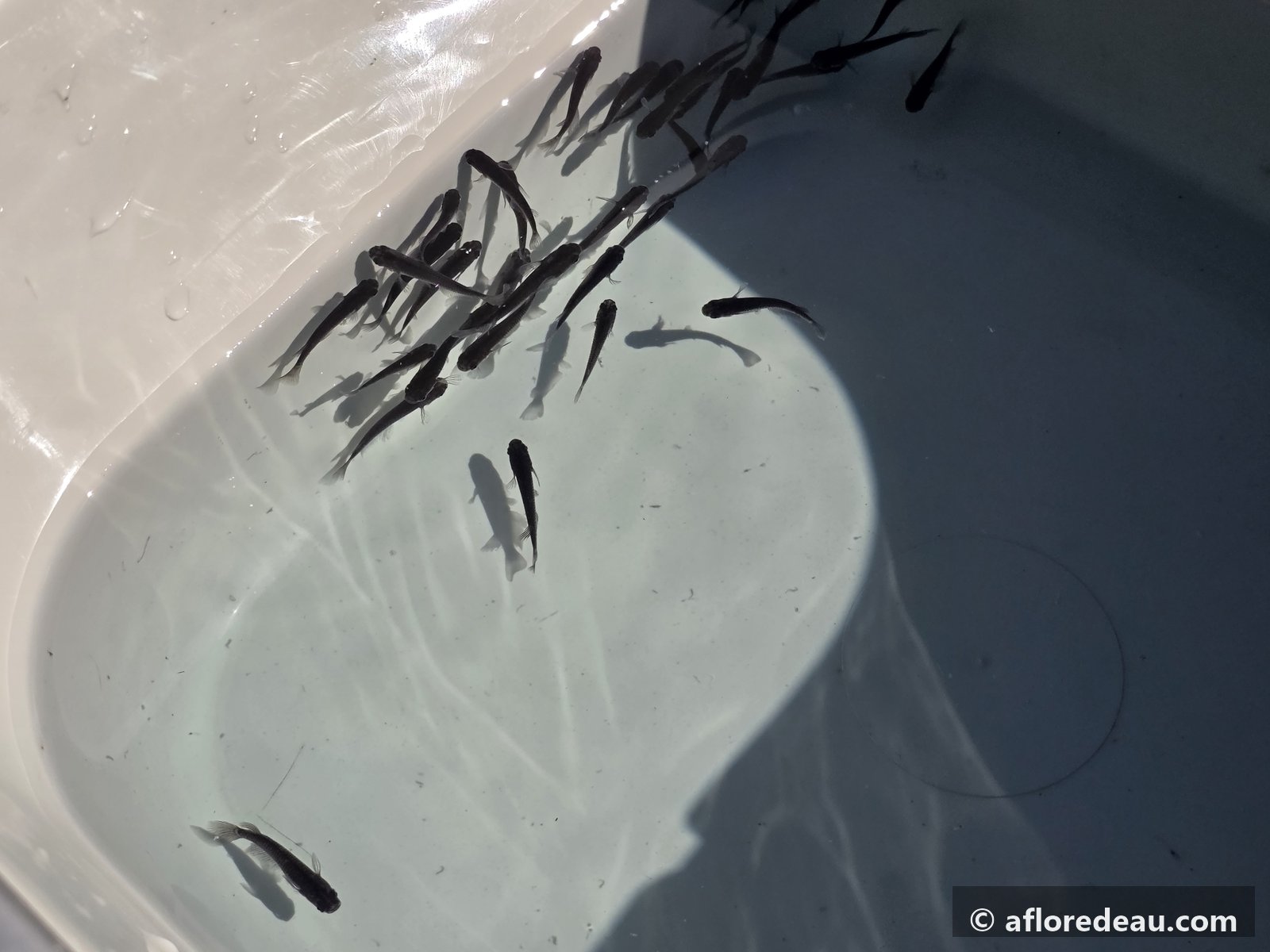
The medaka (Oryzias latipes) is a small fish of 3 to 4 cm that lives in a group and feeds at the surface. A healthy fish rises as soon as a hand approaches the tank. It takes the food quickly, competes for room with the others, and swims back down in a straight line. This scene is repeated every day. It is precisely because it is repeated that the eye immediately spots the one that does not behave like the others.
The Japanese source Tokyo Aqua Garden sums this up in one rule: longevity comes from early detection and rapid intervention. With us at Lesneven, feeding also serves as an inspection round. We count, we see who comes up and who stays down, we look at the body from above. Thirty seconds per tank is enough, every day.
The underlying causes are almost always the same: degraded water, a temperature that has moved too fast, a lack of oxygen, too much food or too many fish. A sick medaka is first of all a medaka whose environment has changed. The guide to water parameters details what to measure.
The signs to know, one by one
Swimming and position in the tank
A fit medaka occupies the upper half of the water and moves with the group. The signs that should alert you are limp swimming, a fish that stays alone in a corner, that stays motionless on the bottom outside winter, or that wedges itself near the surface with its head up. Zigzag swimming, spinning or swimming on its side is a more serious sign. A fish that rubs against the decor or the walls often signals a parasite or irritated gills.
Appetite
This is the first indicator, and the most reliable. A medaka that no longer rushes at the food, that takes it and spits it out, or that stays indifferent while the others eat, has a problem. Tokyo Aqua Garden cites causes of loss of appetite that are not diseases: a pH fallen below 6.0, water above 35 °C, water below 10 °C, or a fish already full from an over-generous meal. If it refuses a food it normally takes within one to two minutes, the cause lies elsewhere.
Breathing
The medaka breathes through its gills and does not normally gulp air. A fish that stays at the surface opening and closing its mouth is short of oxygen. In summer, this is the classic sign of water that is too warm, because warm water dissolves less oxygen. Rapid breathing, with the opercula beating fast, without any exertion, points rather to damaged gills or poisoning by ammonia or nitrites.
Body colour
A stressed medaka turns pale. The reds of the Youkihi (楊貴妃) turn orange, the blacks turn grey. This loss of colour is reversible if the cause goes away. It becomes worrying when it comes with a loss of sheen on the scales and fins that droop. Conversely, red patches on the body, haemorrhagic areas at the base of the fins or a cottony white film are no longer signs of stress but diseases, described in the article on medaka diseases.
Fins
They should be open, taut and transparent at the edges. A tail fin closed like a brush, edges that whiten and then fray, redness at the base, are the first stages of fin rot. A white spot of about a millimetre, single or scattered, is a sign of white spot disease (ichthyophthiriasis). Both diseases are easily treated when seen early.
The gills and their colour
On a 3 cm fish, gill colour can be made out through the transparency under the operculum. On varieties with transparent scales, the red cheeks of the Panda or the Kōhaku (紅白), it can be seen directly. Tokyo Aqua Garden gives a simple scale. Bright red: healthy fish. Pale pink or whitish: diseased gills, often parasitised by monogenean worms (Dactylogyrus, Gyrodactylus), with accelerated breathing. Dark red and swollen: inflammation, from lack of oxygen or excess ammonia. Chocolate brown: nitrite poisoning, the haemoglobin no longer carries oxygen. Darkened after inflammation: repair phase. On a medaka, the practical guide remains the rhythm of the opercula and the position of the fish.
The belly
Seen from above, the belly of a healthy medaka looks slightly wider than the head. A belly narrower than the head signals a fish that is getting thin: underfeeding, competition in the tank, old age, or, if it eats and still wastes away, wasting disease. A very swollen belly, with scales that lift like a pine cone, is dropsy. In a female kept alone or without a spawning support, a belly that is permanently swollen can be egg retention.
What is normal and should not worry you
Some behaviours look like signs of disease and are not.
- In winter, below 10 °C, the medaka stays motionless on the bottom, does not eat and lets itself drift. This is overwintering. Do not disturb it, do not “treat” it. See the overwintering guide.
- In the spawning season, a female carries a cluster of eggs under her belly for a few hours, sometimes longer. This swollen belly is normal. A male chasing her relentlessly is too.
- After a water change or transport, a fish turns pale and hides for a day or two. If the water is right, it recovers its colours.
- A fish more than two years old gets thin, curves and reacts more slowly. This is not a disease, see the article on causes of death and ageing.
The three-step approach: water, isolation, observation
1. The water first
Before looking for a disease, check the environment. Water temperature, with a thermometer in the tank and not in the air. pH. Ammonia and nitrites if the tank is less than two months old or if many fish were added at once. Smell of the water. Uneaten food rotting on the bottom. Dead leaves decomposing, especially in quantity: see dead leaves in a medaka tank. In most cases, the sign observed is explained there. A water change of a third to a half, at the same temperature, with water left to stand or conditioned, is the first measure and often the only one. The guide to water changes shows how to do it without shock.
2. Isolate the fish
If a single fish is affected or the sign is clear (white film, eaten fins, white spots, swollen belly), move it to a quarantine tank: a clean 5 L bucket, water from the original tank, gentle aeration. It no longer contaminates the others, it is no longer jostled at mealtimes, and you can treat it with salt without touching the main tank, where salt would kill plants and shrimp. The salt bath at 5 g per litre is the first treatment available without a prescription.
3. Observe for several days
Watch the isolated fish twice a day. It eats or it does not, the lesions advance or recede. A medaka that takes food again after two or three days of rest and salt is on the right track. A fish whose lesions spread despite clean water is a job for a vet, because veterinary antibiotics and antiparasitics require a prescription in the European Union. The article treating a sick medaka without medication details what is possible before that stage.
One last point: a single sick fish in a tank of thirty is not a catastrophe. Five fish showing the same sign on the same day means the tank has a problem.
The key figures
| Normal meal | everything eaten in 2 to 3 minutes, 1 to 2 times a day |
|---|---|
| Appetite falling | pH below 6.0; water above 35 °C; water below 10 °C (TAG) |
| Reduced activity | below 15 °C; rest below 10 °C (TAG) |
| Heat stress | above 30 °C; danger at 34 °C |
| Belly seen from above | slightly wider than the head = normal; narrower = wasting |
| White spot (ich) | about 1 mm (TAG) |
| Quarantine | 5 L minimum; 1 to 2 weeks for a new fish (TAG) |
Frequently asked questions
My medaka stays on the bottom without moving. Is it ill?
If the water is below 10 °C, no: it is overwintering. If the water is at 20 °C and the others are swimming, yes, or at least it is in difficulty. Check the water and isolate it.
My medaka is breathing at the surface. What should I do right away?
Add aeration or a gentle movement of water, shade the tank if it is hot, do a partial water change at the same temperature. If the tank is new, test ammonia and nitrites.
Is a pale medaka necessarily ill?
No. Paleness is a response to stress: transport, a water change, a light-coloured bottom, a predator prowling. It goes away within a day or two if the cause goes away. It is worrying if it lasts and the fish stops eating.
Sources
- Tokyo Aqua Garden, “メダカの体調が悪いサインとは!長生きのコツは事前察知と早期対処です!”, https://t-aquagarden.com/column/medaka_badsign
- Tokyo Aqua Garden, “メダカが餌を食べない!屋外・屋内飼育での理由と治療・解決策を解説”, https://t-aquagarden.com/column/medaka_not_eat
- Tokyo Aqua Garden, “エラの色で魚の健康が分かる!状態ごとの色と対処法を紹介します”, https://t-aquagarden.com/column/fish_gill_condition
- medaka.fr fact base: temperature and activity thresholds (Kamihata, TAG, WEB図鑑).
- Regulation (EU) 2019/6 on veterinary medicinal products.