
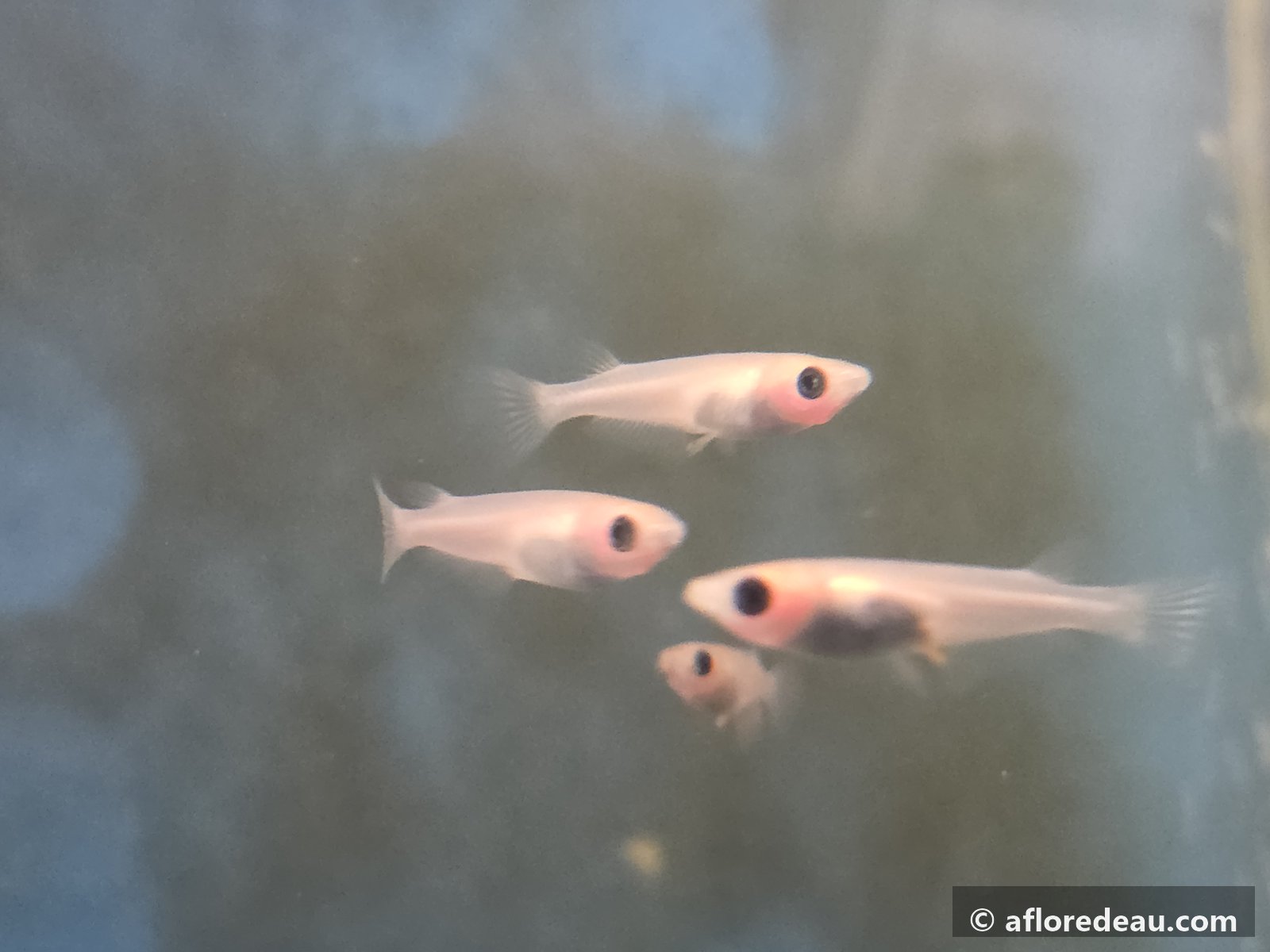
A medaka that eats but visibly loses weight, its back turning into a knife blade, its belly hollowing out, then a staggering swim: Japanese breeders call this 痩せ細り病, yase-hosori-byō, wasting disease. It is the most feared of their diseases because it is almost never cured. Since 2023 we have known where it lodges, in the kidney, but not yet how to treat it. This page says what is established, what is only a breeder’s opinion, and what to do when a fish loses weight. It also explains why “worming the whole tub” is not the right answer.
Recognising wasting disease
The sign that defines the disease is the contradiction: the fish eats and loses weight all the same. Japanese descriptions agree. At the start, the belly looks a little hollow and the spine begins to show on the back. Then the fish becomes clearly thinner than its neighbours, the head seems too big for the body, the flanks hollow out, and the outline becomes angular, “like a set square” writes the site 日淡といっしょ. At the advanced stage, the bones can be made out under the skin, movements slow, and the swimming becomes staggering, sometimes oblique or vertical, the fish hanging at the surface. One breeder, Hime-medaka, notes that at the very beginning the body looks slightly arched, and that the vertical-swimming form can survive, wasted, for about two months.
Speed matters. The GEX study places the sudden wasting between two weeks and a month after the start of breeding; Hime-medaka speaks of “a few weeks to a month”. A fish that melts away in three weeks while eating is the typical picture. There is no external lesion: no white film, no eaten fins, no swollen belly. When these signs are present, it is another disease, to be looked up in medaka diseases.
What looks like the disease and is not
Not every thin medaka is ill, and that is the first sorting to do. Tokyo Aqua Garden, which incidentally never uses the Japanese term “wasting disease” (痩せ細り病), lists the ordinary causes of a fish that is too thin: not enough food, not enough light, a current too strong that exhausts it, inbreeding that produces puny individuals. Hime-medaka adds harassment: a dominant fish that stops another from eating. The site 日淡といっしょ adds cold, which blocks digestion in winter and between seasons, and old age, because a medaka of two years or more loses weight slowly before dying, and that is not contagious.
The same site proposes a simple sort. A single thin fish in the tub: individual cause, age, harassment, birth defect. Several fish losing weight one after another: environmental cause or infection. A fish that regains weight within two weeks when food and water are improved did not have the disease. One that keeps melting away regardless, did.
What research says: the kidney, not the gut
For twenty years, Japanese breeders put forward every possible cause, water quality, bacteria, parasites, internal malformation, without proof. The first histological study dates from 2023. The laboratory of the manufacturer GEX, with Professor Emeritus 保智己 of Nara Women’s University, raised fifty Himedaka in an aquarium, took ten affected fish, and examined their organs under the microscope, section by section, in comparison with healthy fish. The results were presented at the autumn 2023 congress of the Japanese Society of Fisheries Science.
- In eight fish out of ten, images suggesting parasites were found in the kidney tubules. The parasite was not identified.
- Also in the kidney, granuloma lesions typical of a mycobacterial infection, and the presence of acid-fast bacilli was confirmed by staining. The species is not specified.
- The other organs, gills, liver, digestive tract, muscle, gonads, showed no lesion that could explain the thinness.
The conclusion is cautious: the disease “may be caused by” a parasite or a mycobacterial infection of the kidney. Mycobacteria live everywhere, in soil and in water. And the sentence that matters to the breeder: “commercial veterinary medicines are difficult to use against this; there is, to date, no effective treatment”. The announced follow-up of the study concerns the route of infection and prevention.
This result matches what veterinary research already knew about laboratory medaka. In 2001, a colony of laboratory medaka in the United States was decimated by a mycobacteriosis caused by Mycobacterium fortuitum: loss of sheen, wasting, balance problems, granulomas in several organs, and transmission to the offspring, which led to the colony being euthanised. In 2012, Mycobacterium marinum caused an acute fatal disease in the medaka in experimental infection. “Fish tuberculosis” is a known disease in aquarium keeping, chronic, with no established treatment, and it is very probably this, at least in part, that lies behind the wasting disease of Japanese breeders.
And intestinal worms?
You read on social networks that a medaka losing weight has “worms” and that you must worm the whole tub. This idea comes from keeping live-bearers, guppies and platies, in which the nematode Camallanus is common and visible: small red worms sticking out of the anus. In the medaka, none of the Japanese sources consulted for this page mentions an intestinal worm as a cause of wasting, and the GEX study found a digestive tract with no lesion. White, stringy faeces, the classic sign of intestinal flagellates in discus, appear in no Japanese description of the disease.
That does not mean a medaka can never have worms. But a wormer is given on a sign, not at random: red worms visible at the anus, or persistent white stringy faeces in several fish. In that case, and only then, a levamisole-based product sold for aquariums makes sense, following its instructions, with carbon removed from the filter and UV switched off. Treating a whole tub of fish that are already exhausted without this sign adds a chemical stress to fish that cannot cope with it. Tokyo Aqua Garden says it bluntly: in a thin fish, a medicated bath or a salt bath “can be the final blow”.
What to do when a medaka loses weight
1. Isolate it at once
As soon as the belly is hollow, the fish goes into a hospital tub, a simple container of a few litres with water from the original tub. Two reasons: if it is contagious, it no longer infects the others; and alone, it eats without competition, which settles the case of harassment. Japanese sources are unanimous on this point, and on the fact that the chance of recovery depends on the stage: a breeder from the JASMA association estimates, from his own impression, “about one chance in two” for a fish caught early, and “almost none” for a fish that is already staggering.
2. Feed richly, digestibly, and often
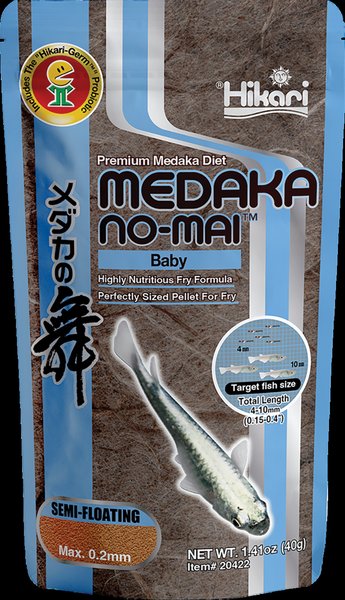
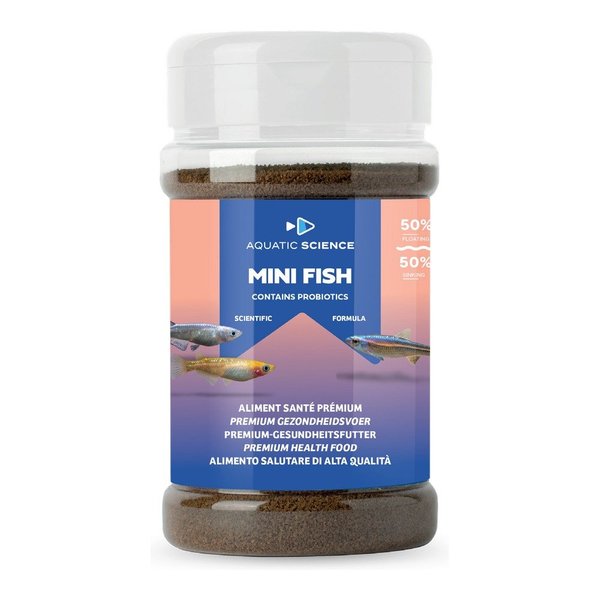
A fish that no longer assimilates must receive what digests best: live or frozen daphnia and brine shrimp, a fry powder such as Hikari Medaka Baby, green water, or a fine, very digestible granule such as Aquatic Science Mini Fish. The site 日淡といっしょ advises “little and often”, with a protein-rich food, and warns that recovery, when it comes, takes one or two months, not days. Ordinary flakes pass poorly. The flakes it does not swallow foul the small tub: remove leftovers. The details of foods are in what medaka eat.
3. Salt, with caution
The salt bath is the only “treatment” that all the Japanese sources cite. Medaka Life gives 0.5%, that is 5 g per litre, for about a week. The JASMA breeder prefers to raise it gradually: 0.1% on the first day, 0.3% the next, up to 0.6% if nothing changes, for one to two weeks. The full method is in the salt bath. Two reservations: salt relieves a tired fish by reducing its osmotic work, it does not kill a mycobacterium lodged in the kidney; and a very wasted fish may not tolerate the bath, hence the value of starting low.
4. Medicines: what to know before buying any
In Japan, breeders who treat combine salt with two aquarium medicines, エルバージュ and アグテン, for one to two weeks. These products do not exist under these names in France, and above all, the most cautious sources say the same thing: if the cause is a mycobacterium, conventional antibacterials “have no effect”, writes Hime-medaka, which classes the disease among the incurable; 日淡といっしょ advises against any medicine “until the cause is identified”. A wormer with no sign of worms, an antibacterial against a bacterium that does not respond to it: in both cases, you tire the fish for nothing. The money is better spent on daphnia.
5. Knowing when to stop
A fish that no longer eats, that staggers or hangs at the surface, almost never recovers. Keeping it for weeks in a hospital tub prolongs the agony. Japanese breeders say it with reticence, but they say it: at this stage, euthanasia is the clean decision, and dead fish do not go back in the tub or into the garden compost, so as not to spread a bacterium that survives in soil.
In our breeding at Lesneven, with about twenty tubs, this picture turns up from time to time, and always in an isolated fish: one that melts away while its neighbours stay plump. We have never seen a whole tub waste away. That is consistent with Japanese descriptions, and one more reason not to treat a whole tub because of a single fish.
Contagion and hygiene
Nobody has measured contagiousness in hobbyists’ medaka. The sources judge it “possible depending on the cause”, with accounts of tubs where fish lose weight one after another, and others where only one is affected. Hime-medaka specifies that mycobacteria take refuge in the biofilm and bottom sludge: a tub that has had the disease is emptied, scrubbed completely and dried in the sun, whose ultraviolet kills the bacterium. Nets and buckets do not pass from one tub to another. New fish stay in quarantine for one to two weeks before entering a stocked tub, and a fish that has lost weight is not used as a breeder: with M. fortuitum in the laboratory, transmission to the offspring is documented.
A precaution for the keeper: fish mycobacteriosis can, rarely, infect a wound on the hand, the “aquarium granuloma”. Wash your hands after handling a suspect tub, and wear gloves if you have a cut.
Preventing it
- Density. All the sources put overcrowding at the head of the factors: stress, degraded water, competition for food. One fish per litre is the benchmark in our breeding guide.
- Water. A third of the volume renewed each week in season, bottom siphoned, and a new tub properly cycled before fish go in.
- Food. Sufficient and varied. The JASMA breeder thinks that nutritional deficiency produces more thin fish than infection itself, and that well-lit tubs or tubs in full sun see fewer; that is his opinion, but it costs little to follow it: tubs outdoors, in the light, fed every day in season.
- Quarantine. One to two weeks for any newcomer, in a separate container, with its own equipment.
- New blood. A line bred in a closed circle for years gives puny fish, which Tokyo Aqua Garden calls “of insufficient development”. From time to time, introduce a breeder of another origin, after quarantine.
Frequently asked questions
My medaka eats a lot and still loses weight. Is it necessarily this disease?
No. First check that it is really eating, and not just rushing at the food before being chased off. Put it on its own, feed it well for two weeks. If it recovers, it was harassment or the ration. If it keeps melting away, it is probably the disease.
Should I worm the whole tub as a precaution?
No. No Japanese source describes intestinal worms in the wasted medaka, and the reference study found the gut intact. A wormer is given on a sign: red worms visible at the anus or persistent white stringy faeces.
Can the survivors breed?
Better not. Transmission of a mycobacterium to the offspring is documented in the laboratory, and nothing says that a fish that has regained weight is rid of the bacterium lodged in its kidney.
Is it dangerous for me?
Very rarely, through a wound on the hand: the “aquarium granuloma”. Wash your hands, wear gloves if you have a cut, and that is all.
Sources
- GEX Laboratory and Nara Women’s University (保智己), “メダカの痩せ細り病の原因究明” (investigating the cause of medaka wasting disease), presentation at the autumn 2023 congress of the Japanese Society of Fisheries Science, page of 13 October 2023, gex-fp.co.jp: 8 fish out of 10 with parasite-like images in the kidney tubules, acid-fast bacilli and granulomas, other organs healthy, no known effective treatment.
- Hime-medaka, “痩せ細り病” (wasting disease), 16 January 2025, hime-medaka.com: progression over a few weeks, vertical swimming, ineffectiveness of antibacterials, biofilm and disinfection in the sun, differential diagnosis.
- 日本改良メダカの会 (JASMA), “痩せ細り病” (wasting disease), 2023, updated on 10 September 2025, jasma.sc: breeder’s opinion, deficiency and light, progressive salt protocol 0.1 to 0.6%, “about one chance in two” if caught early.
- 日淡といっしょ, “メダカの痩せ細り病” (medaka wasting disease), 2026, nittanwith.com: a syndrome rather than a single disease, one fish / several fish sort, mycobacteriosis, no medicine without a cause, zoonosis.
- Medaka Life, “メダカの痩せ細り病” (medaka wasting disease), 20 June 2026, medaka-life.com: stages, 0.5% salt bath for a week, prevention.
- Tokyo Aqua Garden, “メダカが痩せる原因と対策” (why a medaka loses weight, and what to do), 2 November 2021, updated on 24 September 2024, t-aquagarden.com: ordinary causes of thinness, a treatment can finish off a thin fish.
- Sanders G. E. and Swaim L. E., “Atypical piscine mycobacteriosis in Japanese medaka (Oryzias latipes)”, Comparative Medicine, 2001: Mycobacterium fortuitum, wasting, granulomas, transmission to the offspring. Mosi L. et al., Microbes and Infection, 2012: M. marinum in the medaka.