

The medaka (Oryzias latipes) is the little fish of Japan’s rice fields that, after twenty years of selective breeding, has become Japan’s third most popular ornamental fish. More than 900 varieties, an official standard, competitions. Medaka.fr covers it in depth: variety profiles following the Japanese nomenclature, care guides written for Europe’s climates, and the experience of a professional aquaculturist who breeds them in Brittany, in western France.
What is a medaka?
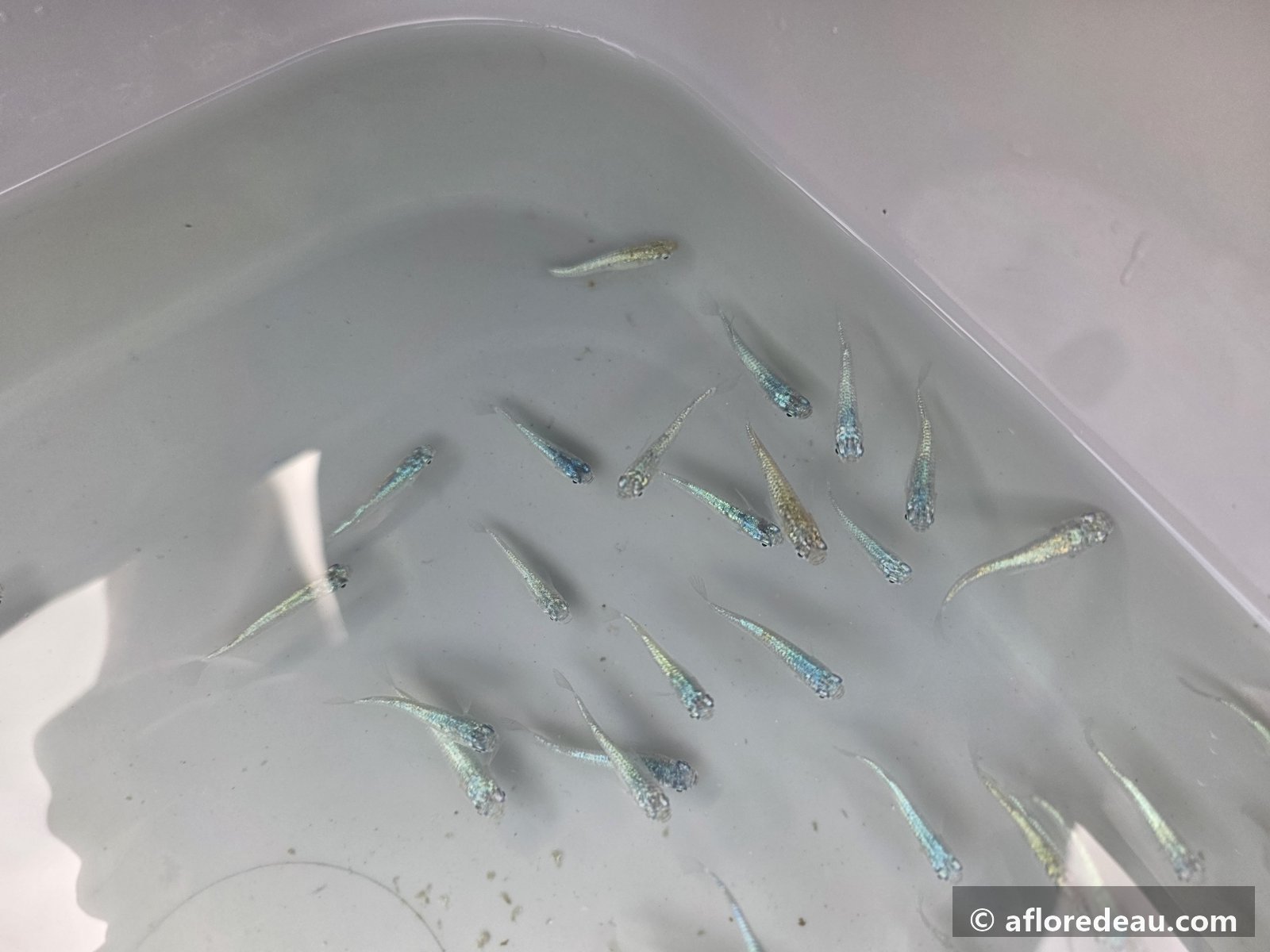
The medaka, or Japanese rice fish, is a small freshwater fish native to East Asia. Its scientific name is Oryzias latipes; in Japan it is called メダカ. Adults measure 3 to 4 cm and live 2 to 3 years, sometimes 4 when kept in calm conditions. It tolerates water from 5 to 30 °C: it is the ornamental fish that winters outdoors in much of Europe, in a simple bowl, with no heater or filter, and it does just as well in an aquarium. It lives in groups, spawns almost every day from May to September, and its fry feed on the micro-fauna of a planted tub.
The wild medaka is brown. Since 2004 and the creation of the Youkihi, the vermilion medaka, Japanese breeding has produced hundreds of varieties of colour, sheen and shape, of which an official directory lists more than 900: white, blue, orange, black, Miyuki with its shining stripe along the back, lamé with glittering scales, bicolours and tricolours, short-bodied Daruma, Longfin with veil-like fins. These varieties come from crossing and selection, with no genetic engineering of any kind. A standard, that of the Japan Medaka Association, describes each fish by seven characters, and this site follows that standard.
Getting started takes very little: a container of at least 10 litres, plants, no more than one fish per litre, and the patience to let it settle before adding the fish. All of this is explained in the guides below.
Which variety is my medaka?
Seven questions, in the order of the Japanese standard, and the tool gives you the official name of your fish, the matching profiles, and the varieties in the Japanese directory, out of 900, that have exactly those characters: identify a medaka. Before you start, photograph it from above, against a light background and against a dark one.
Where to start
- Identify a medaka: answer the seven questions of the standard and the tool names the variety.
- Reading a medaka’s name: the Japan Medaka Association’s seven groups of characters, and what Miyuki, lamé, Hikari or Daruma mean.
- Medaka varieties: the overview, from solid colours to tricolours, with detailed profiles.
- Setting up your first tub, then keeping them outdoors or indoors, with the right plants.
- Getting through winter: what to do in October, climate by climate, and feeding according to water temperature.
- Breeding and raising fry.
- Thirty frequently asked questions and the Japanese glossary.
Variety profiles
Each profile gives the Japanese name, the official classification, the origin of the line where it is documented, how to recognise a fine specimen, and what changes when keeping and breeding it.
- Solid colours: Youkihi, yellow Himedaka, orange, dark orange, blue, white, Black Dragon, Champagne.
- Bicolours and tricolours: Kōhaku, Sanshoku lamé, White Orange, White Black, Orange Black, Panda.
- Sheens and lamé: Miyuki Longfin, blue with external sheen, Platinum, yellow Aurora lamé, Saboten, Neptune, golden Longfin.
- Body shapes: yellow Hikari, Miyuki Daruma, Youkihi Daruma, Tomoki.
The forum
Since September 2026, medaka.fr has had its own forum, in French: forum.medaka.fr. Ten sections following the site’s categories, a short code of conduct, and one simple rule for getting a fish identified: one photo against a white background and one against a black background, both from above.
The questions we are asked most
What is the ideal temperature for medaka?
Between 20 and 25 °C for growth and spawning, with a tolerance of 5 to 30 °C. Below 10 °C the medaka stops eating and overwinters at the bottom; above 30 °C it suffers. See water parameters.
How do medaka breed?
The female spawns every morning once the water reaches 18 to 20 °C with 13 to 14 hours of daylight, and carries her eggs under her belly before attaching them to plants. Collected and incubated separately, they hatch after about 250 degree-days, that is ten days at 25 °C. See medaka breeding.
How big does an adult medaka grow?
3 to 4 cm. Short-bodied Daruma stay smaller; Longfin look larger because of their fins.
Who writes this site
Gabriel Gayrin, a qualified aquaculturist, has run À Flore d’Eau in Lesneven, Brittany, since 2007. The foods and equipment mentioned on these pages are those of the shop. More about the site and its sources.