

The blue medaka, Ao medaka (青メダカ), is one of the basic colours of improved medaka: a grey-blue fish of normal type, with no reflection or pattern. It has no blue pigment; it lacks yellow, and it is this lack that makes it look blue. Discreet and hardy, it is also the starting point of the Miyuki. We breed it in Lesneven.
Identity card
| Name | Blue medaka · 青メダカ · Ao medaka; WEB図鑑 entry no. 0047 |
|---|---|
| Trade name | Blue medaka; “Blue medaka” or “Silver blue” at some importers |
| JMA classification | blue (青) · normal scales · normal eyes · no particular iridophore · no pattern · normal fins · normal type |
| Origin | Old line, year and creator not given in the WEB図鑑 (entry no. 0047), which only notes that in early 2004 the males were still grey and the females pearl blue: the variety was therefore already under selection at that date. Derived from the brown form by loss of the yellow pigment; one reads that it appeared over the course of crosses between brown and white. |
| Adult size | 3 to 4 cm |
| Temperature | Tolerates 5 to 30 °C; breeding from 18-20 °C, optimum 20-25 °C |
| Difficulty | Beginner: hardy, inexpensive, undemanding |
| Recommended background | Dark, preferably black: on a white background the colour disappears |
Recognising a blue medaka
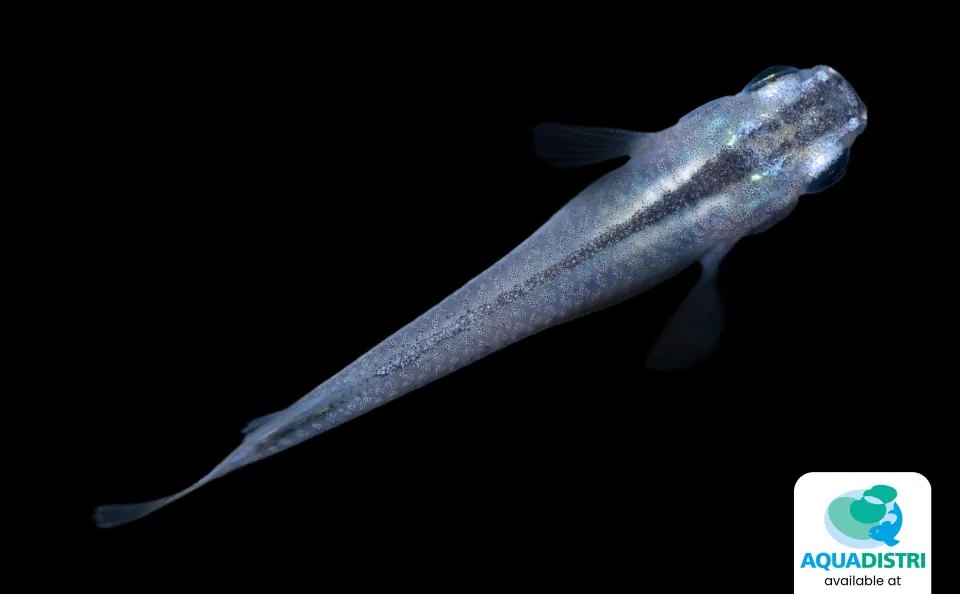
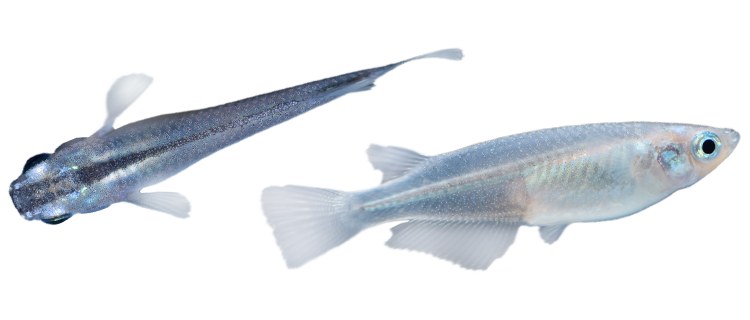
The word “blue” promises more than the fish shows. The WEB図鑑 is clear: the medaka has no blue-pigment cells, and the real shade is close to grey. This grey looks bluish because the black and white pigments are left alone, the yellow having disappeared. Depending on the quantity and size of these black and white cells, the coat ranges from a pale “pearl blue” to a dark “purple blue”, almost black. If a little yellow remains, you get green: this is how the WEB図鑑 explains the green colour.
To place it among the basic colours, think by subtraction. The wild brown has all three pigments. The white has lost the black and the yellow. The blue has lost only the yellow: darker than a white, less warm than a brown. The cheeks are opaque, the eyes ordinary, the back without a shiny band. A shiny back would make it a blue external-light medaka, in other words a Miyuki.
A fine specimen is even, with no paler patches, with a clear shade seen from above. The dark purple-blues are the most sought after because they read from afar. Know that a blue fades after transport and regains its shade when left in peace: do not judge a batch on the day it arrives.
Keeping the blue medaka
Nothing special compared with our setup guide: at least 1 litre per fish, a 60 cm tank for 50 to 60 fish at most, pH 7 to 8, plants, settled water. It tolerates 5 to 30 °C and winters outdoors in 30 litres with a deep zone, with no feeding below 10 °C (see overwintering). Feeding according to our guide, with no particular colour-enhancing food: the colour does not come from yellow.
The only point that matters is the background. A Japanese breeder sums it up: black background to bring out the shade, white background and the fish fades away. In a dark water-lily tub, a group of blues shows well from above; in a glass aquarium with a pale base, it passes for a grey fish. It is a matter of presentation, not health.
Breeding the blue medaka
Breeding is that of our breeding page: spawning from 18-20 °C with 13 to 14 hours of daylight, eggs on the mop, 250 degree-days of incubation, fry fed from the third day.
The blue breeds true. The absence of yellow pigment comes from the r locus, recessive in medaka genetics: two blue parents give blue fry, with shades from pearl to purple, and brown returns only by crossing with a carrier of the wild allele. Sorting looks at the depth and evenness of the shade, at about 2 cm on a black background. Keep the darkest and most uniform, with more females than males in the spawning tank.
The blue is also a working base. The Miyuki was born from a mutation on a blue medaka, and the WEB図鑑 lists the blue Hikari, the silver and the green after the blue. Anyone who wants to select their own lines does well to keep a tank of pure blues.
Our blue medaka in photos and video
Blue medaka 2.7-3 cm, September 2026 batch in a holding tank. Photos and video taken at our shop in Lesneven.


Similar varieties
- Blue external-light medaka: the same fish with the Miyuki’s shiny band on the back.
- White medaka: has lost the black as well as the yellow.
- Miyuki Longfin medaka: external light and elongated fins on a blue base.
- Platinum medaka: white with strong external light.
- Neptune medaka: blue to the snout with green-gold lamé, Savanna line 2023.
- Black Dragon medaka: black, the next step into the dark.
Frequently asked questions
Why does my blue medaka look grey?
Because it is. The medaka has no blue pigment. The bluish shade is an effect of black and white pigments without yellow. A black background accentuates it, a pale background removes it.
Blue or Miyuki: what is the difference?
The Miyuki is a blue that carries a reflective band on its back, the external light. Without that band, it is a blue. Both have the same colour base.
Is the blue visible in a garden pond?
From above, on a dark background, yes. It stays more discreet than an orange, which pleases some and disappoints others. For a pond, take it as a group.
Sources
- medaka.fr fact base (section 4 of the SOCLE): TAG, WEB図鑑, Kamihata, afloredeau.com guide.
- 改良メダカWEB図鑑, “青メダカとは 改良メダカWEB図鑑No.0047”, https://medakazukan.net/0047_ao/
- 改良メダカWEB図鑑, “青体色 ~メダカの体色の特徴~” (trait 4/44), https://medakazukan.net/%E9%9D%92%E4%BD%93%E8%89%B2%E3%80%80%EF%BD%9E%E3%83%A1%E3%83%80%E3%82%AB%E3%81%AE%E4%BD%93%E8%89%B2%E3%81%AE%E7%89%B9%E5%BE%B4%EF%BD%9E%E3%80%80%E3%83%A1%E3%83%80%E3%82%AB%E3%81%AE%E4%BD%93%E8%89%B2%E3%81%AE%E7%89%B9%E5%BE%B44/
- AQUALASSIC, “青メダカ 改良メダカ解説”, https://www.aqualassic.com/medaka_ao/
- 東京アクアガーデン, “青いメダカ品種10選”, https://t-aquagarden.com/pro-picks/blue_medaka_variety