

The Neptune is a blue lamé medaka released in July 2023 by Medaka-ya Savanna, in Saitama. The blue covers the whole body up to the snout, and the back carries large lamé scales with green-gold reflections. It is one of the most recent varieties to reach the market. It is sold commercially as “Neptune jaune bleu” (yellow blue). It suits a breeder who has already kept lamé medaka.
Identity card
| Name | Neptune · ネプチューン · Nepuchūn |
|---|---|
| Trade name | Neptune jaune bleu (the “yellow” denotes the gold reflections of the lamé) |
| JMA classification | blue · Aurora line according to JASMA, though semi-transparent scales are not confirmed by a WEB図鑑 entry · normal eyes · lamé + pectoral fin light · no pattern · normal fins · normal type |
| Origin | Medaka-ya Savanna, Saitama; first sale on 26 July 2023 on Yahoo Auctions; cross (Miyazakura × Himitsu Heiki) × Saboten |
| Adult size | 3 to 4 cm |
| Temperature | 5 to 30 °C tolerated; breeding from 18-20 °C |
| Difficulty | Intermediate: simple to keep, but a timid fish that is slow to start spawning |
| Recommended background | Black: it tightens the blue and makes the lamé stand out |
Recognising a Neptune
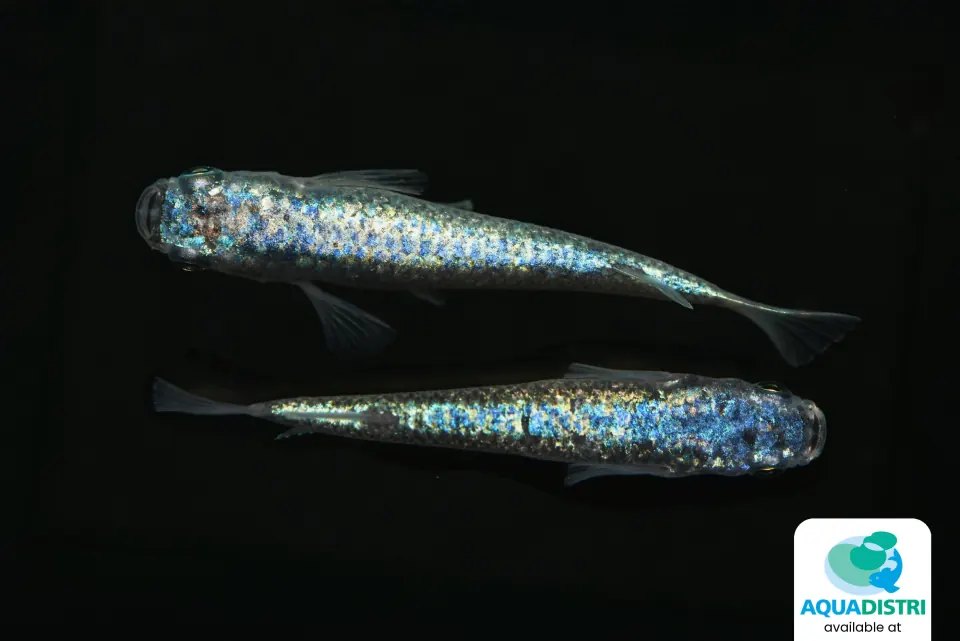
The Neptune is the son of the Saboten. Savanna crossed two lamé lines, Miyazakura and Himitsu Heiki, then crossed the result back with its 2021 Saboten. The Saboten contributed its fecundity and its fixation; the other two parents contributed the blue. The name was chosen by a vote on Instagram, and the first trio sold for 601,000 yen at auction, a figure that got the variety talked about in Japan.
What strikes you first is the head. In most lamé medaka, the head stays grey or dark. In the Neptune, the blue runs up to the snout and the head shines more brightly than the body. On the back, the lamé scales are large, bigger than the fine lamé of a Sanshoku lamé, and lean towards green and gold depending on the angle. The pectoral fins carry a luminous edge, inherited from the Aurora line. The body is of normal type, with no elongated fins despite the Saboten parent.
JASMA describes three expressions in the same spawning: the blue fish, which are sought after, and “gold” or “silver” fish whose reflections dominate the blue. The trade name “jaune bleu” probably comes from this mix: a single batch contains fish with a blue dominance and others with golden reflections. The yellow is not a body colour here, it is the shade of the lamé.
A fine specimen has a clear blue head, lamé covering the back without interruption, and green-gold reflections legible in the sun. It is confused with the Saboten, greener and long-finned, and with blue lamé Miyuki, whose head stays dark.
Keeping the Neptune
The basics are those of the care guide. Three particularities.
The background must be black. JASMA is clear on this: on a dark background, the blue tightens and the lamé stands out. On a pale background, the fish becomes pale and loses its blue head. A black tank outdoors, with sun for part of the day, is the ideal setup. A slightly bluish LED lamp strengthens the colour indoors.
The Neptune is timid. It gets this trait from its Sapphire-line parents, according to JASMA. It hides at the slightest movement and stays at the bottom of a bare tank. Floating plants, frogbit or elodea, and a tank placed away from foot traffic restore its calm. A fish that hides eats less and colours less.
The lamé is seen from above. Like the Saboten, the Neptune is a fish for a basin or open tank, not for an aquarium viewed from the side.
Breeding the Neptune
Savanna announces a fixation of about 70%, high for such a recent variety; this is the Saboten’s contribution. JASMA qualifies this: only half of the young show pure blue, the rest lean towards gold or silver. The two figures do not contradict each other, they do not measure the same thing: 70% of true lamé fish, half of them with the sought-after blue head.
The females spawn well once started, but the first spawning is slow to come compared with an ordinary medaka, again according to JASMA. You need patience, water at 20-25 °C and 13 to 14 hours of daylight. The breeding method is the same as for the other varieties.
When sorting, keep the young with a blue head and continuous lamé. The “gold” and “silver” fish are fine ornamental fish and can be sold on, but they do not go back into the breeding tank if you want to keep the blue. A batch sold under the trade name “jaune bleu” is not sorted: it already mixes gold and blue fish, and it is up to the buyer to choose breeders from among the blues.
Our Neptune in photos and video
Neptune 2-3 cm, September 2026 batch: fish with blue heads and fish with golden reflections in the same tank. Photos and video taken at our shop in Lesneven.


Similar varieties
- Saboten: the parent, green, long-finned.
- Blue external light: the blue Miyuki, with a band of light rather than lamé.
- Blue: basic blue, without iridophores.
- Yellow lamé Aurora: same Aurora base, yellow head instead of blue.
Frequently asked questions
Why “jaune bleu” (yellow blue)?
Because the lamé of the back leans towards green-gold and some fish in the batch have dominant golden reflections. The body itself is blue.
My Neptune hides all the time.
It is a trait of the line. Add floating plants, move the tank away from foot traffic, and give it a few weeks.
Is it really a 2023 variety?
Yes. The first sale took place on 26 July 2023. It is one of the most recent Japanese varieties to reach the European market.
How much is it worth in Japan?
The first trio sold for 601,000 yen in 2023, a launch price. Current prices are not documented in our sources. An order of magnitude, not a reference for Europe.
Sources
- JASMA, “ネプチューンメダカの特徴・繁殖・飼育”, jasma.sc/medaka/nepuchu-n/
- nedo-freedom, “メダカ『ネプチューン』とは?”, nedo-freedom.com/medaka-neputyu-n/ (cited via the medaka.fr editorial base: date, cross, price of the first trio, Instagram vote)
- inoue-medaka, Neptune entry, cited via the medaka.fr editorial base (fixation ≈ 70%)
- Kamihata, day length for spawning, cited via the medaka.fr editorial base