

The yellow lamé Aurora is a medaka with semi-transparent scales, a yellow head and a back scattered with shiny scales. No fish in a batch looks like its neighbour: the spread of yellow, grey and lamé changes from one individual to the next. We know it as “Lamé tête jaune” (yellow-head lamé). Its official name in Japan is Yozakura (夜桜, “night cherry blossom”), a yellow-and-black variety with semi-transparent lamé scales: our fish are its pale form, almost without black, which the WEB図鑑 calls yellow lamé Aurora.
Identity card
| Name | Yozakura · 夜桜 · Yozakura (“night cherry blossom”), official JMA name: yellow-black semi-transparent scales lamé (黄黒半透明鱗ラメ); pale form: yellow lamé Aurora · オーロラ黄ラメ · Aurora Ki Lamé |
|---|---|
| Trade name | Lamé tête jaune (our shop); yellow Yozakura at our supplier Aquafarm; in Germany, Aquarium Glaser sells a “Yellow Head Clear Scales” that could be the same fish |
| JMA classification | yellow · semi-transparent scales (Aurora) · normal eyes · lamé · no fixed pattern · normal fins · normal type |
| Origin | Yozakura, WEB図鑑 entry no. 0153, created in 2017 by Tarumi Masaharu (垂水政治) by crossing a yellow Miyuki and an Aurora Miyuki, then selected for lamé; the intensity of the black varies greatly between lines. The Miyuki Sapphire variant is no. 0800 (2023) |
| Adult size | 3 to 4 cm |
| Temperature | 5 to 30 °C tolerated; breeding from 18-20 °C |
| Difficulty | Beginner for keeping; intermediate for selection, as the lamé and the yellow are not passed on regularly |
| Recommended background | Dark for colour; a pass on a white background lets you judge the lamé |
Recognising a yellow lamé Aurora
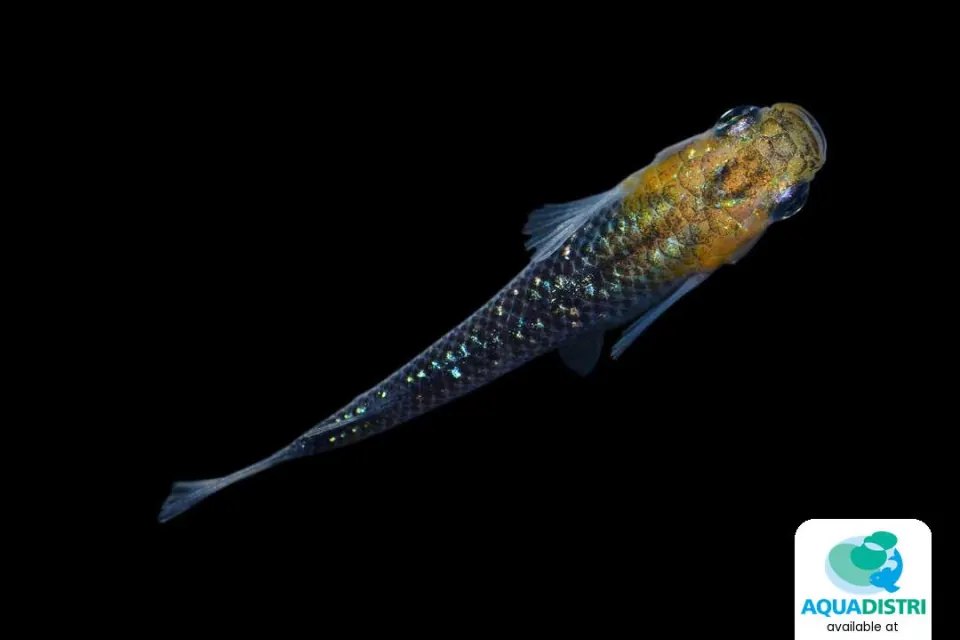
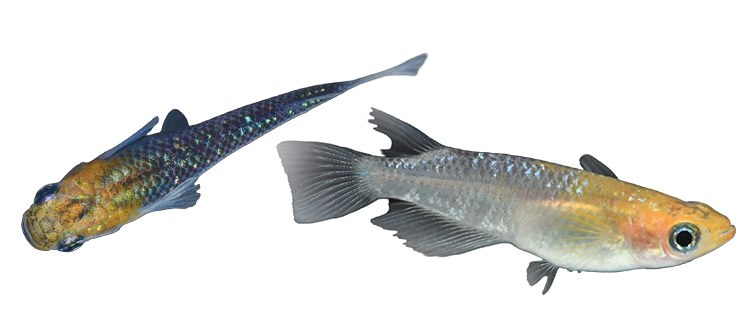
The word Aurora (オーロラ) denotes a scale type in the JMA classification: semi-transparent scales, intermediate between the normal scale and the transparent scale of the Panda or the Sanshoku. On an Aurora, the cheeks and gill covers show a little red, and the body takes on a milky look, with lighter and darker areas. This base is what gives the variety its unpredictable shades.
On this base, the yellow concentrates on the head and upper body. Tokyo Aquagarden describes the fish as a mix of yellow and pale grey-blue, covered with lamé scales with shifting reflections. From one individual to another, the yellow may cover the head only, or run down the back; the grey may dominate or disappear. The trade name “yellow head” picks the most constant trait.
A fine specimen has a clearly yellow head, with no drift towards brown, and tight lamé over the whole back down to the base of the tail. It is confused with a yellow lamé Miyuki, which lacks semi-transparent scales and has a uniform body, and with Sanshoku lamé, which carry black and vermilion in clear patches.
The batch we examined does have semi-transparent scales, which confirms it is an Aurora and not a simple yellow lamé. It carries no external-light band on the back.
Our September 2026 batch, photographed from above in a white holding tank, shows exactly this: an orange-yellow head, a milky, translucent body through which the spine can be made out, and shiny scales scattered over the back. These are the three traits of the yellow lamé Aurora. The identification still needs confirming on adult fish, but it is probable.
Keeping the yellow lamé Aurora
Conditions are those of all medaka: see the care guide. At least one litre per fish, pH 7 to 8, weekly water changes of 10 to 20%.
Colour depends on background and lighting. On a dark background, the yellow strengthens and the grey areas darken. The lamé shows mainly in the sun, seen from above; it is a fish for an outdoor basin or open tank, not an aquarium fish seen from the side. A white background lightens the body and shows off the glitter, which is the Japanese breeders’ setting for lamés, but the yellow loses out. The simplest is to keep the tank dark and judge the lamé in a white container at sorting time.
A colour-enhancing food maintains the yellow. See the page on feeding medaka.
Breeding the yellow lamé Aurora
The Aurora line passes on its semi-transparent scales well. The yellow and the lamé, however, are variable: one spawning gives very yellow fish, almost grey fish, and lamé of varying density. The WEB図鑑 leaves the fixation rate blank on the neighbouring entries, no. 0163 and no. 0800.
Tokyo Aquagarden reports a practice among Japanese breeders: deliberately crossing with individuals lacking one trait, for example no lamé, to strengthen the expression of another. This is a technique for experienced breeders. For the hobbyist, the rule remains to keep the young with the yellowest heads and the most lamé on the back, and to breed them together. The general method applies unchanged.
Our yellow lamé Aurora in photos and video
Batch known as “lamé tête jaune”, September 2026: yellow head, translucent body scattered with lamé. Photos and video taken at our shop in Lesneven.


Similar varieties
- Yellow (Himedaka): the classic yellow variety, normal scales, no lamé.
- Sanshoku lamé: lamé on three colours, transparent scales.
- Neptune: blue lamé on an Aurora base, blue head instead of yellow.
- Panda: fully transparent scales, black ring around the eye.
Frequently asked questions
Why are the fish in the batch so different?
Because the semi-transparent scales of the Aurora line produce light and dark areas placed at random. It is the character of the variety, not a flaw in the batch.
What does Aurora mean?
It is the JMA name for semi-transparent scales, halfway between the normal scale and the transparent scale. See the glossary.
Is the lamé visible in an aquarium?
Barely. The lamé reflects light coming from above. It shows in a basin or open tank viewed from above, in the sun or under a lamp.
Is it a Miyuki?
Not in its basic form. The yellow lamé Aurora Miyuki Sapphire variant, no. 0800 in the WEB図鑑, adds the external light; the fish described here has none, as we checked on the batch.
Sources
- Tokyo Aquagarden, “オーロラ黄ラメメダカ”, t-aquagarden.com/column/zukan_auroraglitter_yellow
- 改良メダカWEB図鑑, “オーロラ黄ラメ幹之サファイア系 No.0800”, medakazukan.net/0800_aurorakilamemiyukisapphire/ (cited via the medaka.fr editorial base)
- Aquarium Glaser, list of imported strains, cited via the medaka.fr editorial base (“Yellow Head Clear Scales”)
- JMA manual, 5th edition, scale classification, cited via the medaka.fr editorial base