
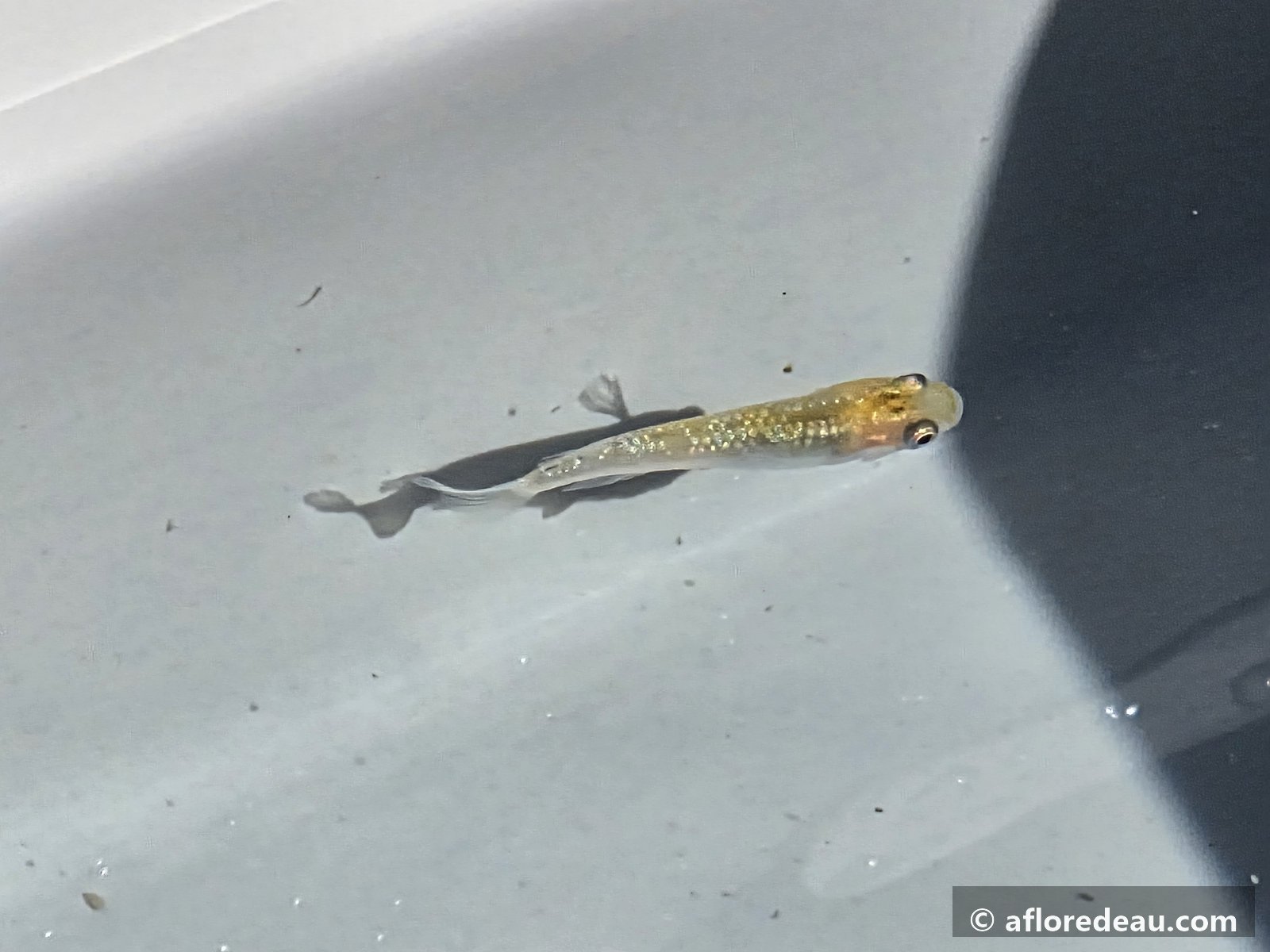
A July clutch incubated in a box left in full sun, and six months later a batch in which you are hunting for females: the case turns up every winter among amateur breeders, and it has a precise explanation. A medaka’s sex is written in its chromosomes, but water that is too warm during the first days of the egg can turn a genetic female into a male, fertile or not depending on the temperature. Japanese researchers have measured the threshold, the window and the mechanism. Here is what they found, and what it changes for a garden incubator.
A genetic sex, up to 27 °C
The medaka has sex chromosomes like mammals: XX for females, XY for males, and the gene that triggers male development, DMY, was identified in 2002 on the Y chromosome. It was the first gene of this type found in a vertebrate other than mammals, and it is one of the reasons the medaka is a laboratory animal all over the world. As long as the water stays in the normal range, sex follows the chromosomes, and a clutch gives roughly as many males as females.
But this genetic programme has a flaw, which fish breeders know from other species and which geneticists have documented in the medaka since 2005: the temperature of the water during the development of the egg.
What heat does to an egg
The reference experiment is that of a team at the Tokyo University of Marine Science and Technology, published in 2007. Eggs of the Hd-rR laboratory strain were incubated at temperatures from 17 to 34 °C, either from fertilisation, or only from the stage when the heart beats, until hatching. The real sex of the adult fish was then compared with their genetic sex.
- Genetic males (XY) stay males, whatever the temperature, cold or hot.
- Genetic females (XX) become males above 27 °C, in a proportion that rises with temperature, up to 100% at 34 °C.
- The sensitive window is the very beginning: the treatment only has an effect if it starts in the first days, before the embryo’s heart beats. Applied after that stage, it changes nothing. The fate of the gonad is therefore decided well before anything can be seen, and before the eyes appear.
- The males obtained are normal: healthy testes, courtship, viable offspring with a true female. Except those from 34 °C, which produced no offspring.
A 2005 study had already shown the phenomenon at 32 °C from fertilisation to hatching: 24% of genetic females turned into males in one strain, 50% in another. The extent therefore depends on the line, and an ornamental variety may be more or less sensitive than a laboratory strain; nobody has measured it variety by variety.
The mechanism has been known since 2010: heat raises cortisol, the stress hormone, in the embryo, and it is cortisol that blocks the female programme. Cortisol alone is enough to masculinise a genetic female, and a cortisol inhibitor stops the heat from acting. More recent work shows that oxidative stress produces the same effect, even without cortisol: it is not temperature in itself, it is the stress on the embryo that tips the sex.
Where this happens in a European tub
A medaka egg incubates in about 250 degree-days: at 32 °C, it hatches in eight days, and the whole sensitive window is spent in warm water. The risk situations are specific:
- an incubation box or jar left in full sun, on a south-facing windowsill, a terrace or the edge of the tub: a small dark volume exceeds 30 °C within an hour of July sun, even in Brittany;
- a black, shallow fry tub on a balcony, in which the spawning mops are left;
- an outdoor tub in full sun in a continental or Mediterranean climate in July and August, where the afternoon water exceeds 30 °C several days running, as the regional calendars describe;
- an indoor incubator heated too high, or a heater without a reliable thermostat.
This is not a matter of a few degrees’ difference on an average: masculinisation begins as soon as the water holds above 27 °C during the first days, and water that swings between 24 °C at night and 33 °C in the afternoon has spent several hours a day in the active zone. What this gives in the end is a summer batch where males clearly dominate, sometimes at 80 or 90%, whereas a June clutch incubated in the shade gives half and half.
Recognising a skewed batch
Sex can be read at about 2 to 3 cm, on the dorsal and anal fins: see sexing medaka, and the case of the Hikari. A normal batch runs at around one female to one male, with chance variations on small numbers: out of ten fish, three females is nothing abnormal. Out of forty fish from the same summer clutch, five females is a masculinised batch, and the cause is to be sought in the temperature of the first eight days, not in the parents or the variety. These males are real males, usable as breeders; the lines keep no trace of the episode, since the change does not touch the chromosomes: an XX male crossed with an XX female will give only genetic females, which is incidentally how laboratories obtain entirely female batches.
Incubating to keep females
- A thermometer in the incubator, read in the middle of the afternoon on sunny days. The target is 24 to 26 °C: warm enough for hatching in ten days, well below the 27 °C threshold held continuously.
- Never a box in the sun. The incubator goes in the shade, in a clear container, and preferably indoors in July and August in southern and continental climates.
- The first days count. An egg collected in the morning and put in the shade the same day is protected; eggs left a week on the mops in a tub at 31 °C are not. In summer, collect every morning.
- Cold is not the answer. Water below 15 °C kills the egg and feminises nothing; below 20 °C, hatching becomes uncertain and the fry do not digest. You do not compensate for a warm tub with a cold incubator; aim for 24-26 °C.
- In the outdoor tub itself, afternoon shade from mid-June to the end of August, a light-coloured tub and a level kept at its maximum hold the water below 30 °C in most regions. What protects the adults from heat also protects the sex of the eggs.
What is not true
- Cold does not make females: at 17 °C, nothing changes, except that the embryo dies.
- Temperature no longer acts after the first days: heating or cooling fry, young fish or adults does not change their sex.
- Colour does not tell the sex in ornamental varieties. The laboratory strain in which females are white and males orange does not exist in the trade: see heredity in the medaka.
- A batch of males is not a curse of the variety nor a sign of inbreeding: it is almost always a story of an incubator in the sun.
The key figures
- 27 °C: above it, a genetic female can become male. 32 °C: a quarter to a half. 34 °C: all of them, and sterile.
- The window: from fertilisation to the moment the heart beats, that is the very first days.
- Genetic males never change, at any temperature.
- Incubation target: 24 to 26 °C, in the shade, clear container, collect every morning in summer.
Frequently asked questions
My July batch has only three females out of thirty. Can I still use it?
Yes. The males are fertile and the females normal. Keep the three females and the best males, and incubate the next clutch in the shade. The proportion will return to normal from the next generation.
Is one day of heatwave on the parents’ tub enough to masculinise the eggs?
The eggs laid that day and left in the tub, perhaps; those collected in the morning and put in the shade, no. It is the temperature of the egg’s first days that counts, not that of the parents.
My indoor incubator is at 28 °C. Is that too much?
It is borderline: above 27 °C held continuously, some of the females tip over. Set it to 25-26 °C; hatching will take a day longer and the batch will be balanced.
Sources
- Hattori R. S., Gould R. J., Fujioka T., Saito T., Kurita J., Strüssmann C. A., Yokota M., Watanabe S., “Temperature-dependent sex determination in Hd-rR medaka Oryzias latipes: gender sensitivity, thermal threshold, critical period, and DMRT1 expression profile”, Sexual Development 1, 2007, doi 10.1159/000100035, pubmed.ncbi.nlm.nih.gov: from 17 to 34 °C, threshold above 27 °C, 100% at 34 °C, window closed at the heartbeat stage, XY insensitive, fertile males except at 34 °C.
- Sato T., Endo T., Yamahira K., Hamaguchi S., Sakaizumi M., “Induction of female-to-male sex reversal by high temperature treatment in medaka, Oryzias latipes”, Zoological Science 22, 2005, bioone.org: 32 °C from fertilisation to hatching, 24% and 50% of XX males depending on the strain, fertile.
- Hayashi Y., Kobira H., Yamaguchi T., Shiraishi E., Yazawa T., Hirai T., Kamei Y., Kitano T., “High temperature causes masculinization of genetically female medaka by elevation of cortisol”, Molecular Reproduction and Development 77, 2010, pubmed: 32-34 °C, cortisol, inhibition by metyrapone.
- Kitano T. et al., Kumamoto University, 2019-2022 work on oxidative stress and the masculinisation of XX fish, frontiersin.org.
- Matsuda M. et al., “DMY is a Y-specific DM-domain gene required for male development in the medaka fish”, Nature 417, 2002: the sex gene.
- GEX, “メダカの屋外飼育の月別ポイント”, gex-fp.co.jp: 250 degree-days, limit of 33 °C; Hime-medaka, hime-medaka.com: eggs dead below 15 °C, hatching uncertain below 20 °C.
- medaka.fr: spawning, eggs and incubation, raising the fry.