
Under EU veterinary rules, a private keeper cannot buy antibiotics or antiparasitic treatments for fish without a prescription. This is not a handicap for the medaka: clean water, quarantine, salt, temperature and fasting settle most problems caught early. What remains, serious infections and established parasites, is a job for a vet.
Why treating without medication is the rule, not the exception
Japanese guides recommend a pet-shop product for every disease: Green F Gold, Hikosan Z, Kanpara D, methylene blue. In Japan these products are sold over the counter. In the European Union, Regulation 2019/6 on veterinary medicines, applied since January 2022, reserves antibiotics and antiparasitics for prescription by a vet. What remains freely available is limited to water conditioners, salts and a few plant extracts.
This constraint has one merit: it forces you to start with what matters. The bacteria and fungi that cause disease are present in every tank. They only attack a weakened fish. A medicine that kills the germ without correcting what weakened the fish solves nothing. Badly dosed, or given for a disease it does not target, it kills the fish more surely than the disease does.
Methylene blue deserves a clarification. Our fact base mentions it at a low dose to protect eggs from mould during incubation, in a separate container, until the eyes appear. It is not a treatment for fish to be used without reservation.
What works: changing the water and correcting the parameters
This is the first treatment, and often the only one. A medaka that is turning pale, has stopped eating, is breathing fast or is rubbing itself most often has a water problem: ammonia or nitrites in a tank that is too new or overstocked, pH that has fallen below 6.0, a temperature that has climbed, waste built up on the bottom.
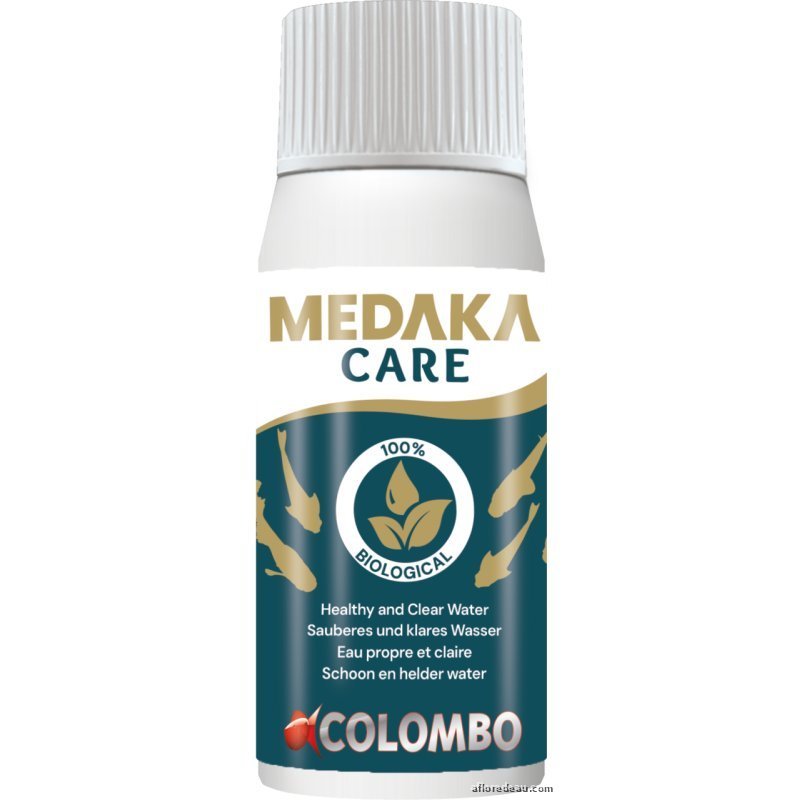
Tokyo Aqua Garden presents frequent water changes as a treatment in themselves. Fresh water stimulates the fish, restarts its metabolism, and removes some of the bacteria and parasites floating in the water. The source insists on gentleness: a change that is too abrupt exhausts a fish that is already weak. In practice, change a third to a half of the volume, at the same temperature, with water left to stand for twenty-four hours or treated with a conditioner to neutralise chlorine. A product such as Medaka Care fills this role. It does not cure anything by itself.
Measure before correcting. The guide to water parameters gives the target values, the cycling guide explains why a new tank poisons its first occupants, and the guide to water changes details the procedure.
What works: quarantine
Use a bucket or a small tank of at least 5 L, with no substrate and gentle aeration. Put in it the fish that shows a symptom, and also any fish or plant that comes into your collection, for one to two weeks according to the Japanese source. Quarantine protects the other fish, shelters the sick one from competition at mealtimes, and lets you treat with salt without touching the planted tank. It is the measure that prevents the most losses, because white spot, gill worms and fin rot almost always arrive with a newcomer.
What works: salt
A 0.5% salt bath, that is 5 g of pure salt per litre, in a quarantine tank, for five to seven days, with the salt water renewed daily. The Japanese source presents it as effective for fish that tolerate salt, medaka and carp above all. Salt reduces the fish’s osmotic effort, so it keeps its energy for healing, and it hinders external parasites and surface bacteria.
It helps with general fatigue, injuries, early fungus or fin rot. It does not cure established dropsy or established worms. The full protocol is in the article the salt bath step by step.
What works: temperature
This is a double-edged tool. The Japanese source describes a gradual rise to 28-30 °C to speed up the fish’s metabolism and the life cycle of certain parasites, notably white spot, which is only vulnerable at the free-swimming stage. For the medaka, our fact base puts stress above 30 °C and danger at 34 °C. So stop at 28 °C, raise it slowly, and aerate more, because warm water holds less oxygen.
The same source warns that heat is contraindicated for Aeromonas infections, red patches and dropsy. These bacteria multiply mostly between 25 and 30 °C. In that case, keep the water between 18 and 23 °C. A simple rule: heat only for white spot. In the other direction, a fish that is unwell in water at 32 °C during a heatwave is treated first with shade, a top-up of cooler water and aeration, as described in medaka through the seasons.
What works: fasting
Tokyo Aqua Garden makes it the first of the three pillars of treating without medication. Digestion uses energy that a sick fish does not have. A fast of five to seven days, never longer, leaves that energy for healing, stops uneaten food rotting in the quarantine tank, and clears digestive blockages, which are common in Daruma (ダルマ) types. When feeding resumes, give a single granule, then increase over several days. A fry, on the other hand, does not fast: hunger is its first cause of mortality, see raising the fry.
What works: plants and green water
This is not a direct treatment, but it is an environment that stops fish falling ill. A well-planted tank absorbs nitrates and offers hiding places that reduce stress. Green water, sought after by Japanese breeders, is a phytoplankton that feeds fry and convalescent fish continuously while consuming ammonia. A fish that is getting thin for no visible reason, belly narrower than the head seen from above, benefits from a spell in green water, where it grazes all day. The source on the signs of poor health recommends this method for weight loss, together with exposure to sunlight, with part of the tank shaded.
What does not work
- Human antibiotics. Leftovers from the family medicine cabinet: the dose is impossible to get right in a tank, they select for resistant bacteria, and using them on an animal without a prescription is illegal. Never.
- Garlic. You read everywhere that it expels worms and stimulates immunity. None of the Japanese sources cites it as a treatment. A piece of garlic in a tank mostly feeds bacteria. It cures nothing serious.
- Salt in the main tank. It kills plants and shrimp and does not treat an isolated fish any better than a bucket.
- Home remedies. Vinegar, bicarbonate of soda, hydrogen peroxide, essential oils, alcohol on a wound. These products burn the gills or unbalance the water. None has an established dose for a 3 cm fish. Over-the-counter plant extracts have at best an effect on mild fungal infections and delay the real diagnosis.
- Changing everything at once. Heating, salting, treating, changing 100% of the water, all on the same day. The fish dies of the treatment.
When a vet is needed
Tokyo Aqua Garden is clear about the limits: established parasites require an antiparasitic, and serious infections exceed the fish’s natural capacity to heal. In practice, consult when lesions spread despite three or four days of salt and clean water, when several fish show the same sign, when the belly is swollen with raised scales, or when breathing stays fast after the water has been corrected.
A vet consultation costs more than a medaka of a common variety. Many breeders choose to isolate, treat with salt and accept the loss if the fish does not pull through. That is a reasonable choice, as long as you do not let the sick fish suffer for long. For a whole tank in decline, or for a rare line, a consultation is justified.
Finding a fish vet
Any vet can prescribe for a fish, but few know ornamental fish. There are three leads: vets who treat exotic pets, found through your national veterinary directory; vets who look after koi ponds, known to clubs and pond suppliers; and veterinary schools, which sometimes have an exotic animal department.
For the consultation, bring the fish in a jar with water from its tank, and a description of the water: volume, age of the tank, temperature, test results, date of the last water changes, new arrivals. The vet can also carry out painless euthanasia when a fish has no chance of recovery.
The key figures
| Curative water change | a third to a half, same temperature, water left to stand or conditioned (TAG) |
|---|---|
| Quarantine | 5 L minimum; 1 to 2 weeks for a new fish (TAG) |
| Salt | 0.5%, that is 5 g per litre, 5 to 7 days (TAG) |
| Heat against white spot | gradual rise, 28 °C maximum for the medaka; Japanese source 28-30 °C |
| Aeromonas infections | keep at 18 to 23 °C, do not heat (TAG) |
| Fasting | 5 to 7 days maximum, resume with one granule (TAG) |
Frequently asked questions
Can you order a fish medicine from a foreign website?
Importing veterinary medicines without a prescription as a private individual is prohibited in the European Union. Beyond the law, a product used without a diagnosis is a gamble with the fish’s life.
How can you tell whether it is the water or a disease?
If several fish are unwell at the same time, it is the water. If a single fish shows a clear lesion, it is a disease, but the water still needs checking. The signs of a sick medaka are detailed in a separate article. A medaka lying still on the bottom below 10 °C, on the other hand, is overwintering and does not need treating: see the overwintering guide.
Sources
- Tokyo Aqua Garden, “魚の病気を薬を使わないで治療する方法!薬浴以外にできることを解説”, https://t-aquagarden.com/column/no_use_fish_medicine
- Tokyo Aqua Garden, “メダカの塩水浴とは?”, https://t-aquagarden.com/column/medaka_saltwater
- Tokyo Aqua Garden, “メダカの体調が悪いサインとは!”, https://t-aquagarden.com/column/medaka_badsign (green water, sunlight)
- medaka.fr fact base: temperature thresholds, methylene blue on eggs, green water, hunger in fry (TAG, WEB図鑑, Kamihata).
- Regulation (EU) 2019/6 of the European Parliament and of the Council of 11 December 2018 on veterinary medicinal products, applicable since 28 January 2022.