
A medaka fry lives two to three days on its yolk reserve, then it has to eat: hunger is the first cause of mortality. Feed it from the third day, four to five times a day, with a fine powder, infusoria or green water, without changing the water or filtering during the first weeks. A loss of 20 to 30 % is normal, and the young are put together with the adults at 1 to 2 cm depending on the method.
The harigo stage, the needle fry
At hatching, the fry measures a few millimetres. The Japanese call it harigo (針子), the needle fry, because all you see of it is a fine line and two eyes. It stays at this stage for about two weeks. This is the most fragile period in a medaka’s life: the fish has no reserve, tolerates neither current nor sudden changes in the water, and can only catch tiny prey.
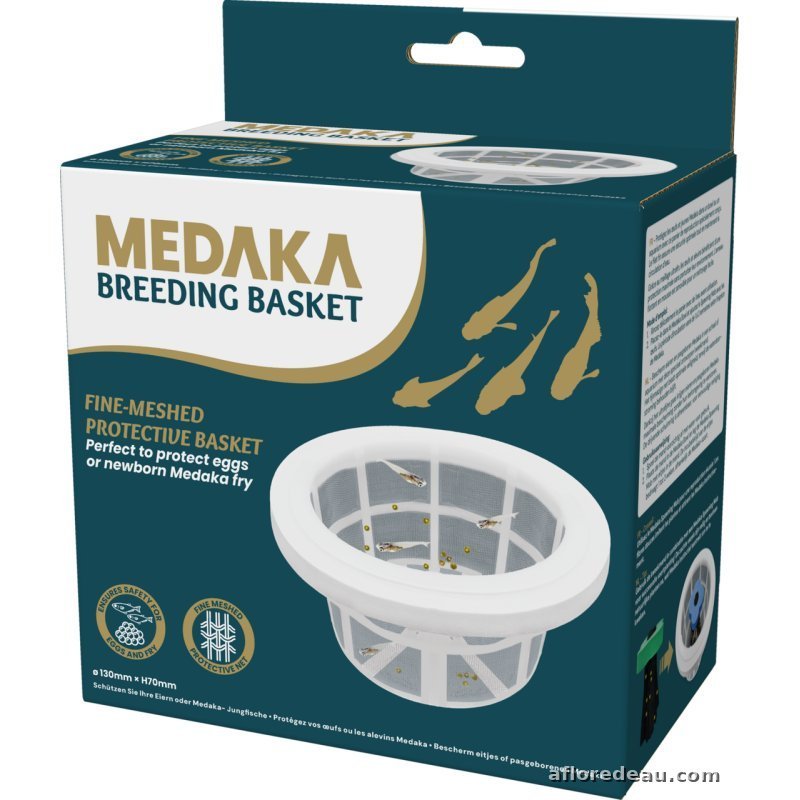
The rearing container does not need to be large at the start. A 10 to 20 litre tub, a floating basket in the main tub, or a bowl in the shade will do for one clutch. What matters is stability: same temperature as during incubation, no suction filter, no adult fish. A floating rearing basket placed in the parents’ tub keeps the fry at the right temperature and protected, without extra equipment. The full sequence from spawning to hatching is in breeding medaka: spawning, eggs and incubation.
Feeding from the third day
The yolk sac feeds the fry for two to three days. After that it has to eat, and a fry that finds nothing dies within a few days. This is by far the first cause of loss among beginners, well ahead of water quality. So start on the third day, and even the day after hatching for the first hatched of a staggered clutch.
Frequency is the second point. A harigo eats little at a time and has no stomach to store food: it needs four to five small meals a day. Two meals a day are the strict minimum, and growth suffers (medakazukan.net). For anyone working during the day, the solution is to combine: one or two powder meals morning and evening, and green water or infusoria that stay available continuously in between.
The three foods of the first weeks
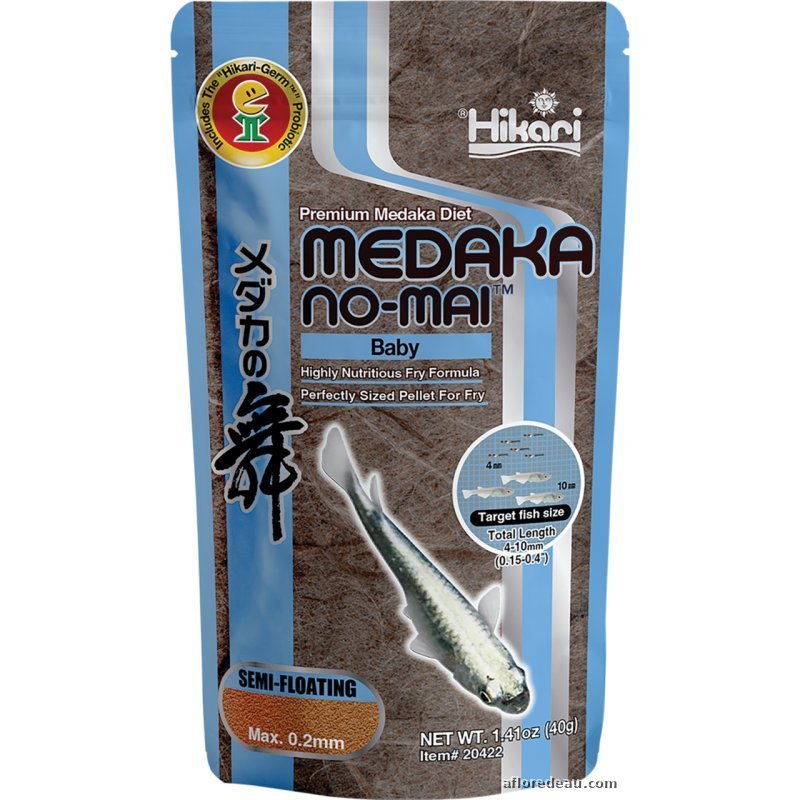
The first is fry powder. It is ground fine enough for a harigo’s mouth to swallow it, and it floats for a few moments before sinking. Drop a tiny pinch on the surface, which is eaten in two to three minutes, no more. Any excess falls to the bottom and rots. Hikari Medaka Baby is a powder designed for this stage. You can also crush adult food very finely between two fingers, but the grain size is less even.
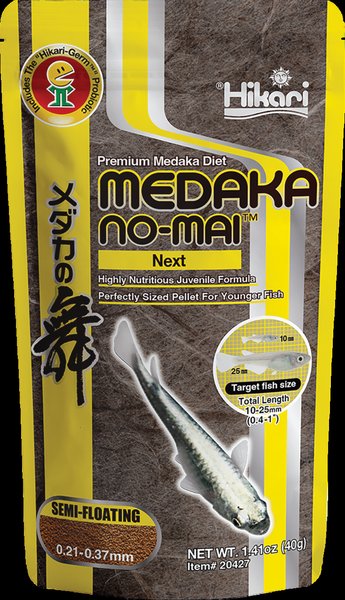
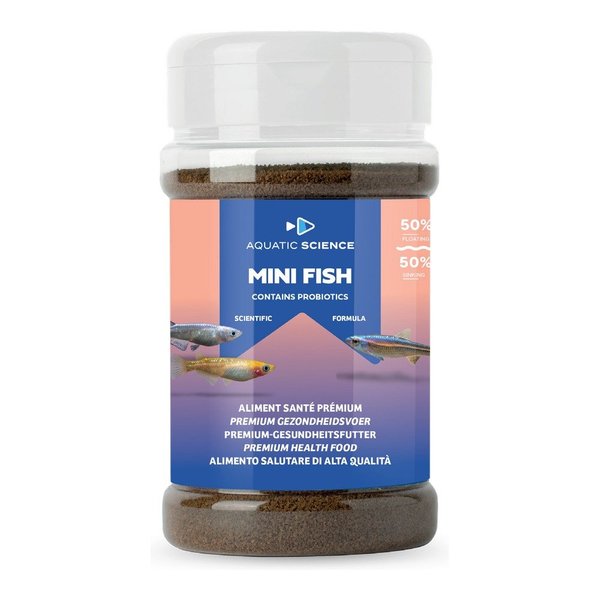
Hikari’s medaka range then follows growth: Medaka Baby, 0.2 mm at most, up to 1 cm, then Medaka Next, 0.21 to 0.37 mm, from 1 to 2.5 cm. From a centimetre, Aquatic Science’s Mini Fish, in 0.3 mm, will also do. Move from one grain to the next by mixing the two for a few days. See our presentation of the Aquatic Science range.
The second is green water, the grīn wōtā (グリーンウォーター) of Japanese breeders. It is water laden with suspended phytoplankton, the kind that turns green by itself in a tub in the sun. Fry find permanent food in it, and the micro-organisms that develop in it are another. Green water that is too dense is diluted with clear water. You produce it by leaving a bucket of tub water in the sun for one to two weeks, or you take some from an outdoor tub that is already green.
The third is infusoria, those protozoa and rotifers that swarm in water where a little plant matter is decomposing. A lettuce leaf or a piece of banana skin in a jar of tub water in a warm place produces them in a few days. You then pour some of this cloudy water into the fry tub. It is the smallest live food, the one that suits the youngest harigo.
Daphnia, a little later
Daphnia are small crustaceans of about 2 mm. They are too big for a harigo, but they become an excellent food as the young approach one month (t-aquagarden.com). The advantages are clear: daphnia stay alive in the tub without fouling the water as long as they are not eaten, and their movement triggers hunting.
Raise them in a bucket or bowl in light shade, in water that has been left to stand, at an ideal temperature of 25 °C. They feed on green water or a pinch of dry baker’s yeast every two or three days. A light daily stir or weak aeration prevents stagnation. A daphnia culture sometimes collapses for no apparent reason, so it is better to keep two. Brine shrimp nauplii are an alternative, smaller at hatching, but they live only a short time in fresh water and require daily hatching.
No water change, no suction filter
During the harigo stage, that is the first two weeks, do not change the water. Renewal stresses the fry, alters the temperature and removes the micro-organisms they feed on. Sudden mortality after a water change is classic. Just add water to make up for evaporation, at the same temperature, and siphon off with a fine tube the food remains that build up on the bottom. A little green silt on the bottom is not a problem, it is a pantry.
A filter is useless at this stage, and a suction filter is dangerous: harigo get sucked against the strainer or into the pump. If you want aeration, an air stone set to a thread of air, with no current, is enough. A floating plant or a tuft of Java moss helps stabilise the water and provides hiding places. The general principle is the same as in an outdoor tub without a filter.
When the fry exceed 1 cm, you can begin partial changes, a quarter of the volume at most, with water left to stand at the same temperature. Where there is no chloramine in the tap water, as in France, a 24-hour rest is enough outdoors, two to three days indoors.
Sorting by size
Within one clutch, some fry grow twice as fast as others. The biggest eat first and end up harassing, even eating, the smallest. This is why breeders sort, senbetsu (選別), as soon as the difference becomes visible, often around three to four weeks. Separate the fast from the slow into two tubs. The small ones, freed from competition, often make up part of their lag.
This first sort is not yet a selection on quality. That comes later, when colours and body shape are readable, at 2 or 3 cm. What you look at then is described in sexing medaka and choosing breeders.
Normal mortality
Even when well managed, a clutch loses some. A mortality of 20 to 30 % over the first weeks is considered normal by the Japanese WEB図鑑, and a survival rate of 70 to 80 % is judged good (medakazukan.net). Some of the fry are weak from hatching and do not feed. Beyond 30 % losses, look for a cause: hunger, a water change, water too cold, suction by a filter, or a hydra established in the tub. This small polyp, attached to walls and plants, catches harigo with its tentacles. The subject is covered in predators of medaka.
When to put the young with the adults
An adult of 3 to 4 cm eats anything that fits in its mouth. There are two benchmarks. If the young have been fed separately and are vigorous, you can put them with the adults from 1 cm, with hiding places available (medakazukan.net). As a precaution, many breeders wait for 2 cm, the size at which the young is no longer a possible prey (tokyoaquagarden.com). The ideal, when space allows, is to wait for adult size, which also avoids competition for food.
With us, the young join the adults rather at around 2 cm. In every case, put them together on a mild afternoon, in a well-planted tub, and watch on the first day.
Late-season fry and winter
A clutch from August or September poses a problem in temperate Europe: the young will not be big enough to get through winter outdoors. Fry of the year that are too small do not survive outdoor overwintering, and their growth stops below 15 °C. There are two solutions. The first is to bring the small ones indoors into an aquarium, heated to at least 20 °C and lit for 13 to 14 hours, so that they keep growing and eating. How this works is described in keeping medaka indoors. The second is to stop collecting eggs from mid-August, and let the adults prepare for winter.
Young born in May or June reach 2 cm or more before autumn. They can overwinter outdoors with the adults, in a tub of at least 30 litres with a deep zone, without feeding below 10 °C. In Brittany, this works. In cold continental or mountain climates, keep a spare tub indoors. The guidelines are in overwintering medaka outdoors.
The figures to remember
| Yolk reserve | 2 to 3 days |
|---|---|
| First meal | day 3 |
| Meals per day | 4 to 5, minimum 2 |
| Harigo stage | about 2 weeks, no water change |
| Daphnia | from about 1 month, crustaceans of about 2 mm |
| Normal mortality | 20 to 30 % |
| Joining the adults | from 1 cm if fed separately, 2 cm as a precaution |
| Winter outdoors | only for young that are big enough, 30 L tub with a deep zone |
Frequently asked questions
My fry die one by one in the first week: why?
In most cases, they are not eating enough. Check that the food is fine enough, that it is given four to five times a day, and add green water or infusoria so that there is always something to eat. Indoors, also check the temperature, at least 25 °C, and ammonia, which nitrite tests do not see: see raising fry indoors.
Can you feed fry with crushed flakes?
Yes, provided you reduce them to a very fine powder between your fingers or in a mortar. A commercial powder has a more even grain size and is easier to dose.
The water in the fry tub is turning green: is that serious?
No, it is even desirable. Green water feeds the fry. If it becomes so dense that you can no longer see the fish, dilute it with clear water that has been left to stand.
When can you see the fry’s colour?
It depends on the variety. Miyuki fry are born dark and the external light rises with age. For most varieties, the colour becomes readable at around 2 cm.
How many fry in a 20-litre tub?
A few dozen at the start, then divide as they grow. At around 2 cm, return to the rule of one litre per fish.
Sources
- 改良メダカWEB図鑑, FAQ, https://medakazukan.net/faq/
- Tokyo Aqua Garden, “Medaka eggs”, https://tokyoaquagarden.com/medaka-eggs
- Tokyo Aqua Garden, “ミジンコの繁殖”, https://t-aquagarden.com/column/daphniapulex_breeding
- Kamihata, medaka-keeping guide
- À Flore d’Eau keeping guide, afloredeau.com