
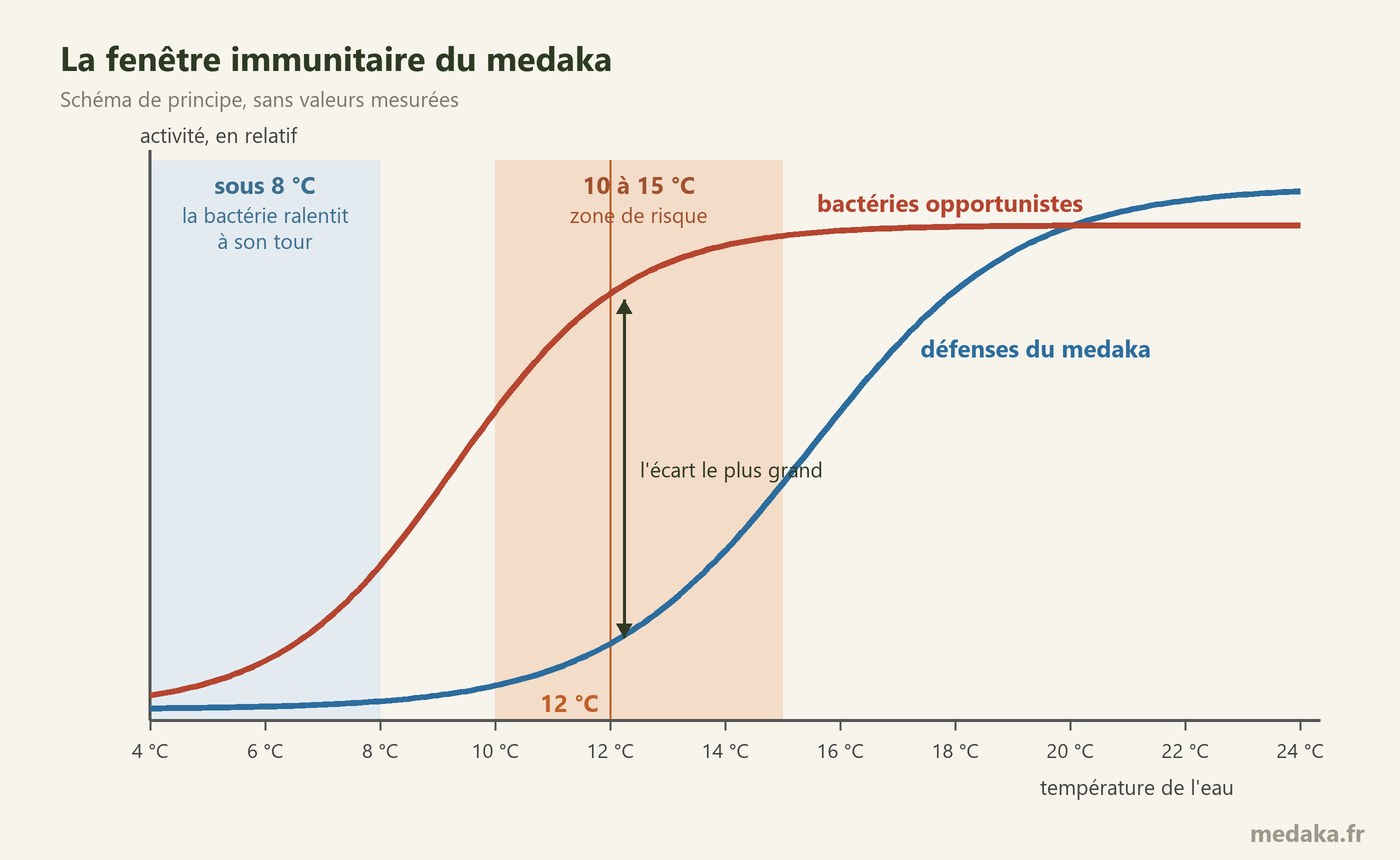
When the water in a tub falls below 15 °C, two clocks drift apart. The medaka’s defences slow down quickly in the cold, while the opportunistic bacteria already present in the water, in particular those of the genus Aeromonas, slow down much less. The Dutch breeders at medaka.nl call this the “immune gap” and place it between 10 and 15 °C, with maximum risk around 12 °C. Across Europe, depending on the climate, this band is crossed between mid-October and the end of November. During those few weeks, an infection can take hold even though nothing has changed in how the tub is run. Here is what this window covers, the markers that let you follow it with a thermometer, and the routines that get you through it without losses.
What the immune window covers
The medaka does not produce its own heat: its internal temperature follows that of the water. Everything that makes up its defence follows the same movement. Studies on temperate-water fish have long shown it: when the water cools, antibody production and the maturation of immune cells slow down markedly, more so than the so-called non-specific defences, which hold up better. The fish is not defenceless. It is slower than the bacterium.
Aeromonas hydrophila does not arrive with a newly bought fish. It already lives in the tub, often for months, without causing anything, and becomes dangerous only when immunity drops, as explained in medaka diseases. It multiplies fastest in warmth, between 25 and 30 °C, but it keeps dividing at 12 °C, only more slowly. The bacterium loses a little speed, the fish loses far more: it is this gap that creates the window.
So this is neither a disease nor an epidemic, but a period. You can perfectly well get through it without a single sick fish. It does explain, however, why bacterial infections in autumn so often strike tubs that were doing well all summer.
Temperature markers
The only figure that counts is the temperature of the water, not that of the air nor the date on the calendar. A min-max thermometer, read in the morning and in the middle of the afternoon, is enough to place a tub within the window: see reading the temperature of a medaka tub.
- Above 15 °C: defences still fully active, digestion normal. No window.
- Between 10 and 15 °C: risk zone, with a peak around 12 °C, where the bacterium stays active and the defence is already running slowly.
- Below 8 °C: bacterial division drops in turn and the window gradually closes. The fish goes into overwintering.
- More than 4 °C difference between morning and afternoon: warning signal. Each swing costs the fish energy that does not go to its defence.
Volume bears directly on this difference. A shallow 60-litre tub can fall to 8 °C on a clear November night and climb back to 15 °C the following afternoon; a pond of several cubic metres hardly moves. The fish can put up with that regime for a few days, not for three weeks. A polystyrene box or a double tub clearly reduces the swings.
A longer window in mild Atlantic climates
In the Netherlands, the window closes with the first real frosts. That reasoning holds for a climate where the cold eventually settles in. In mild Atlantic climates such as ours in Brittany, the water in a tub can stay for weeks between 8 and 13 °C, with mild afternoons that lift it above 10 °C in the middle of January. Where the window lasts three to four weeks elsewhere, a mild winter stretches it out quietly. Vigilance therefore does not stop at the first frost: it lasts as long as the morning thermometer stays above 8 °C.
In continental climates and in Alpine valleys, it is the opposite: the 10 to 15 °C band is crossed quickly and frost arrives early. In Mediterranean climates, the window opens later, often in November or December, and can reopen during a mild spell. Month-by-month outdoor tub calendars for French regions (in French, not valid for other countries) show how these shifts play out: Brittany, the North and the Paris Basin, the East and Centre-East, the South-West, the Mediterranean and Corsica.
The signs, and what to check first
The signs of an opportunistic infection in cold water are the classic ones: white or frayed edges on the tail and dorsal fins, red spots or sores on the flanks, a swollen belly on a fish that no longer eats, rubbing against the wall or staying still in a corner, pale gills beating fast.
A single sign says little; three at the same time say a lot. And before treating, test for ammonia and nitrite: a nitrite spike after a period of generous feeding gives exactly the same picture as the start of an infection, and in that case it is the water that has to be corrected. The details of the early signs are in sick medaka: the signs, and the causes of death in dead medaka: the causes.
Fin rot (尾ぐされ病, ogusare-byō) is an end point, not a beginning. When it is visible, the cause often goes back two or three weeks. Treatments without medication, including the salt bath, are described in treating a medaka without medication; they are given in a separate tub, without touching the main tub.
The levers you really control
The ration
Digestion slows with the water. A summer ration given in November is partly poorly digested, comes out as waste, feeds precisely the bacteria you do not want to feed, and uses up oxygen. This is the most frequent cause of things going wrong at this time of year.
The rule we apply is the one in overwintering medaka: between 15 and 10 °C, cut back, one meal a day then every other day, in small amounts, and remove what is not eaten within two or three minutes; below 10 °C, stop completely, even if a mild afternoon lifts the water. Hunger does not kill a healthy medaka in winter; polluted water does. The detailed rations at each step are in feeding medaka according to temperature.
Clean water before the cold
The bacterium lives in whatever is decomposing: leftover food, leaves, silt. The right moment to clean is the start of the window, when the water is still around 15 °C, not in midwinter. Net out the leaves and dead plants before they sink, see dead leaves in a medaka tub. On a heavily loaded bottom, siphon out the worst of it, and a microorganism activator such as Aquatic Science’s Biobooster+ finishes the job: we sell it and have used it for twenty years, and its effect can be seen within a few hours. It works best while the water is still mild, like everything biological.

For the water itself, follow the rule for water changes: autumn slows the pace, and below 10 °C you no longer change the water, you only top up the level. If a test shows ammonia or nitrite during the window, a partial change remains possible as long as the water is above 10 °C, a quarter at most, with settled water that is within 2 °C of the tub’s. Never a complete drain: you would remove the bacterial film that stabilises the water and put the fish into a new system at the worst possible moment.
Calm
Stress releases cortisol, which directly slows the immune response. Netting, sorting, moving, a cat sitting for an hour on the rim: minor events in September, costly in November. Sorting and transfers are done before the water falls below 15 °C. If a step becomes necessary during the window, do it once only, in the morning, and not on the day you touch the water.
The weekly round
A quarter of an hour a week, always in the same order: the water, the food, then the fish.
- Record the morning and afternoon temperatures; if the difference is more than 4 °C, shelter or insulate the tub.
- Remove leaves, dead plants and leftover food.
- While the water is above 10 °C, test ammonia and nitrite and note the value with the date.
- Adjust the ration to the morning thermometer, and stop it below 10 °C.
- Look at each fish one by one: fin edges, flanks, behaviour, rather than the tub as a whole.
- Write down what you observed and changed. The breeding journal in the Medaka app is made for this: without notes, every autumn starts from zero.
Frequently asked questions
Is the immune window the same thing as an Aeromonas infection?
No. The window is the period when the defence lags behind the bacterium; the infection is what happens when the bacterium takes advantage of that lag. You can get through the window without a single fish affected.
At what temperature is the risk highest?
Around 12 °C, within the 10 to 15 °C band. Below 8 °C, the bacterium slows down in turn. That is why a mild, wet autumn that keeps the water around 10 to 12 °C for weeks calls for more vigilance than a properly cold winter.
Should I treat the water as a precaution?
A treatment gives its best result when the source of the problem has been removed: leftover food, decomposing leaves, silt. Clean first, then help the tub, with Biobooster+ for organic matter. Salt is kept for an affected fish, in a separate tub, and not for the whole tub: it weighs on plants and on young fish. If in doubt, a water sample taken to an aquarium specialist or a vet is better than a treatment chosen at random.
Why do fry and old fish fall first?
Young fish have not finished building their immunity and are still growing, which uses energy. Old fish have fewer reserves. Both have less margin than a healthy one-year-old adult. That is also why some varieties should not overwinter (越冬, ettō) outside: see varieties that should not winter outside.
Should I bring the fish indoors to avoid the window?
Bringing a medaka into a room heated to 20 °C does take it out of the window, but it is no longer overwintering: it is one more breeding season, with feeding and water changes. If you bring fish in, do it early, before the crossing of 10 to 15 °C, and without thermal shock. The markers are in when to introduce or bring in medaka.
Sources
- Medaka.nl, “Immuunkloof bij vijvervissen: waarom november zo zwaar valt” (the immune gap in pond fish: why November is so hard), medaka.nl: the 10 to 15 °C band, peak around 12 °C, easing below 8 °C, warning at more than 4 °C difference over a day, signs of an opportunistic infection.
- Q. H. Abram, B. Dixon and B. A. Katzenback, “Impacts of Low Temperature on the Teleost Immune System”, Biology, vol. 6, no. 4, 2017, full text: review of fish immunity in cold water.
- P. Le Morvan, D. Troutaud and P. Deschaux, “Differential effects of temperature on specific and nonspecific immune defences in fish”, Journal of Experimental Biology, vol. 201, 1998, pp. 165-168: specific defence is more sensitive to cold than non-specific defence.
- Feeding and water change rules in autumn: afloredeau.com care guide, reflected in the overwintering and water change guides on medaka.fr.