
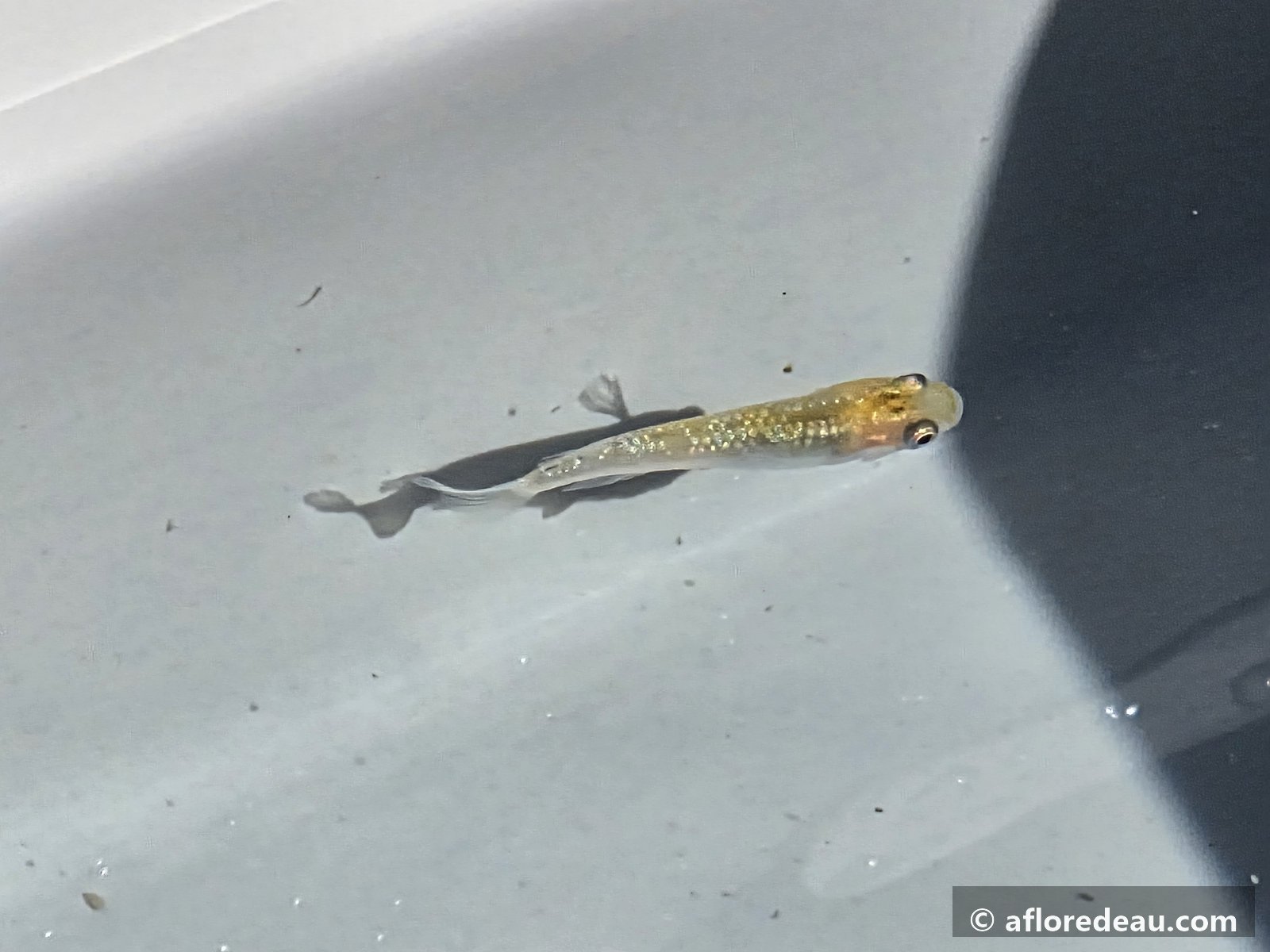
A wild-type medaka spends the winter under the ice without anyone looking after it. But decades of selective breeding have produced short bodies, veil-like fins, unpigmented eyes and heavily inbred lines, and none of these cope with the cold in the same way. Japanese breeders have a clear list of what comes indoors, what stays out, and what is decided fish by fish, and that list does not always match reputations. Here is what it says, trait by trait, with the thresholds, and what we take from it in Lesneven.
What winter asks of a medaka
Below 15 °C, appetite drops; below 10 °C, digestion slows right down and the fish goes to the bottom; below 5 °C, it no longer moves. This is not true hibernation: on a sunny day the water climbs back towards 10 °C and the fish comes up for a pinch of food at midday. A healthy adult holds out down to 0 °C in the water, under surface ice, as long as the bottom does not freeze, and the bottom of a deep enough container stays at around 4 °C, the temperature at which water is densest. Japanese breeders add a nuance that matters: what kills, more than cold, is sudden change, and it is the thin, old or injured fish that gives up at 2 or 3 °C, where a well-covered adult gets through. Everything that follows comes from this: any trait that hampers swimming, digestion, healing or feeding becomes a risk as the water cools.
Daruma: the short body cannot stay down
The Daruma has shortened vertebrae, and therefore compressed organs and an often misshapen swim bladder. It swims poorly, and as soon as the water cools, two things combine, according to Japanese sources: digestion slows in a belly that empties badly, so a meal taken too late stays there, and the fish can no longer hold itself at the bottom. It turns over, floats at the surface, exhausts itself and dies. This is the sequence all the Japanese sources describe: cold, turning over, exhaustion.
The thresholds quoted vary because none has been measured: do not let it go below 20 °C, say some; risk of death below 10 °C, say others; and among the Tokyo professionals, Daruma kept at 28 °C all year round, which prevents both indigestion and turning over. But Japanese practice is not unanimous: a shop in Yokohama keeps all its Daruma outdoors in deep containers and only brings in those that turn over, and a breeder in Ehime, where the climate is mild, counts a few per cent turning over each winter, with the rest coming through without trouble. So the real criterion is the individual you see floating, more than the variety. The half-Daruma, with a less shortened body, swims almost like a normal fish and causes fewer problems.
At our farm in Lesneven, the Daruma only go outside from June to September, and come in before the water drops below 15 °C; indoors, our advice is 20 °C or more, little food, in the morning. A Breton winter is not an Ehime winter: it is long and damp, and the water in a container stays for weeks between 5 and 9 °C, exactly the range in which a Daruma turns over. The same holds, even more so, for continental and northern European winters. A Daruma that has turned over once is hard to treat; bringing it in beforehand costs one container and a small heater. See the Miyuki Daruma profile.
Long fins: the injury that does not heal
In Longfin, Hirenaga and Swallow medaka, the fin tips tear easily, on a decoration, in a current, in a scuffle. In summer the tear closes up. In cold water the fish’s defences drop, and the injury becomes the entry point for fin rot and fungal infection, which settle precisely on fish weakened by cold or injured. One site speaks of frostbitten fins; none describes damage from the ice itself. The sure mechanism is injury plus cold equals infection.
The Japanese advice: a gentle current, decorations without sharp edges, water changes a little earlier in autumn, and overwintering indoors or in a greenhouse, “outside possible with precautions”. Our advice: bring Longfin in during October along with this year’s fry, into a cold room without heating, where the water stays above 10 °C. See the Miyuki Longfin and the golden Longfin.
Albinos: a reputation that is half true
What is established: an albino sees poorly, because the retina does not develop normally without pigment; it finds food late, dislikes direct sun, and below 1 cm sunburn kills it; albino lines bred brother to sister grow slowly. What is not established: any weakness specific to winter. No source describes a cold-related mechanism, and a Japanese breeder who specialises in albinos states that they live wherever an ordinary medaka lives, and that “albino means fragile” is a breeder’s mistake. The sites that advise bringing them in do so out of caution, because of their eyesight: a fish that eats late builds up fewer reserves before winter, and a thin fish dies at 2 °C where a well-covered one gets through at 0.
Our advice: an adult albino, well covered in October, in a deep, covered container, can winter outside; a thin albino or one of this year’s young comes in.
Miyuki, external sheen: not a risk, a myth
The normal-bodied Miyuki winters outdoors like a Youkihi; Japanese breeders class it among the hardy varieties. What is said about it is that its sheen “goes in” during winter and “comes back” in spring. Nothing documents this. What is documented is that the sheen lengthens during growth, and more so in water at 28–30 °C than at 20 °C; in winter growth stops, so the sheen stops spreading, but what has been gained does not disappear. Breeders who see the sheen fade after a spell in a black container are observing an effect of the background, not of the cold. See the Miyuki profile.
Transparent scales, Panda, tricolours, lamé: hardy in the cold
Transparent-scaled varieties and Panda have only one documented sensitivity, pH shock during water changes; nothing about cold, and breeders who keep them outdoors report nothing. Tricolours and lamé have weak genetic fixation, which concerns their offspring, not their winter; the Japanese winter them outdoors, and one breeder even thinks the cold deepens the black of tricolours, while asking to be only half believed. The phrase “highly selected lines are more fragile” comes up everywhere without ever being backed by a winter case. The only body-shape trait that matters here, apart from the Daruma, is the strongly deformed spine seen in some Hikari: a pronounced curve compresses the organs, and those individuals come in.
This year’s fry: size decides
This is the clearest consensus across all the sources: 1.5 cm minimum to winter outdoors, preferably 2 cm, and not thin. Below 1 cm, overwintering outside is “practically impossible”, and between 1 and 1.5 cm it sometimes succeeds in mild regions, though no breeder recommends it. A one-month-old fry of 1 cm and a one-week-old fry of the same size do not have the same resistance; what counts is the reserves built up. Hence the rule in the calendars: the last egg collection for outdoor rearing must be early enough for the young to reach 1.5 cm when the water drops below 15 °C. In France, where our calendars come from, that means early August on the Breton coast and late September around the Mediterranean; the colder and earlier your autumn, the earlier the last collection. Latecomers come in and are kept warm.
What comes in, what stays out
| Trait or variety | Documented risk | What we advise |
|---|---|---|
| Daruma | turning over in the cold, indigestion; thresholds quoted from 10 to 20 °C | in Lesneven, outside from June to September only; winter indoors at 20 °C or more |
| Half-Daruma | lower | comes in with the Daruma, as a precaution |
| Longfin, Hirenaga, Swallow | torn fins, fungus and rot in cold water | come in during October, cold room above 10 °C |
| Albino | poor eyesight, smaller reserves; no winter mechanism | outside if adult and well covered; inside if thin or young |
| Hikari with a strongly curved spine | compressed organs | come in, fish by fish |
| Miyuki, transparent scales, Panda, tricolours, lamé | none linked to cold | outside |
| Himedaka, Youkihi, black, white, blue | none | outside; these are the hardiest |
| Fry under 1.5 cm | insufficient reserves | come in and are kept warm |
| Thin, sick fish, or fish over 2 years old | give up at 2–3 °C | build them up in September, bring in the weakest |
For those that stay out, the container is prepared in October: depth, volume, cover, feeding stopped; see overwintering medaka outdoors. For those that come in, a cold, dark room is enough for Longfin and albinos, which sleep there almost as much as outside; Daruma and fry need heating.
The figures to remember
- 15 °C: appetite drops. 10 °C: feeding stops. 5 °C: motionless. 0 °C: the limit for a healthy adult; 2–3 °C is enough to kill a thin or old fish.
- Daruma: brought in before the water drops below 15 °C, winter at 20 °C or more.
- Longfin: brought in during October, above 10 °C, without heating.
- Fry: 1.5 cm minimum outside, preferably 2 cm.
- Albino, Miyuki, Panda, tricolours: no documented winter weakness.
Frequently asked questions
My Daruma has been floating on its side since the water reached 8 °C. What should I do?
Bring it in straight away into water at the same temperature, then raise it by one degree a day to 20–22 °C, without feeding for two or three days, then very little. Turning over that is congenital is hard to treat; turning over caused by cold, caught early, can often be put right.
My Longfin’s fins are fraying in November. Is it serious?
It is the signal: bring them into a cold room, with clean, calm water, and watch for white, cottony edges, a sign of fungus, which is treated with a salt bath. See the salt bath.
Do I need to heat the room where I bring in Longfin and albinos?
No, a frost-free room is enough: they spend the winter there in slow motion, with little or no food. Only Daruma and fry need 20 °C or more.
Sources
- Tokyo Aqua Garden, “ダルマメダカとは!飼育は難しいのか?” (the Daruma: is it difficult to keep?), 2022, updated 2026, t-aquagarden.com; “初心者におすすめできないメダカの品種4種” (four varieties not recommended for beginners), t-aquagarden.com; “メダカの冬眠について” (on overwintering), t-aquagarden.com: thresholds of 15, 10, 5 and 0 °C, 2–3 °C for weak fish, surface ice tolerated.
- GEX, “メダカの品種によって強い・弱いはあるの?” (are some varieties hardier than others?), gex-fp.co.jp: Daruma that cannot stay down, long fins and rot, albinos and eyesight, transparent scales and pH; “屋外飼育、冬に備えて” (outdoors, preparing for winter), 2016, gex-fp.co.jp: 1.5 cm and not thin.
- Medakaya-en, “屋外飼育のメダカの失敗しない越冬方法” (overwintering outdoors without failure), 2025, medakayaen-ec.com: Daruma kept outside, only those that turn over come in; “初心者におすすめのメダカ7選” (seven varieties for beginners), medakayaen-ec.com.
- Hime-medaka, “ダルマメダカの遺伝・産卵・繁殖” (Daruma genetics, spawning and breeding), hime-medaka.com; “メダカが越冬できる最小サイズ” (the minimum size for overwintering), hime-medaka.com; “餌切りのタイミング” (when to stop feeding), hime-medaka.com; “アルビノメダカの魅力” (the “albino means difficult” mistake), 2026, ameblo.jp.
- 日淡といっしょ, “メダカの冬越し完全ガイド” (complete overwintering guide), 2026, nittanwith.com; “メダカの品種完全図鑑” (complete guide to varieties), nittanwith.com: Daruma below 10 °C, Longfin indoors or in a greenhouse, hardy varieties; ほぼメダカのブログ, “越冬中に死ぬメダカの特徴” (traits of medaka that die over winter), 2025, hobomedaka.com; メダカの飼い方.com, “ダルマメダカとは” (what is a Daruma), medaka.papa77.com: 20 °C; 日本改良メダカの会, “ダルマメダカ飼育完全ガイド” (complete Daruma care guide), 2025, jasma.sc.
- Zakkaya-sun, “メダカの体外光の伸ばし方” (lengthening the external sheen), zakkaya-sun.shop; Peace Garden Hiroshima, “幹之メダカの光を伸ばすには” (making the Miyuki sheen longer): 28 versus 18 °C.
- Nakayama T. et al., “Seasonal regulation of the lncRNA LDAIR modulates self-protective behaviours during the breeding season”, and Shimmura T. et al., “Dynamic plasticity in phototransduction regulates seasonal changes in color perception”, Nature Communications 8, 2017, doi 10.1038/s41467-017-00432-8: winter behaviour of the medaka, motionless at the bottom, eating almost nothing.